Japan’s Construction Industry: Challenges Today and What’s Changing
The short version
- Japan’s construction workforce is shrinking and ageing, and fewer young people are joining.
- Since April 2024, construction companies have had to work inside strict overtime limits — after a five-year grace period other industries did not get.
- Drones, layout tools, BIM and front-loading are already in use. Robots and AI may help more later.
- My own view: the answer is not only more people, and not only more technology. It needs both.
Hi there, I’m Shirokuma!
Japan’s construction industry is going through big changes right now. Fewer people are joining, the rules on working hours have changed, and new digital tools are showing up on job sites.
In this article, you’ll learn:
- The main challenges Japan’s construction industry faces today
- How working hours changed in 2024 — and what things were like before
- How the industry is trying to change, from drones to 3D models
I’m in my 12th year in construction. I spent years as a site supervisor, and today I work in production design, creating detailed construction drawings. I’ll share what I’ve seen from both sides.
Where Japan’s Construction Industry Stands Today
A shrinking and aging workforce
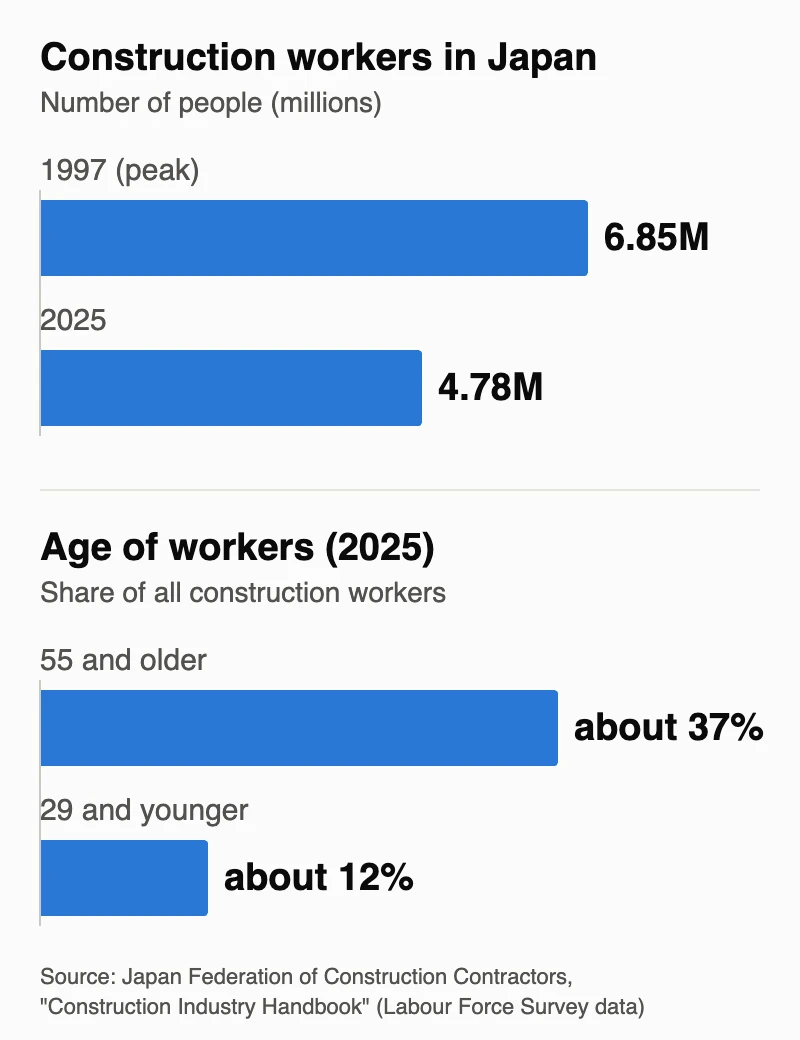
The number of people working in Japan’s construction industry has been going down for a long time. It peaked at 6.85 million in 1997, and by 2025 it had dropped to 4.78 million.
The workforce is also getting older. In 2025, about 37% of construction workers were 55 or older, while only about 12% were 29 or younger.
Source: Japan Federation of Construction Contractors, “Construction Industry Handbook” (based on the Labour Force Survey by the Ministry of Internal Affairs and Communications)
This matters because construction skills are usually passed down on the job, from experienced workers to younger ones. When many veterans are close to retiring and few young people are coming in, that handoff gets harder.
The image problem
In Japan, construction work has long been described as “3K”:
- Kitsui — hard
- Kitanai — dirty
- Kiken — dangerous
Outdoor work in all kinds of weather and long working hours helped create this image. Honestly, it’s one of the reasons many young people have chosen other careers.
A gap between generations on site
On many sites, you’ll find veteran supervisors with decades of experience working alongside young supervisors who grew up with smartphones. They often have different ideas about how work should be done, and which tools to use.
In my experience, the biggest challenge is the middle. There aren’t many mid-career people who can connect the two groups and teach the younger ones.
When everyone is busy running a site, it’s easy to say, “Let’s keep doing it the old way.” But if new tools are always put off until “later,” the way we work will never really change.
Working Hours: How Things Used to Be and What Changed in 2024
The old days: long hours were normal
For a long time, long working hours were simply part of the job in Japanese construction. Site supervisors often arrived early to prepare for the day, spent the daytime on site, and then went back to the office in the evening to work on drawings, schedules, and paperwork. And in my experience, the younger you were, the longer you tended to stay on site.
In the past, it wasn’t unusual to see overtime that went unpaid, or working hours that were recorded as shorter than they really were. Many people accepted this as “just the way construction works.”
Looking back, I think this was one of the biggest reasons for the industry’s tough image — and a big reason why some talented people left.
The 2024 overtime cap
This is where a big change came in.
In Japan, a company can only ask employees to work overtime if it has signed a special agreement with them. This is called a 36 Agreement (saburoku kyōtei), named after Article 36 of Japan’s Labor Standards Act.
For many years, the construction industry was given extra time before strict overtime limits applied. That grace period ended in April 2024. Since then, construction companies have had to follow these limits:
| Rule | Limit |
|---|---|
| Standard overtime limit | 45 hours per month, 360 hours per year |
| Maximum with a special agreement | 720 hours per year |
| Overtime + holiday work in a single month | Less than 100 hours |
| Average of overtime + holiday work (over any 2–6 months) | 80 hours or less per month |
| Months allowed over 45 hours | Up to 6 months per year |
There is one exception: work to recover and rebuild after a disaster is not covered by the “less than 100 hours” and “80-hour average” rules.
Source: Ministry of Health, Labour and Welfare, “Overtime limits for the construction industry, drivers, doctors, and others”
In Japan, people often call the challenges that came with these new limits the “2024 problem.”
What’s still challenging
Setting a limit on hours is one thing. Actually getting the same work done in less time is another.
Construction projects have fixed deadlines, and there are only so many people on each site. If the amount of work stays the same, cutting hours just puts more pressure on the people who are left.
That’s why I believe the rules alone aren’t enough. We also need to change how the work gets done — and that’s exactly what the next section is about.
How the Industry Is Changing
Digital tools on site
In Japan, using digital technology on construction sites is often called ICT construction. ICT stands for “information and communication technology.” In simple terms, it means using tools like drones, 3D data, and GPS-guided machines to make site work faster and more accurate.
I used ICT tools during my years as a site supervisor, and two experiences really stuck with me.
1. Planning from the sky with a drone
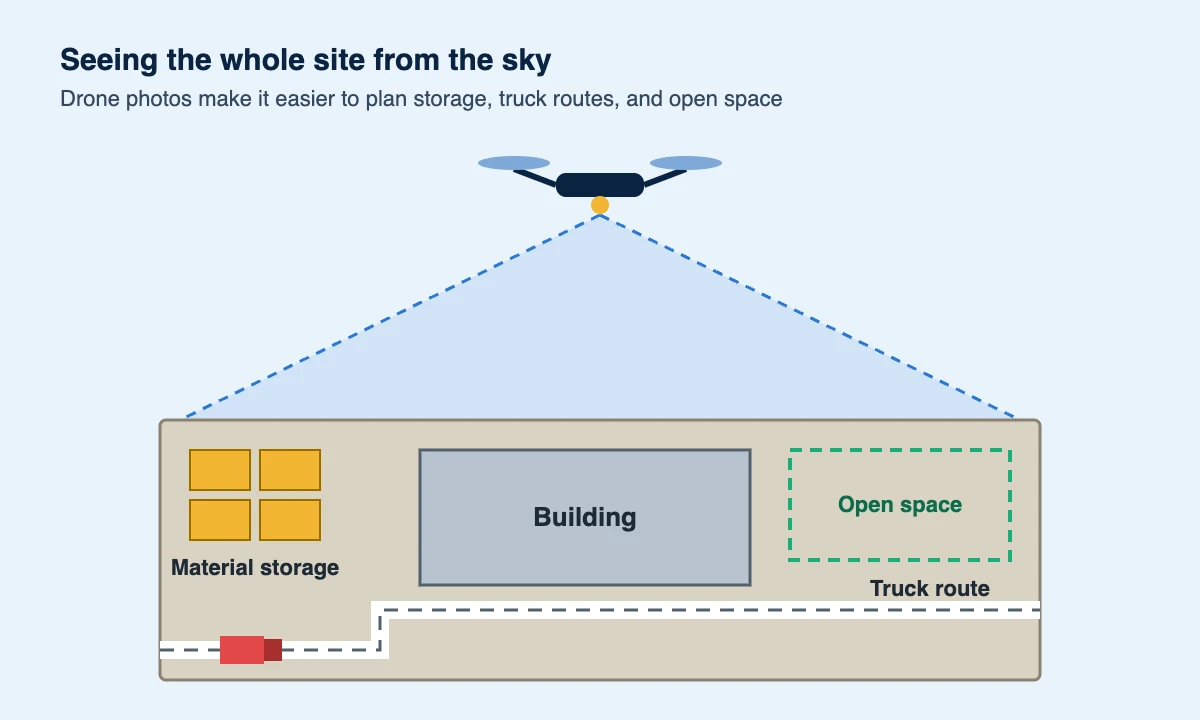
On one project, I used a drone to take photos of the entire site from above. From the ground, it’s hard to see how everything fits together — where materials are stored, how trucks move in and out, and how much open space you really have.
Looking at the site from the sky made all of that clear at a glance, and I used those photos to plan the work. (I hold a Class 3 multirotor drone pilot certification from DPA, a drone pilot association in Japan.)
2. Checking positions myself with a layout tool
On Japanese sites, there’s a job called sumidashi — marking the exact positions and reference lines for where things will be built. Often, we would call in a specialist team just to mark or check these points.
With a layout navigation tool (known in Japan as Kui-Navi), I could check positions by myself, easily, without having to call anyone in. That saved time — and it meant I didn’t have to wait for someone else’s schedule just to confirm a single point.
Neither of these tools is magic. But small changes like these, added up, can make a real difference in how a site runs.
BIM
BIM stands for Building Information Modeling. Instead of working only with flat 2D drawings, you build a 3D model of the building on a computer. Each part of the model can also hold information, like materials, sizes, and equipment.
One big advantage is that you can spot problems early. For example, if a pipe and a beam would run into each other, you can find that in the model before anyone starts building — not after.
Front-loading
Front-loading means putting more time and effort into the early planning stages of a project, so that fewer problems come up later on site.
This is actually closely related to my current job. In production design, I create detailed drawings that show exactly how a building will be put together. The goal is to solve as many problems as possible on paper — before they turn into delays, rework, or overtime on site.
From my own experience, I know how much pressure falls on the site when problems are found late. The more we can sort out at the start, the lighter the load on the people doing the work.
Robots and AI
With fewer people joining the industry, robots and AI are getting more attention in Japanese construction.
Robots may one day take over some of the repetitive or physically tough tasks. AI could help with early planning, such as drafting site layouts or checking schedules, which would free up time for people to focus on the work only humans can do.
That said, there are still real questions about safety and quality control. It will take time to figure out which tasks can safely be automated. Personally, I’m excited to see how this develops — but I think it’s something to watch step by step, not something that will change everything overnight.
FAQ
Is there a labor shortage in Japan’s construction industry?
Yes. The number of construction workers in Japan has dropped from its peak in 1997, and the workforce is getting older, with far more workers aged 55 and over than workers aged 29 and under. You can find the numbers in the first section of this article.
What is the “2024 problem” in Japanese construction?
It’s the name people in Japan use for the challenges that came when strict overtime limits started applying to the construction industry in April 2024. Companies now have to finish the same kind of work within fewer overtime hours, which means they need to find ways to work more efficiently.
Can foreigners work in construction in Japan?
Yes. One way is through a residence status called Specified Skilled Worker (tokutei ginō), which includes the construction field. For the first level (Specified Skilled Worker (i)), applicants generally need to pass both a skills test and a Japanese language test.
The rules and requirements can change, so please always check the latest information from the Immigration Services Agency of Japan before making any plans.
What is ICT construction?
It’s the use of digital tools — like drones, 3D data, and GPS-guided construction machines — to make site work faster and more accurate. You can read about my own experiences with these tools in the “Digital tools on site” section above.
Summary
Here’s a quick look back at what we covered:
- The workforce is shrinking and aging. Fewer young people are joining, and passing skills down to the next generation is getting harder.
- Working hours have changed. Long hours used to be normal, but since April 2024, construction companies in Japan have had to follow strict overtime limits.
- The way we work is starting to change. Drones, layout tools, BIM, and front-loading are already helping, and robots and AI may help more in the future.
So what does the future look like? I don’t think the answer is just “hire more people,” and I don’t think it’s just “use more technology,” either. We need both: an industry that more people want to join, and smarter ways of working that give everyone — especially young workers — the time and support to grow.
I’ll keep sharing what I’ve learned from Japanese job sites, so I hope you’ll stick around. If you have any questions, feel free to reach out anytime!
Read next: Japanese Construction Workwear: From Baggy Pants to Fan Jackets, and Why
Who decides how long a job takes: Construction Schedules in Japan: Who Actually Sets Them — nobody on the site writes the schedule, and since October 2020 an unreasonably short one has been illegal.