Construction Schedules in Japan: Who Actually Sets Them
The short version
- The construction period is set by the client, before the builder is involved in deciding it. You can prove it from the wording of the law.
- Two Japanese words both become “schedule” in English. Koki is the contract period. Koteihyo is the programme the site rewrites constantly.
- The site’s job is to absorb what moves. Two months of buried obstruction went into a period that did not change.
- Time and money are settled separately. A large agreed design change can move both. An accident moves the date and leaves the cost with the site.
- Since October 2020 it has been unlawful to impose an unreasonably short period — and since March 2024 the official standard says to count commuting time and build in the days too hot to work.
Hi there, I’m Shirokuma!
Here’s a question I’ve never been asked by a Japanese colleague and have been asked several times by people from outside Japan: who writes the construction schedule?
In Japan, nobody on the site writes it. By the time a construction company has the job, the length of the job is already a number in the contract. The site’s work is to make that number come true.
That one difference explains a surprising amount about how Japanese projects run — including why they feel inflexible, why a single late approval matters so much, and why the country has spent the last few years passing rules to make projects longer rather than shorter.
In this article, you’ll learn:
- Who actually sets the schedule on a Japanese project, and how you can prove it
- What a Japanese site spends its time waiting for
- Who pays when a project runs long
- Why, since October 2020, it has been **illegal in Japan to impose a schedule that is unreasonably short**
- And why the official standard now tells you to count commuting time and hot days
One thing before we start, because it’s the kind of number you’d expect in an article with this title. I’m not going to tell you what percentage of Japanese projects run late. I went looking for it and there is no public dataset I’d be willing to quote. So this article is about mechanisms, not rates — what makes a schedule move, and who carries it when it does.
Who Sets the Construction Schedule in Japan
The assumption that trips people up
Depending on where you’ve worked, you may be used to a sequence like this: the contractor wins the job, develops a programme, submits it, and the client reviews and accepts it. The duration is something the builder proposes and defends.
That is not how a Japanese job starts. The kōki — the construction period — is already written down. It’s in the tender documents, and then it’s in the contract. The contractor’s bid is a price for finishing inside that period. You’re not proposing a duration; you’re pricing one.
Two words that both become “schedule” in English
This is worth separating carefully, because English flattens it into one word and the flattening causes real confusion.
| Japanese | Say | What it is |
|---|---|---|
| 工期 | kōki | The contract period. A start date, an end date, and a legal obligation |
| 工程表 | kōteihyō | The programme — the sequence of activities the site plans inside that period |
The kōki belongs to the contract. The kōteihyō belongs to the site, and the site rewrites it constantly — that’s a normal week, not a crisis.
So when people say a Japanese project is “running late,” there are two completely different things that might be happening. Usually it’s the kōteihyō moving around inside a kōki that hasn’t moved at all. The site absorbs it. That’s the job.
It only becomes the other kind of late when the kōteihyō has no slack left to give and the kōki itself has to change — which is a contractual event, not a site decision.
How you can tell who sets it: read the subject of the sentence
I want to give you evidence for this rather than just asserting it, and the evidence is in an unusual place: the wording of Japanese construction law.
Article 19-5 of the Construction Business Act says that the ordering party must not conclude a contract setting a construction period that is markedly shorter than the period normally recognized as necessary to carry out the work.
Read who that sentence is pointing at. Not the builder. The client.
A law only needs to tell someone to stop doing a thing if that someone is in a position to do it. The entire provision is built on the assumption that the party placing the order is the party deciding how long the work gets — otherwise there would be nothing to prohibit.
This is the most useful single sentence in the article if you’re about to work with a Japanese contractor. The schedule is not a deliverable you’ll receive and review. It’s an input you’re setting, whether you meant to or not — and since 2020, setting it badly has been a legal matter rather than a commercial one. I’ve given that its own chapter further down.
What it means in practice
Three things follow from this, and they shape everything in the rest of this article.
The negotiation happens before the contract, or it doesn’t happen. Once the kōki is signed it is very difficult to move. If you have concerns about the duration, the moment to raise them is while it’s still a number in a tender document.
The site’s job is absorption. A Japanese site team is organised around making a fixed end date happen despite everything that moves underneath it. That’s a real skill and it’s the thing I’d point to if someone asked what Japanese site management is actually good at.
But absorption has a limit, and the limit is money. Every day a site absorbs something, it does it with people, machines and temporary works that are being paid for. That’s the part that doesn’t appear on the kōteihyō at all, and it’s where most of this article ends up.
Source: Construction Business Act, Article 19-5; Ministry of Land, Infrastructure, Transport and Tourism, on the amended Construction Business Act.
What a Japanese Site Is Actually Waiting For
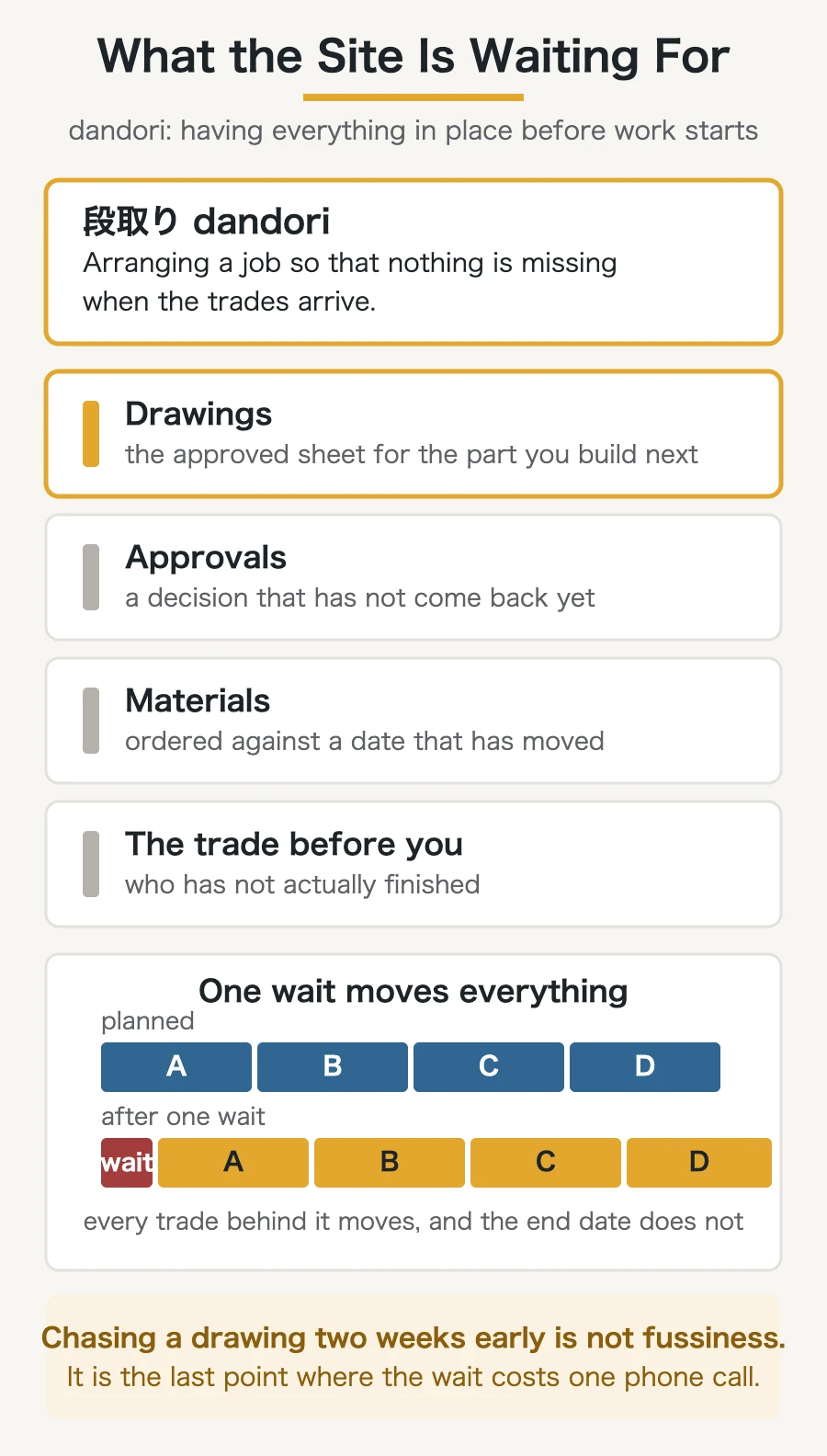
There’s a word you’ll hear constantly on a Japanese site, and it has no clean English equivalent: 段取り (dandori). It means the arranging — the setting up of a job so that when the work starts, everything it needs is already in place. People, materials, access, drawings, the trade before you having actually finished.
Dandori is most of a supervisor’s day. The building work itself is done by the trades. What the supervisor does is make sure that when they arrive, there is nothing missing.
So the honest way to ask “why do projects run late” is to ask what the arranging is waiting for.
In my experience, it’s the drawings
If you asked me what a Japanese site spends the most time waiting on, I wouldn’t say materials and I wouldn’t say labour. It’s drawings.
Not “we don’t have any drawings” — there are always drawings. It’s the specific drawing for the specific part you’re about to build, in its approved, final, build-from-this state, in your hands before the trade turns up rather than after.
That gap is where the waiting lives.
Why one wait moves everything
Here’s what makes a drawing wait expensive on a Japanese job rather than merely annoying.
The programme is sequenced tightly. Trades follow each other closely, each one booked for a window, with the next one booked against the end of that window. It’s an efficient way to run a site and it is how a fixed kōki gets delivered.
But a tight sequence has a property: it transmits. A trade that can’t start on Monday doesn’t just lose Monday. It loses its window, and the trade behind it loses the start it had planned against that window, and the one behind that has already ordered materials for a date that no longer makes sense.
This is why Japanese supervisors are so insistent about things that look minor from outside. Chasing a drawing approval two weeks early is not fussiness. It’s the only point in the chain where the cost of that wait is still one person’s phone call rather than four trades’ rescheduling.
If you’re working with a Japanese site team and they seem to be asking for information unreasonably far in advance, this is why. They are not being bureaucratic. They are trying to keep a problem small while it is still small, in a system where the end date is not available to them as a solution.
Weather, and Who Decides to Stop
Rain, snow, wind, heat. Every construction industry on earth loses days to weather, so this part isn’t unusual. What might be unusual is who makes the call.
The shochō decides
On a Japanese site, the decision to stop work for the day is made by the 所長 (shochō) — the site manager, the most senior company person on that site. Not the client. Not head office. Not the foreman of whichever trade is most affected.
That’s worth sitting with for a moment if you’re used to a different arrangement. The person who stops the job is the person standing on it.
I’m not going to give you a number of days lost per year, because it depends entirely on the site, the season and the stage of the work, and I don’t have a figure I’d stand behind.
What that has to do with the schedule
Here’s the connection to everything else in this article.
Traditionally, a weather stoppage is a decision taken on the morning it happens, by a person on site, inside a kōki that was fixed before anyone knew what the weather would do. The site absorbs it, the same way it absorbs everything else.
What changed in 2024 is that Japan started moving part of that decision upstream. The revised standard says days lost to extreme heat should be built into the construction period when it’s set — before the contract, not on the morning.
That’s a small sentence with a large implication. It treats some weather loss as predictable, and therefore as something the contract should carry rather than something the site should absorb.
Whether that fully works yet is a different question, and I’ll come back to it.
This chapter is about the schedule, not the safety rules. For the heat-related duties that actually apply to the people on site, including the heatstroke duty that began in June 2025, see Construction Safety in Japan.
When the Drawing Changes
Design changes happen everywhere. What differs between countries is what a change entitles you to.
The default answer is no
I’ll give you the short version first, because it surprises people: in my experience the construction period is not extended. A change comes, the work in front of you changes, and the end date stays where it is.
That’s the default. It isn’t a negotiating position someone eventually backs down from. It’s the normal state of affairs, and the site plans around it.
The exception
There is one, and it’s worth knowing precisely.
Where the change is large, and where there is agreement with the client, the period does move. Both halves matter. Size alone doesn’t do it — the agreement is what does it, and the agreement has to be reached rather than assumed.
So a Japanese programme has a kind of threshold in it. Below the threshold, everything is absorbed. Above it, and only with the client’s agreement, the contract itself changes.
What absorption looks like: two months underground
Let me give you a real one, because “the site absorbs it” is an abstraction until you’ve done it.
On one job we hit a chichū shōgai (地中障害) — a buried obstruction. That’s something in the ground nobody knew was there: old foundations, abandoned services, buried rubble from whatever stood on the site before. You find it when you dig, and you cannot build through it.
Dealing with it took two months of work.
The completion date did not move.
Two months of unforeseen work went into a period that had been set before anyone knew the obstruction existed, and the end of that period stayed exactly where it was. That is what the word “absorb” means on a Japanese site. It is not a figure of speech.
If you want to understand Japanese site management, understand that sentence. The ground produced two months of work that was in nobody’s programme, and the answer was not to move the date. There are industries where that would be an obvious claim for an extension. Here it was a thing that happened, and then a thing that was dealt with.
One thing that does move the date
For completeness, there is a category where the period really does change, and it isn’t design at all.
A serious accident. If one happens, work stops, and the project can lose something like a month. I should say plainly that I have not had a serious accident on a site I was running, so I’m telling you the shape of it rather than describing my own experience of it.
That’s worth holding next to the chapter you’ve just read. Two months of buried obstruction didn’t move the date. A serious accident does. They are not weighed on the same scale — and the difference between them is the subject of the next chapter.
The Part That Isn’t on the Programme: Money
Everything so far has been about time. But a construction period is a cost before it’s a calendar, and the question underneath this whole article is a simple one that nobody asks early enough.
When a project runs long, who pays?
The rule I’ve seen
It isn’t written on a wall anywhere, but it’s consistent enough that I’d describe it as a rule: it depends on who caused it.
| What happened | Who carries the cost |
|---|---|
| A design change | The designer or the client |
| An accident | The site |
A change that comes down from the design side is paid for by the side it came from. An accident on the site is carried by the site.
That’s the whole logic, and once you see it a lot of Japanese contractual behaviour makes sense. It explains why the paperwork around a change is taken so seriously, and it explains the intensity of site safety culture in a way that “safety is important” never quite does. An accident is the one event that moves the end date and leaves the bill with the people who moved it.
What is actually being paid for
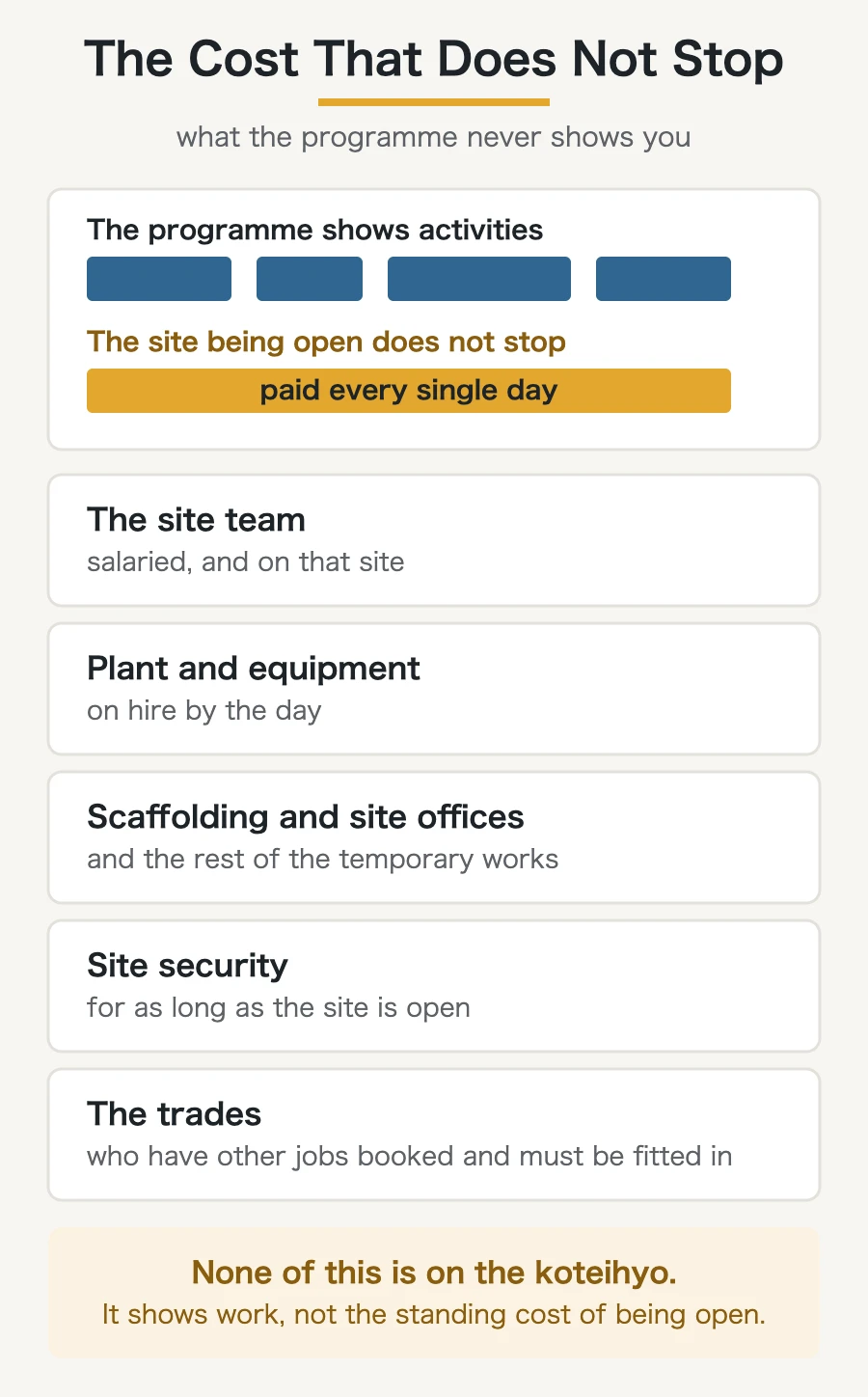
When people hear “the project ran two months long,” they tend to picture two months of building work. That’s not the expensive part.
The expensive part is everything that has to keep existing for two extra months whether or not it is productive:
- The site team, who are salaried and on that site
- Plant and equipment on hire by the day
- Scaffolding, hoarding, site offices and the rest of the temporary works
- Site security
- And the trades, who have other jobs booked and now have to be fitted back in
None of that is on the kōteihyō. The programme shows activities. It doesn’t show the standing cost of the site being open, which runs whether the activity bar is moving or not.
Time and money are settled separately
Here’s the part I’d most want an overseas reader to take away, because it’s the thing that makes Japanese projects hard to read from outside.
An extension of time and a payment are two different decisions, reached by two different routes.
| What happened | Does the end date move? | Who carries the cost |
|---|---|---|
| A large design change, agreed with the client | Yes | The designer or the client |
| A serious accident | Yes — around a month | The site |
| A buried obstruction, on my job | No | — |
In some industries those travel together — if the date moves, money follows. Here they don’t travel together at all, and assuming they do is how people end up surprised.
2020: Japan Made an Unreasonably Short Schedule Illegal
Most countries deal with a brutal programme as a commercial problem. You price the risk, you argue about extensions of time, and if it goes badly you end up in a dispute about delay.
Japan took a different route. It made setting one against the law.
What the provision actually says
Article 19-5 of the Construction Business Act prohibits the ordering party from concluding a contract whose construction period is markedly shorter than the period normally recognized as necessary to carry out the work.
Read that as three separate ideas:
- There is such a thing as the period a job normally needs.
- A contract period can be measured against it.
- Going markedly below it is not driving a hard bargain. It is a breach.
Note what isn’t there: no requirement that anyone be harmed, no requirement that the job actually overrun. The prohibited act is signing it.
When it started
This part of the amended Construction Business Act took effect on October 1, 2020. It is not new law any more — a Japanese client placing work today has been living under it for years.
What happens to a client who does it anyway
This is where people from outside Japan usually expect a fine, and there isn’t one.
If a client concludes a contract with an unreasonably short period, the Minister of Land, Infrastructure, Transport and Tourism (or the relevant prefectural governor) may issue a recommendation to that client. If the client does not follow the recommendation, the fact may be published.
So the sanction is being named.
For the ministry’s recommendation power, there’s a floor on the contract value: 5 million yen, or 15 million yen for general building construction work (kenchiku ichishiki kōji). The prohibition itself is the prohibition; the recommendation route is what sits above those amounts.
I’ll be straight with you about the limit of what I can tell you here: I could not find a public figure for how often this power has actually been used, so I’m not going to characterize it as common or rare.
The problem with “markedly shorter”
You may have noticed the weak point. “Markedly shorter than normally necessary” is a standard you cannot apply without knowing what “normally necessary” is — and a construction period depends on the building, the ground, the season, the trades and the site.
A prohibition needs a yardstick. So Japan wrote one, and then rewrote it in 2024 in a way that I think is the most interesting thing in this article.
That’s the next chapter.
And there is a phone number
One practical point worth knowing, especially if you end up working inside the Japanese supply chain: MLIT operates a reporting line for suspected violations of the Construction Business Act, called the kakekomi hotline (駆け込みホットライン). An unreasonably short construction period is the kind of thing it exists for.
Whether people use it is a different question, and one I don’t have a reliable figure for. But the route exists, and a subcontractor being squeezed on time is not required to treat it as purely a matter between them and the company above them.
If you take one thing from this chapter: in Japan, pushing a contractor to sign up to a programme that cannot be built is not sharp commercial practice. It is conduct the law names, with the ordering party as the responsible party, and with publication as the consequence. That is a different conversation from the one most of the industry is used to having.
Sources: Construction Business Act, Articles 19-5 and 19-6; Ministry of Land, Infrastructure, Transport and Tourism, on the amended Construction Business Act and the prohibition of unreasonably short construction periods.
2024: The Standard That Counts Your Commute
A prohibition needs a yardstick
I left the last chapter on a problem. You cannot enforce “markedly shorter than normally necessary” without a shared idea of what a job normally needs.
Japan’s answer is a document called the Standard on Construction Periods (工期に関する基準), drawn up by the Central Construction Industry Council — the advisory body that sits under MLIT and can recommend that such a standard be put into practice. The council deliberated the draft standard on July 20, 2020, shortly before the prohibition took effect.
That gave the prohibition something to point at. And then, four years later, the standard was rewritten — and the rewrite is the part I’d want you to read twice.
What changed in March 2024
On March 27, 2024, the council revised the standard and recommended its implementation. MLIT announced it on March 29, 2024.
The reason for the revision is the thing that makes it interesting. From April 2024, the cap on overtime hours began to apply to construction work in Japan. The industry had been given a five-year grace period that other industries didn’t get, and it ran out.
So the standard had to answer a new question: if the people on site are no longer allowed to work unlimited hours, how long does the work actually take?
The four things the revision added
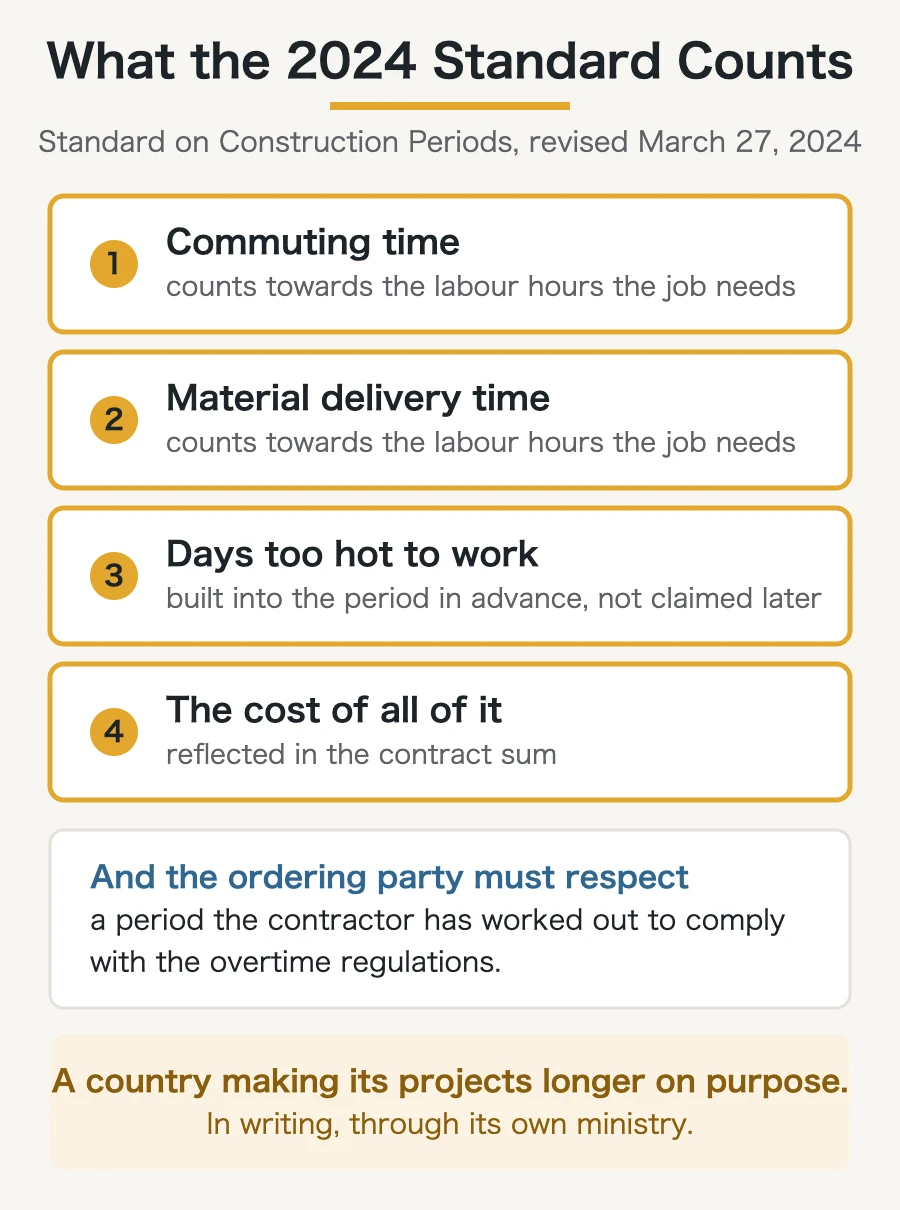
Commuting time and material delivery time count. The revised standard says these have to be included when you work out the labour hours a job needs. Not the hours spent building — the hours spent getting there and getting the materials there.
Days lost to extreme heat have to be built in. The standard now says non-working days caused by extreme heat — mōshobi, the Japanese forecast term for an extremely hot day — should be factored into the construction period when it is set. Not claimed afterwards as a delay. Allowed for in advance.
The contractor’s compliant estimate has to be respected. The contractor submits an estimate of a construction period that complies with the overtime regulations, and the ordering party is to confirm it and respect its contents, rather than acting in a way that pushes the contractor into breaching those regulations.
And the cost has to land in the contract sum. The standard states that the costs of securing enough people, of running shift systems, and of maintaining proper working conditions should be reflected appropriately in the contract amount.
What that adds up to
Put those four together and read them as a single instruction, because that’s what they are.
Japan has told its construction clients: work out how long this takes when nobody breaks the overtime law, when the commute counts as work, when the hottest days aren’t worked at all — and then pay for that.
That is a country deliberately making its projects longer and more expensive. On purpose. In writing. Through its own ministry.
I think this is genuinely hard to get your head around from outside, because most construction industries are being pushed in exactly the opposite direction. The assumption everywhere is that the next decade of construction is about speed. Japan has looked at the same decade and concluded that the binding constraint is people — that there won’t be enough of them, and that the ones who are left will not accept the hours the industry used to run on.
Once you believe that, a longer programme stops being a failure. It becomes the only honest programme.
This is why “why do Japanese projects run late” turns out to be the wrong question to ask about Japan right now. The documented, official, dated trend is projects getting longer by design. If you work with Japanese contractors and their proposed durations have been creeping up, this is the reason, and it is not them being slow.
This is not the same story as working hours
One thing to keep separate, because they’re easy to blur. I’ve written elsewhere about the 2024 overtime cap and what it changed for the people on site — how many hours you work in a day, and what that did to an industry built on long ones.
This chapter is about a different number: how many days the project gets. The same 2024 deadline sits behind both, but one is about a person’s week and the other is about a contract’s length. They moved together, and they are not the same thing.
Sources: Ministry of Land, Infrastructure, Transport and Tourism, revision of the Standard on Construction Periods, March 29, 2024; Central Construction Industry Council deliberation on the draft standard, July 2020.
If You Work With a Japanese Contractor
Let me turn all of this into something you can use.
The negotiation is before the contract, or there isn’t one
I said this in the first chapter and I’ll say it again here because it’s the single most actionable thing in the article. Once the kōki is in the contract, the conversation you wanted to have about it is over. Everything after that is the site absorbing things.
If the duration matters to you, it matters at tender stage.
Ask what the duration assumes, not whether it’s achievable
“Can you do it in fourteen months?” is a question that gets you the answer you want and tells you nothing. A Japanese contractor will take a hard programme seriously and try to make it work. That’s the culture, and it’s genuine, and it means their agreement is not evidence that the number is sound.
The useful questions are about assumptions:
- How many non-working days does this period allow for?
- Does it assume work on Saturdays?
- What approval turnaround does it assume from our side?
- What does it assume about the ground?
That last one isn’t rhetorical. Two months of my working life went into a buried obstruction inside a period that assumed clean ground.
The honest counterweight
I want to be careful not to leave you with the wrong impression, because the law in Chapter 6 makes it sound as though Japanese clients routinely hand over impossible programmes.
In my own career I have not been given a construction period that was impossible from the start. Tight, yes. Demanding, often. But not a contract I looked at and thought could not be built.
So take Chapter 6 as what it is: a rule written for the cases where it happens, not a description of every job. The existence of a prohibition tells you a behaviour occurs. It doesn’t tell you it’s the norm, and I’m not going to imply that it is.
What has actually changed: the weekend
Here’s the change I can report from the contract stage, and it’s the clearest sign that the 2024 rules reached real projects.
Jobs are increasingly being taken on a programme that assumes both Saturday and Sunday off.
That’s a different assumption from the one the industry used to work to, and it isn’t a small one. Two days a week, across a long project, is a large number of days that now have to be inside the period rather than quietly available to the site when things got tight.
It also removes something. The old habit of recovering a slipped programme by working Saturdays was, in effect, the site’s hidden reserve. If the period is now priced and agreed with those days already off, that reserve isn’t there — which is precisely what the rules intended, and which makes the accuracy of the original period matter far more than it used to.
Frequently Asked Questions
Who writes the construction schedule in Japan?
Two different documents, two different authors. The kōki — the contract period — comes from the ordering party and is fixed in the contract. The kōteihyō — the programme of activities inside that period — is written and continually rewritten by the site team.
Can a Japanese contractor refuse a schedule that’s too short?
The law approaches this from the other end. Article 19-5 of the Construction Business Act prohibits the ordering party from concluding a contract with a period markedly shorter than normally necessary, and MLIT runs a reporting line, the kakekomi hotline, for suspected breaches of the Act.
In practice I’d add that I have never been handed a period I considered impossible, so I can’t tell you from experience how that conversation goes.
What happens to the schedule if the client changes the drawings?
Normally, nothing — the work changes and the end date doesn’t. Where the change is large and there is agreement with the client, the period can be extended. The agreement is the operative part.
Do Japanese sites work on Saturdays?
Historically the programme often relied on it. What I can tell you from recent contracts is that jobs are increasingly taken on the assumption that both weekend days are off. I’m not going to give you a percentage, because I don’t have a reliable one — but at the point where the period is set, the assumption has moved.
Who pays when a project runs long?
It depends on the cause. A design change is carried by the design side or the client. An accident is carried by the site. And some things, in my experience, are carried by the site without the date moving at all.
Has the 2024 standard actually made projects longer?
I can’t prove it to you. There’s no public dataset I’ve found that measures the effect, and it would be too early for a convincing one anyway.
What I can report is what I see when periods are being set: the weekend assumption has changed. That’s not the same as proof, and I’d rather give you an honest observation than a confident claim.
Summary: The Schedule Is an Input, Not an Output
Three things to take away.
The construction period is set by the client, before the builder is involved in deciding it. You can prove it from the wording of the law: Article 19-5 tells the ordering party not to impose a period markedly shorter than normally necessary. A rule aimed at the person placing the order is a rule about who holds the pen.
The site’s job is to absorb what moves, and absorption has a price. Two months of buried obstruction went into a period that didn’t change. Whether that costs the client or the contractor depends on one question — who caused it — and time and money are settled separately, not together.
And Japan is now lengthening its projects deliberately. Since October 2020 it has been unlawful to impose an unreasonably short period. Since March 2024 the official standard has said to count commuting time, count material delivery time, build in the days too hot to work, and put the cost of all of it in the contract sum. The question “why do Japanese projects run late” has an awkward answer in 2026: the documented trend is that they are getting longer on purpose.
What I left out
- How often Japanese projects actually overrun. No public dataset I’d quote.
- How often the short-schedule prohibition has been enforced. I couldn’t find a published figure.
- Whether the 2024 standard has measurably lengthened projects. Too early, and not measured publicly.
Where to read next
The hours side of the same 2024 deadline: Japan’s Construction Industry: Challenges and Where It’s Heading — what the overtime cap changed for the people on site, as opposed to the contract.
What the heat rules actually require on site: Construction Safety in Japan: The Rules You’ll Actually Meet — including the heatstroke duty that began in June 2025.
What a day inside one of these programmes looks like: A Day on a Japanese Construction Site: Hour by Hour — the meetings, the breaks, and where the supervisor’s day actually goes.
Thanks for reading. If you set construction periods for Japanese work, or you’ve had one set for you, I’d like to hear how it went.
— Shirokuma
Reading the drawing that keeps changing: Japanese Construction Drawings: How to Read One — how to tell which sheet is the current one, and what happens when it does not work on site.
The one date on the programme the material sets: Concrete Pour in Japan: The Clock Starts at the Plant — temperature windows, a 1.5-hour transport cap, and why concrete does not wait for approvals.