Shokunin: Who’s Who on a Japanese Construction Site
The short version
- Shokunin is an everyday word for the people who do the physical work — not a title. The craft pride behind the romantic version is real anyway.
- You can read the trades from clothing and tools: tobi on the scaffolding, daiku with timber, tekkin-ko tying steel, sakan finishing surfaces.
- The ranks run from minarai to ichininmae, with the hancho and shokucho leading and the oyakata running the company.
- Shokucho is also a legal role with its own required training.
- Two national systems now make skill visible: the ginou kentei skill test, and the CCUS card.
Hi there, I’m Shirokuma!
When I started as a site supervisor, the craftspeople on my site didn’t really talk to me.
Not rudely. They just had no particular reason to. I was young, I was from the contractor’s side, and I hadn’t done anything yet that would make my opinion worth listening to.
What changed it wasn’t a qualification or a clever instruction. It was saying good morning. Every day, to everyone, whether or not they answered. After a few weeks, people started answering. After a few months, they started telling me things I needed to know.
In this article, you’ll learn:
- What shokunin actually means on a Japanese site, which isn’t quite what it means abroad
- Who’s who — the trades you’ll meet, and the ranks you’ll hear
- How someone becomes one, and how the national systems now measure that
What Shokunin Actually Means
The word you’ve probably heard
Outside Japan, shokunin usually arrives wrapped in reverence. A sushi master with forty years behind the counter. A swordsmith. Someone who has given their life to one skill, photographed in beautiful light.
That version exists, and it isn’t false. But it’s not what the word does on an ordinary workday.
What it means on site
On a Japanese construction site, shokunin simply means the people who do the physical work. The carpenters, the scaffolders, the steel fixers, the plasterers, the electricians.
It’s a category, not a compliment. You’d use it in a sentence like “how many shokunin are coming tomorrow?” — the same way you’d say “how many people.”
And in speech it usually comes with -san: shokunin-san. That small suffix is doing quiet work. It marks the person as someone you’re being polite to, which is exactly how the relationship is supposed to run.
Where the romantic version is still true
Here’s the part I wouldn’t want to flatten, though.
The pride is real. I’ve written before about the Japanese tool belt and how carefully people keep their tools — that comes from somewhere. Many tradespeople here can look at work they did ten years ago and tell you exactly what they’d do differently now.
So both things are true at once. Shokunin is an ordinary word for an ordinary job, and the culture around that job takes skill seriously in a way that surprises visitors.
One thing it isn’t
Shokunin doesn’t mean “unskilled labourer,” and it isn’t a lower rank than the office.
A supervisor coordinates. A craftsperson builds. Neither can do the job alone, and on a good site nobody pretends otherwise. If you arrive and treat the trades as people who take instructions, the work will technically continue and you will learn nothing for two years.
That’s the mistake I was closest to making. The greetings saved me from it.
Who’s Who: The Trades
Walk onto a site mid-morning and you’ll see thirty people doing completely different things. Here’s how to read the room.
Two clues do most of the work: what they’re wearing and what’s hanging off their belt. I’ve written about both — the workwear and the tool belt — and once you know the patterns, most people announce their trade before they say a word.
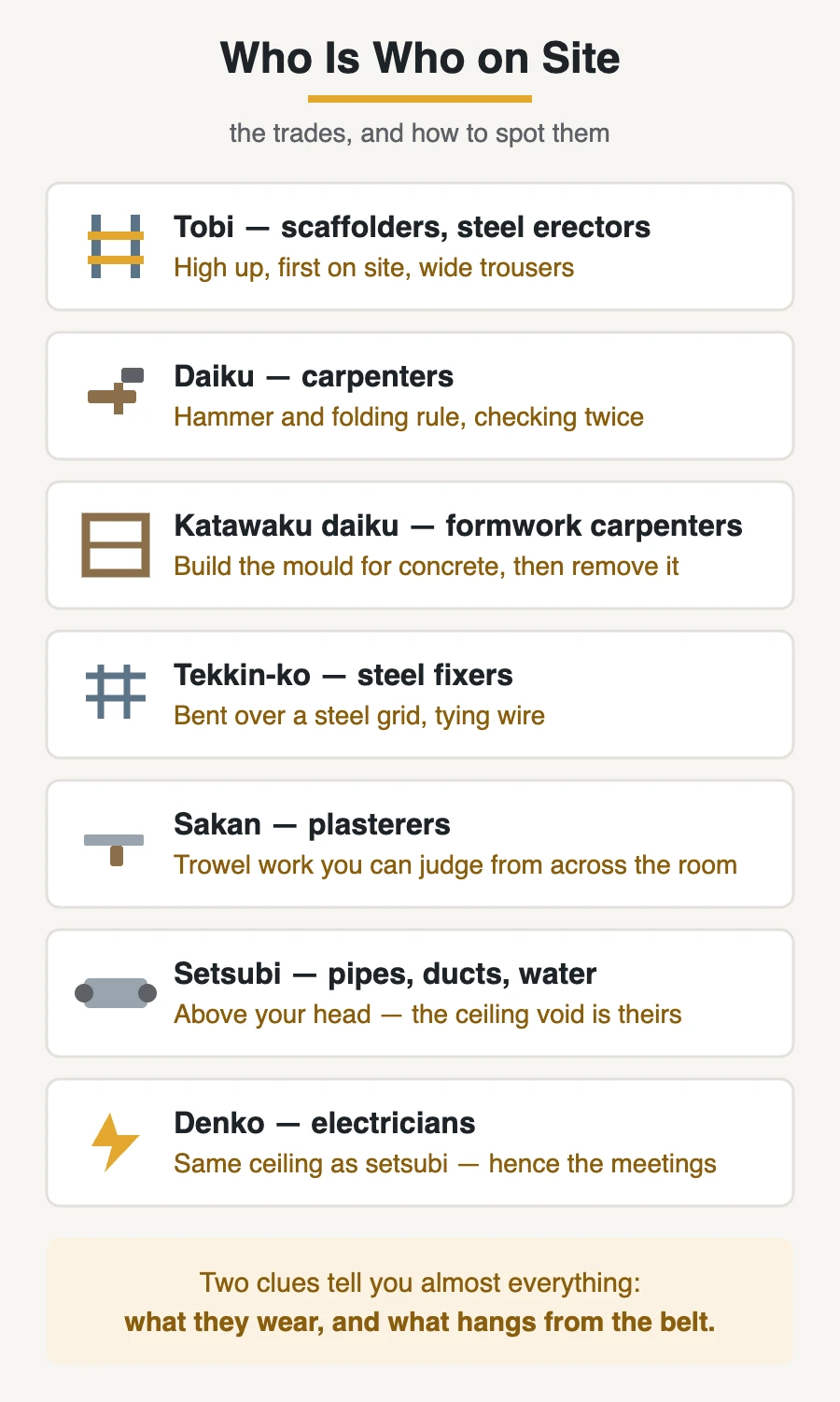
Tobi — scaffolders and steel erectors
The most visible trade on any Japanese site, and usually the first one there.
Tobi erect the scaffolding everyone else works from, and on steel-frame buildings they’re the ones setting the columns and beams. They work high, they move fast, and they have a certain reputation for it.
They’re also the trade most associated with the traditional look — the wide nikkapokka trousers and split-toe jika-tabi boots. Not every tobi dresses that way now, but if you see someone who does, that’s usually who it is.
Daiku — carpenters
Daiku covers a lot of ground. In housing, a daiku may build the whole timber frame. On a larger job, you’ll see them doing interior framing, fitting, and finishing work.
Look for a tool belt with a hammer and a folding rule, and for someone spending a lot of time checking things that look already straight.
Katawaku daiku — formwork carpenters
A separate trade from general carpentry, and one that surprises people.
They build the moulds that concrete gets poured into — a temporary timber and panel structure that has to be exactly the shape of the finished element, strong enough to hold wet concrete, and possible to take apart afterwards.
Then it all gets removed, and nobody ever sees their work. The quality of a concrete surface is largely their doing.
Tekkin-kō — steel fixers
The people tying reinforcing bars into cages before the concrete goes in.
Easy to spot: they work bent over a grid of steel, and they’re using the bansen binding wire and hook I described in the tool belt article. They move in a rhythm that looks effortless and absolutely isn’t.
Sakan — plasterers
Sakan apply and finish surfaces: mortar, plaster, floor screeds.
This is the trade where you can most clearly see skill in the result. Two people apply the same material to the same wall and you can tell which wall belonged to whom, from across the room.
Setsubi — mechanical and plumbing
Air conditioning, ventilation, water, drainage, and sprinklers.
If you read my article on BIM and production design, these are the people whose space the ceiling void actually is. They’re often working above your head, on a rolling scaffold, fitting something long into somewhere tight.
Denkō — electricians
Containment, cabling, fittings, panels. Usually present from early in the frame stage right through to handover, and often working alongside setsubi in the same ceiling, which is exactly why coordination meetings exist.
And the ones people forget
Operators run the excavators, cranes and lifts, and need specific qualifications to do it.
Demolition and earthwork crews come first, before the parts of the job most people picture.
Painters, waterproofers, tilers, glaziers, and interior fitters arrive later, and by then the site looks calm compared to the frame stage. It isn’t — it’s just quieter work with tighter tolerances.
The Ranks You’ll Hear
Trades tell you what someone does. Ranks tell you who to ask.
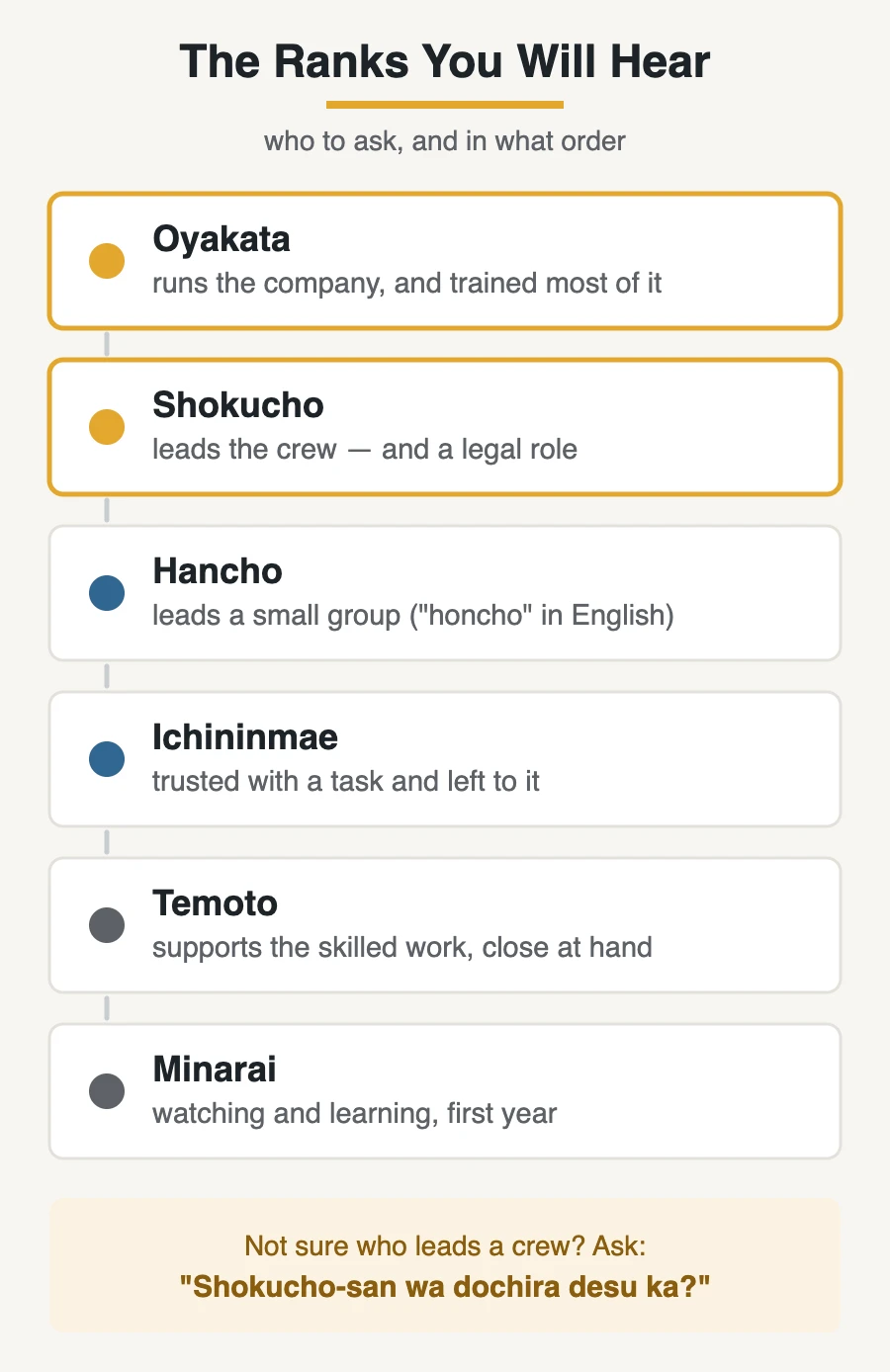
Minarai — the apprentice
Minarai literally means “watching and learning,” which tells you most of what you need to know about how training has traditionally worked here.
A minarai carries, cleans, prepares, and watches. It is not glamorous, and the first year is mostly about being useful to people who are busy.
Temoto — the helper
Temoto means “at hand.” It’s the person supporting the skilled work — passing materials, holding, moving things to where they’ll be needed next.
Sometimes that’s an apprentice learning the trade. Sometimes it’s a permanent role. Either way, if the temoto is good, the skilled work goes noticeably faster.
Ichininmae — a full craftsperson
Ichininmae means “one full portion,” and it’s the line everyone is working toward: you can be given a task and left to do it.
Nobody hands you a certificate for this. It’s a judgement made by the people around you, and it usually becomes obvious in how the work is allocated before anyone says it out loud.
Hanchō — team leader
The person leading a small group within a crew.
English speakers may recognise this one: “honcho” came into English from Japanese hanchō. On a Japanese site it’s a real and specific rank rather than a casual word for a boss.
Shokuchō — the foreman
The shokuchō leads their company’s crew on site. They decide how the day’s work gets done, assign people, and they’re the ones sitting in the foremen’s meeting I described in a day on a Japanese construction site.
This rank is also a legal role. Employers must provide safety and health education to people newly appointed to directly instruct or supervise workers, covering things like deciding work methods, assigning people, and how to instruct and supervise.
Source: Industrial Safety and Health Act, Article 60 (e-Gov, in Japanese), checked September 20, 2026
If you’re on a Japanese site and you need something decided about how a trade works, the shokuchō is who you talk to.
Oyakata — the boss
Oyakata is the traditional word for the person who runs a crew — often the owner of a small company, and often the person who trained everyone in it.
The word carries a family flavour that “boss” doesn’t. In the old apprenticeship model, the oyakata took people in, taught them, and was responsible for them in a way that went well beyond work hours.
And a newer one
Here’s a change I’ve watched happen.
Traditionally a shokuchō worked alongside their crew — they were a craftsperson who also led. Teaching happened in the gaps, which is where “watch my back and learn” comes from. It’s hard to teach carefully while you’re also on the tools.
On sites I’ve worked on, some companies now have a senior foreman who does very little hands-on work and instead manages the whole crew and trains the newer people — we’ve called it a sūpā shokuchō, a “super foreman.” The job is coordination and teaching, not output.
I think it’s a genuine improvement. If teaching is somebody’s actual responsibility rather than something squeezed between tasks, beginners stop depending on luck for whether they get taught well.
A note on titles. These words vary between companies and regions, and a small firm may use only two of them. If you’re unsure who leads a crew, the safe question is “Shokuchō-san wa dochira desu ka?” — where is the foreman?
How Someone Becomes a Shokunin
The traditional path
Join a company — often a small one, often through someone who knows someone. Start as minarai. Carry materials, clean up, prepare, and watch.
Then, gradually, you get given the easy parts of the real work. Then the parts that matter. Somewhere in there, without ceremony, people start treating you as ichininmae.
How long? It depends on the trade and on how well you’re taught, which is exactly the problem with the traditional model.
“Watch my back and learn”
The phrase you’ll hear is that you learn by watching the senior person’s back — senaka wo mite oboero.
It isn’t laziness. A shokuchō who is also doing the work has limited time to explain, and some of what they know genuinely is hard to put into words. Watching a skilled person work is a real way to learn.
But it has obvious costs:
- It’s uneven. A patient senior gives you a career. A busy or unwilling one gives you two wasted years.
- It’s slow. You learn what happens to be in front of you, in whatever order it happens.
- It loses people. If nobody explains why, the work looks arbitrary, and beginners leave.
What I did about it, as the supervisor
I wasn’t learning a trade, but I did need to understand what I was coordinating — and early on I didn’t.
So I asked. Straight out, to the person doing the work: what kind of work is this? Why that order, why that tool, what happens if it’s done the other way.
Two things came of that. I stopped writing schedules that made no sense to the people executing them. And the craftspeople noticed that I was interested in their work rather than just its completion date, which changed how they talked to me.
If you’re new to a Japanese site, I’d recommend this without reservation. Ask during a break rather than mid-task, ask about the work rather than the person, and listen to the whole answer.
The conversations that don’t happen in meetings
Here’s something nobody tells you in training.
I don’t smoke. But I spent a fair amount of time in the smoking area, because that was where a certain kind of conversation happened — the one where you ask a crew to take on something awkward, or find out that a trade is quietly worried about next week.
I’m not recommending smoking, and sites have changed a lot on this. The point is that the useful conversation often isn’t in the meeting. It’s before it, or after it, or standing somewhere with a cup of coffee.
If you want to work well with Japanese craftspeople, be findable outside formal settings. The information that arrives that way is usually the information you needed earliest.
What’s changing in how people are trained
The old model is giving way, slowly, for a practical reason: the industry cannot afford to lose beginners any more.
What I’ve seen change:
- Teaching as a defined job, rather than something done in the gaps — the senior foreman role I described in the last chapter.
- Written procedures, so a beginner can see the whole sequence instead of inferring it.
- National systems that measure skill, which the next two chapters are about. When experience is recorded rather than just remembered, a company has a reason to train people properly and a person has proof they were trained.
None of that replaces watching a skilled person work. It just stops that being the only way in.
The National Skill Test
What it is
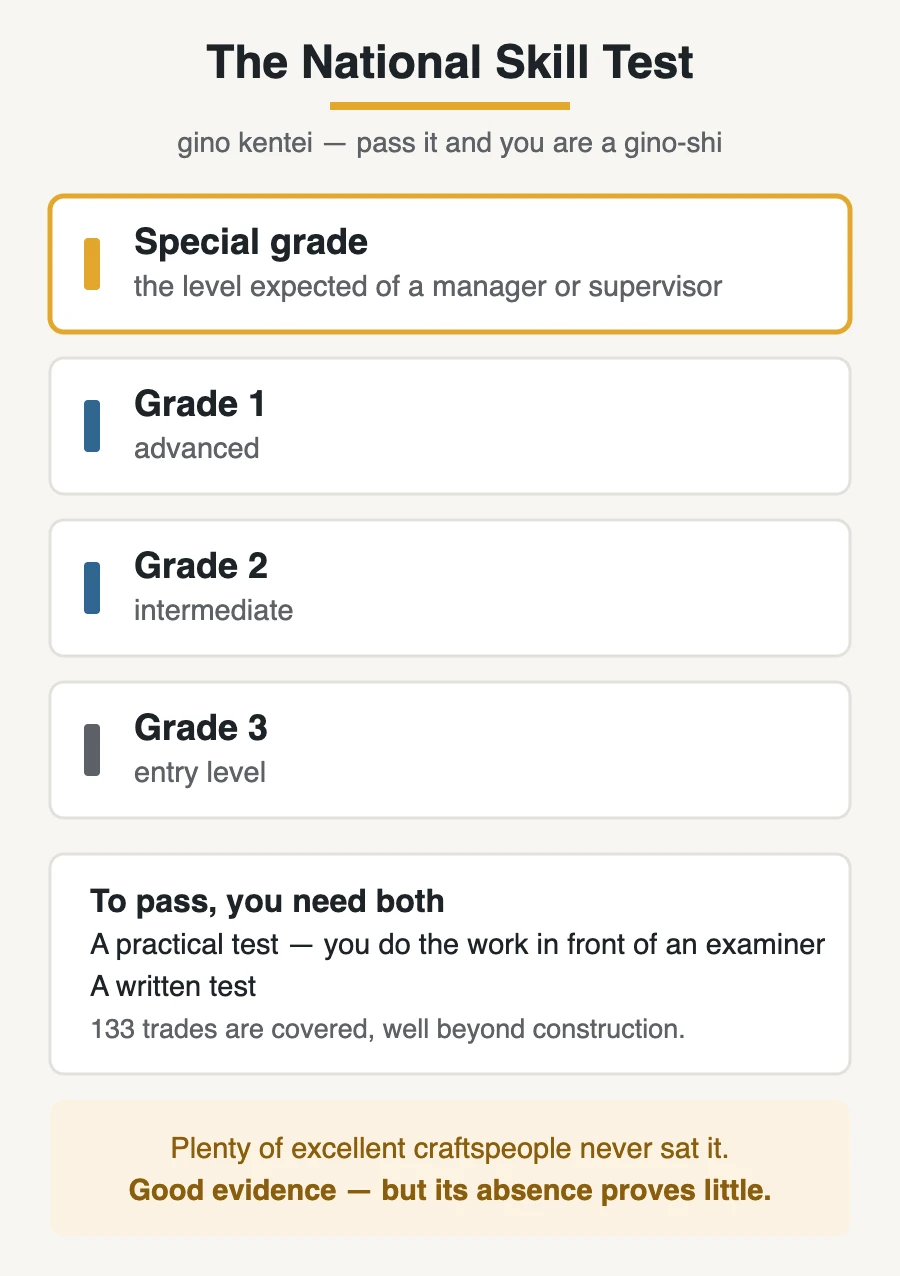
Japan has a national certification that tests how well you can actually do a trade. It’s called ginō kentei, and people who pass can call themselves ginōshi — a certified skilled worker.
The government describes it as a national certification system that evaluates the level of skill a person has acquired for their work. It covers 133 trades, well beyond construction.
Source: Ministry of Health, Labour and Welfare, “What is the Trade Skill Test system” (Waza no Tobira portal, in Japanese), checked September 20, 2026
The grades
Most trades are graded, and the grades mean roughly what you’d expect:
- Grade 3 — entry level
- Grade 2 — intermediate
- Grade 1 — advanced
- Special grade — the level expected of a manager or supervisor
Some trades aren’t graded at all and have a single level instead.
It’s a practical test
This is the part I’d highlight for anyone used to certifications that are entirely written.
To pass, you have to pass both a practical test and a written one. The practical test is the trade itself: you make something, or carry out the work, and it’s judged.
That’s why the title carries weight on site. A ginōshi has demonstrated the work in front of an examiner, not just answered questions about it.
Who runs it
Most trades are examined by the prefectures, with the exam content prepared nationally by the Japan Vocational Ability Development Association. A smaller number — 22 trades — are run by designated testing bodies.
Source: Ministry of Health, Labour and Welfare, “What is the Trade Skill Test system” (in Japanese), checked September 20, 2026
Why it matters beyond pride
Passing isn’t only a personal milestone. The certification feeds into other things: it can give exemptions or eligibility for other qualifications, it counts toward being recognised as a technical person on construction work, and — as the next chapter explains — it’s one of the inputs that decides a worker’s level in the national career system.
In other words, the skill you demonstrate in a test room follows you onto every site you work on afterwards.
The honest view from site
Not every excellent craftsperson holds the certificate.
Plenty of people learned the trade thoroughly, do outstanding work, and never sat the exam — because nobody around them did, or because taking a day off to be tested costs money in a way that’s hard to justify when you’re paid by the day.
So the certificate is good evidence, and its absence is weak evidence. I’d read someone’s work before I’d read their paperwork.
That gap is part of why the system in the next chapter exists: it tries to count what people have actually done, not only what they’ve been examined on.
The Card System (CCUS)
This is the most modern answer to an old problem: how do you prove what a craftsperson has actually done?
What CCUS is
The Construction Career Up System registers a worker’s qualifications and their record of days worked on site, so that skill and experience can be seen rather than claimed.
Each registered worker gets an IC card. Touch it to a reader at the site gate, and that day’s work is added to your record. Over years, that becomes a verifiable history: where you worked, for how long, doing what.
The card is valid for 10 years.
Source: Construction Career Up System, official introduction (in English, PDF), published by the Foundation for Promotion of Construction Industry, checked September 20, 2026
The four levels
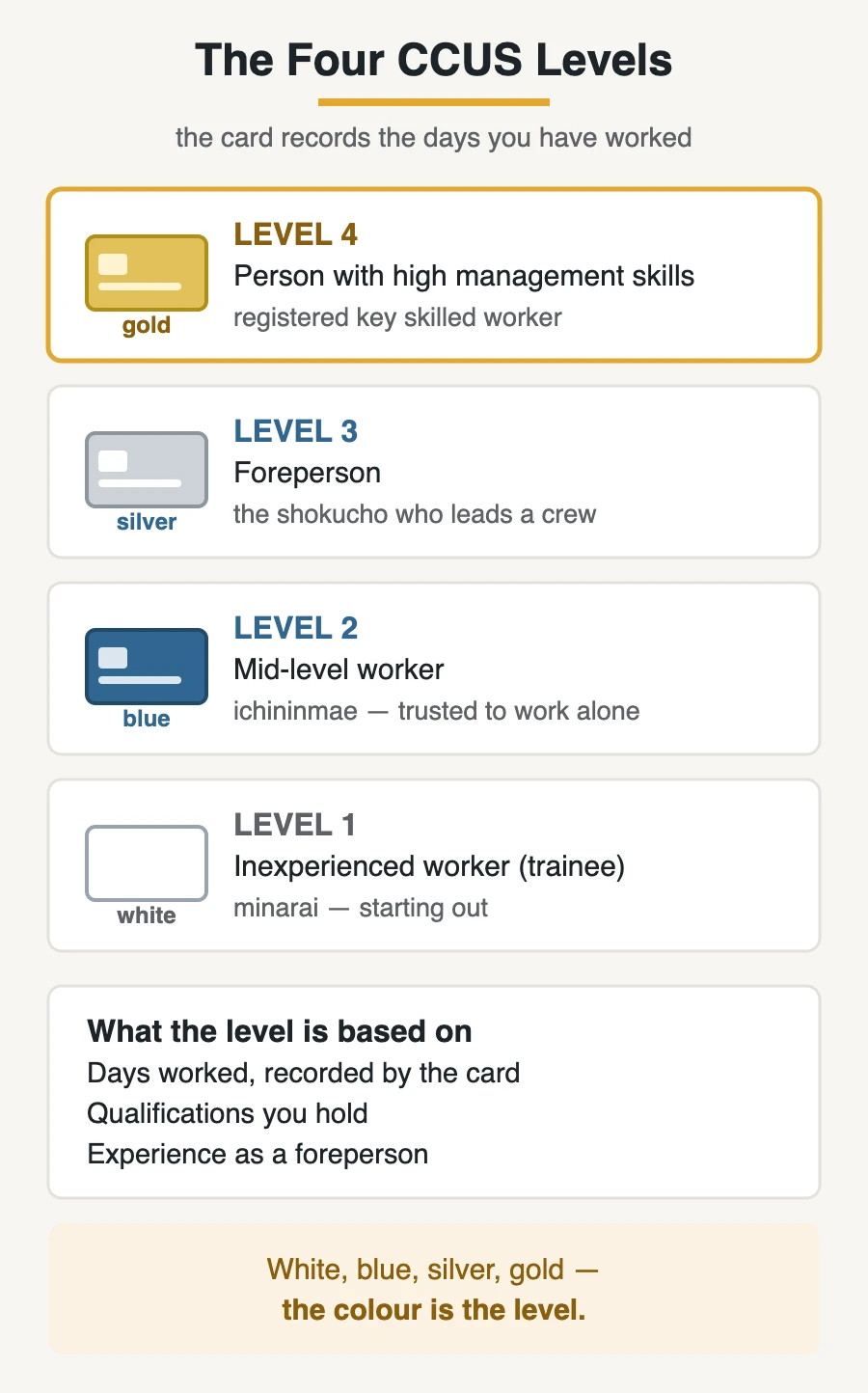
Workers can be assessed into four levels. The system’s own English wording for them is:
| Level | What it means |
|---|---|
| Level 1 | Inexperienced worker (trainee) |
| Level 2 | Mid-level worker |
| Level 3 | Foreperson |
| Level 4 | Person with high management skills / “Registration Key Skilled Worker” |
You’ll notice that this maps almost exactly onto the traditional ranks in chapter 3 — minarai, ichininmae, shokuchō, and the senior figure above them. The system didn’t invent a new hierarchy. It wrote down the one the industry already had.
What the assessment counts
Three things:
- Experience — the number of days worked, from the card records
- Knowledge and skills — the qualifications you hold, which is where the national skill test from the last chapter comes in
- Management ability — registration as a “Registration Key Skilled Worker,” and experience as a foreperson
Source: Construction Career Up System, official introduction (in English, PDF), checked September 20, 2026
The colours
Here’s the part people remember: the card colour changes with the level.
| Level | Card |
|---|---|
| Level 1 | White |
| Level 2 | Blue |
| Level 3 | Silver |
| Level 4 | Gold |
The official material puts the purpose plainly: “You can show your skill level to customers or clients by color.”
Source: CCUS official introduction (English, PDF) and CCUS official site (Japanese), checked September 20, 2026
So a card in a lanyard communicates, at a glance, something that used to take months of working alongside someone to learn.
Why it matters
For a craftsperson, it’s portable proof. Change companies and your record comes with you, which is new — experience used to live in the memory of the people you worked for.
For the industry, it’s an attempt to fix something structural. If skill is visible and recorded, it can be paid for. If it can be paid for, staying in the trade becomes a more reasonable decision for a 20-year-old.
Where it’s at
Registration and level assessment are ongoing across the industry, and how much it changes anyone’s pay in practice depends on the company.
I’d describe it as a system doing the right thing that hasn’t finished arriving. But the direction is clear, and if you’re a foreign worker coming to Japanese construction, having your days recorded from the start is worth more to you than to almost anyone.
What’s Changing
The world I’ve described is real, and it’s also moving. Here’s what’s actually shifting.
Fewer people coming in
This is the pressure behind everything else. The workforce is ageing and not enough young people are joining — the subject of my first article.
Every other change on this list is, in some way, a response to that.
The hours
Construction had five extra years before the statutory cap on overtime applied to it. That ended: since April 2024, the limits apply, with a principle of 45 hours a month and 360 hours a year and a stricter framework for exceptional circumstances.
Source: Ministry of Health, Labour and Welfare, “Overtime limits for construction, drivers, doctors and others” (in Japanese), checked September 20, 2026
The industry is also moving toward a proper two-day weekend, which for a lot of sites is a bigger cultural change than it sounds.
Teaching is becoming a job
The senior foreman role I described earlier is the clearest sign of this: someone whose responsibility is the crew and the beginners, not the output of their own hands.
Alongside that, more is written down. Procedures, sequences, the reasons for doing something in a particular order. Anything written is something a beginner can read twice.
Skill is being recorded
The card system in the last chapter is the structural version of the same idea. When a person’s days and qualifications are recorded rather than remembered, skill can be recognised — and paid for — without the person having to stay in one company for twenty years to be believed.
The tools are changing the work
Some of what used to be learned purely by feel now has an instrument attached to it. I wrote about that in ICT construction.
This doesn’t remove craft. It moves the difficult part: less time spent on repetitive measuring, more on judgement, preparation and checking. It also means a beginner can be useful sooner, which matters when there are fewer beginners.
More people from outside Japan
Construction is one of the fields covered by Japan’s Specified Skilled Worker residence status, created to accept workers with the skills to contribute from the start in sectors facing labour shortages.
Source: Immigration Services Agency of Japan, “Specified Skilled Worker: construction field” and MLIT, accepting foreign workers in construction (in Japanese), checked September 20, 2026
What that means in daily life is that sites are more mixed than they were, and that “watch my back and learn” works even less well when the person watching may not share your language. That pressure is pushing teaching toward things that travel: demonstrations, drawings, written steps, and checking that the message landed.
The honest tension
Here’s what I keep coming back to.
The culture that produced craftspeople of this standard — long apprenticeships, learning by watching, high tolerance for hardship — is partly the same culture that loses young people now.
Softening it is necessary. But there’s a real risk of losing the part that worked: the seriousness about the craft, the idea that doing the job properly is the point rather than a bonus.
The sites I’d bet on are the ones changing the conditions without changing that.
FAQ
What does shokunin mean?
On a Japanese construction site it simply means the people who do the physical work — carpenters, scaffolders, steel fixers, plasterers and so on. Abroad the word often carries a “master craftsman” meaning. Both are real, but the everyday one is just a job category, usually said as shokunin-san.
What’s the difference between a shokunin and a daiku?
Shokunin is the general word; daiku is one specific trade, a carpenter. All daiku are shokunin; most shokunin are not daiku.
Who should I talk to on site?
For how a trade’s work gets done, the shokuchō — the foreman leading that company’s crew. For anything affecting the whole site, the main contractor’s supervisor.
Do I need to speak Japanese?
It helps enormously, but the first requirement is smaller than you think: greet people, every day. Then ask about the work rather than about the person. A lot of technical communication on site happens through drawings, demonstrations and pointing, and people are generally patient if they can see you’re trying.
Is ginōshi worth getting?
If you’re building a career in a trade here, yes. It’s a national certification with a practical exam, it feeds into other qualifications, and it counts toward your level in the career-record system. That said, plenty of excellent craftspeople don’t hold it.
What is the CCUS card for?
It records the days you’ve worked and the qualifications you hold, so your experience is portable between companies. Cards are colour-coded by level, from a white card at Level 1 to a gold card at the top.
Can a foreigner become a shokunin in Japan?
Yes. Construction is one of the fields covered by the Specified Skilled Worker residence status. Expect the qualification requirements for specific work to apply to you exactly as they apply to everyone else, and register for a career card early so your days start counting from the beginning.
How do I earn respect as a newcomer?
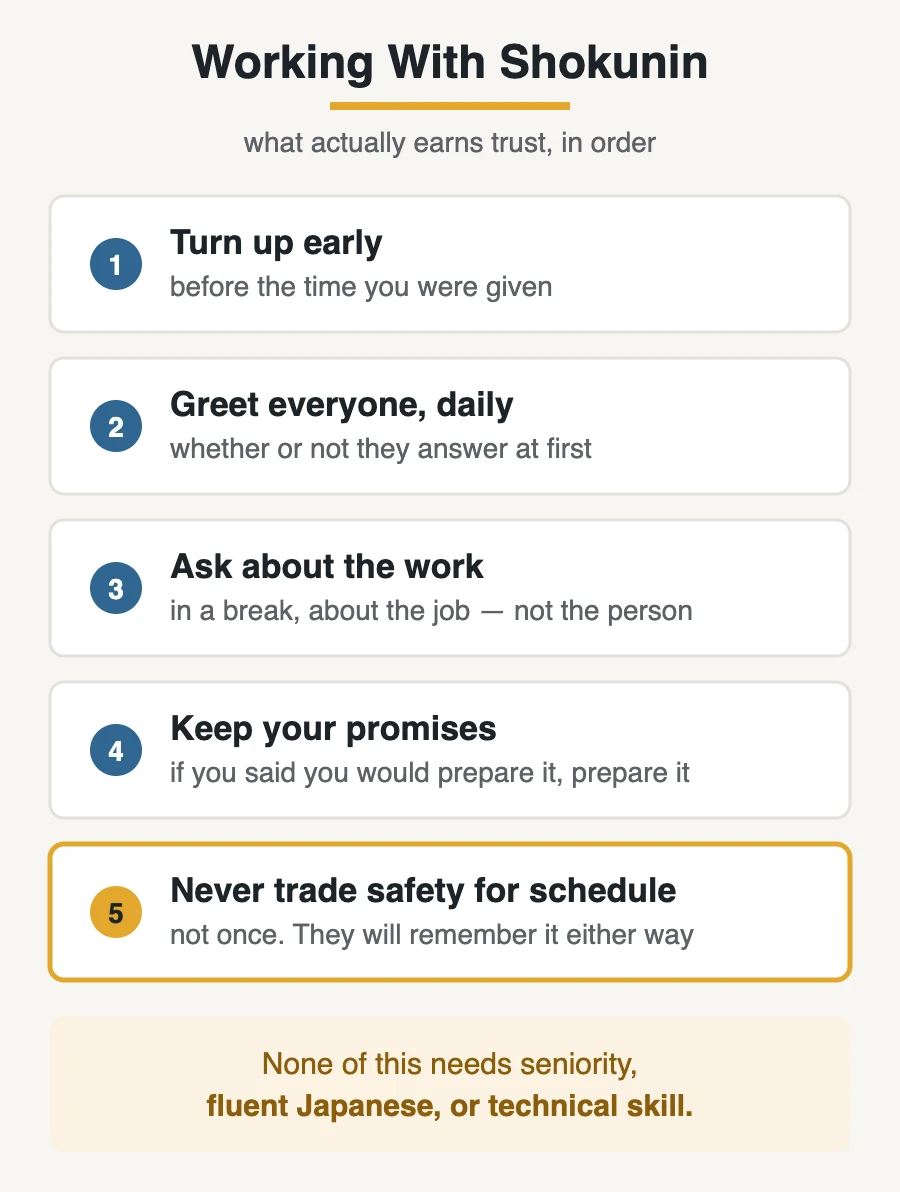
From my own experience, in this order: turn up early, greet everyone daily, ask about the work, keep your promises about what you’ll prepare, and never ask someone to do something unsafe because the schedule is tight. None of that requires seniority or fluent Japanese.
Summary
Here’s the short version.
- Shokunin on a Japanese site means the people who do the physical work. It’s an everyday word, not a title — and the craft pride behind the romantic version is still real.
- The trades are easiest to read from clothing and tools: tobi on the scaffolding, daiku and katawaku daiku with timber, tekkin-kō tying steel, sakan finishing surfaces, setsubi and denkō above your head in the ceiling.
- The ranks run from minarai to ichininmae, with the hanchō and the shokuchō leading, and the oyakata running the company. Shokuchō is also a legal role with its own required training.
- Becoming one has traditionally meant watching a senior person work. That’s changing, because it’s uneven and because the industry can’t afford to lose beginners.
- Two national systems now make skill visible: the ginō kentei skill test, with its practical exam and the ginōshi title, and the CCUS card that records the days you’ve worked and shows your level by colour.
And the part I’d keep if I could only keep one.
When I started, nobody talked to me, and the thing that changed it was saying good morning every single day until it stopped being remarkable. Not competence — I didn’t have any yet. Just showing up and treating people as people.
If you come and work on a Japanese site, the technical things will take you years. That one is available on your first morning.
If you have questions about working with Japanese craftspeople, or anything else about construction here, feel free to reach out anytime! You can read more about who I am and what I’ve worked on on my About page.
Read next: Japanese Tool Belt: What a Site Supervisor Actually Carries
Also worth reading: If you want to become one of them: Construction Work in Japan: How to Actually Get In — the routes in, the two tests, and the foreman role the long-stay status asks you to reach.
How to talk to them: Japanese Construction Terms: The Words You’ll Hear on Site — how to talk to the people in this article, starting from your first morning.
When the hand-off between trades fails: Three Mistakes I Made on a Japanese Construction Site — what happened when the next trade started before the plasterers had finished.
The tools they reach for: Japanese Carpentry Tools: What Lasted, and What Left — a thousand years of them, and what survived into a cordless week.
What your trade is officially worth: Construction Wages in Japan: Look Up Your Own Trade — Japan publishes a daily rate for 51 trades in all 47 prefectures — and that figure is not a wage.