Japanese Tool Belt: What a Site Supervisor Actually Carries
The short version
- Koshi-dogu is part of the rig, worn with your harness — not weather gear you put on some days.
- Supervisors wear one too. A supervisor who keeps walking back to the office is not supervising.
- Carry less than you think. A heavy belt is slower, more tiring, and gives you more things to drop.
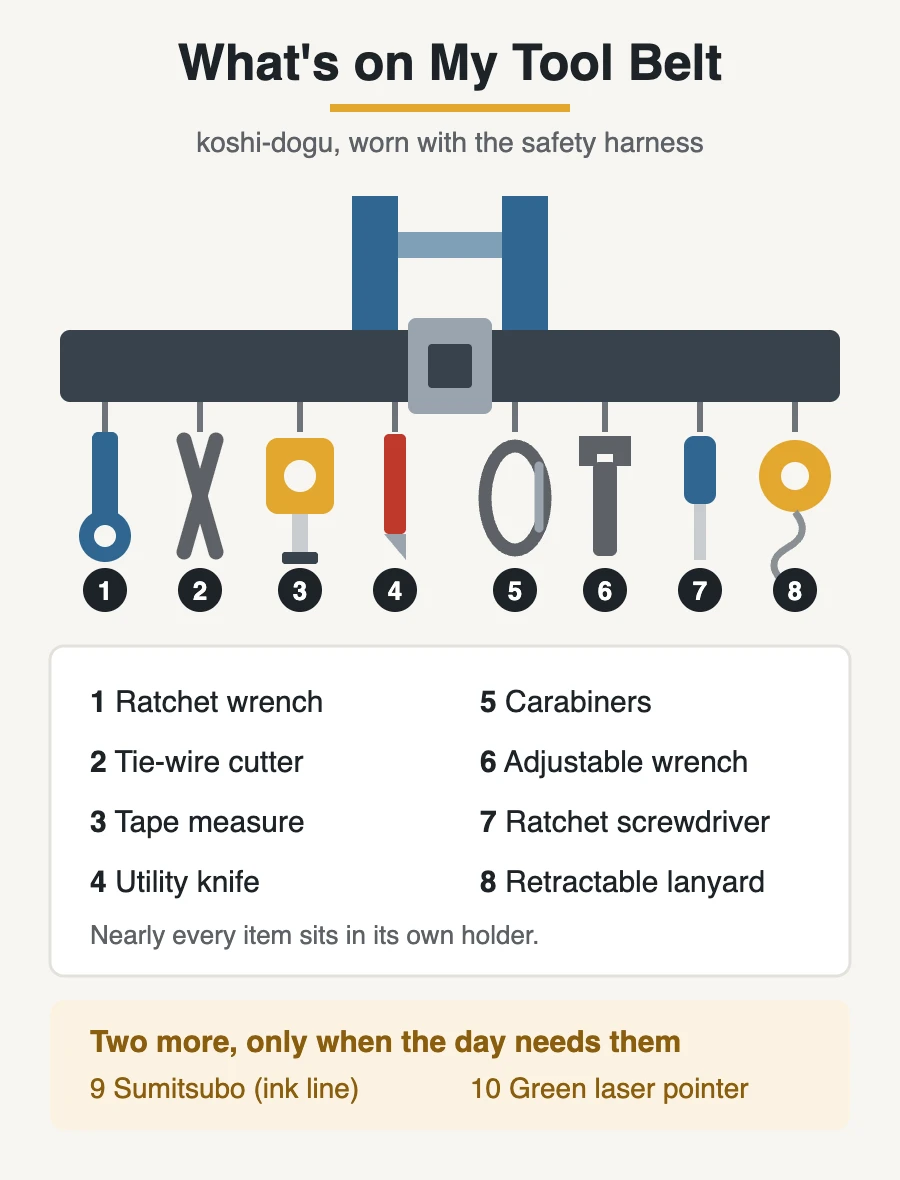
- My core is eight items, with the sumitsubo and a green laser for certain days. Almost everything has a holder, and that is the point.
Hi there, I’m Shirokuma!
Early in my career, I dropped a tool into wet concrete.
It went in without much of a sound, which somehow made it worse. It wasn’t attached to anything, because I hadn’t bothered with a lanyard, because nothing had ever fallen before.
That’s the day I started taking the koshi-dōgu — the Japanese tool belt — seriously. Not as decoration. As a system.
In this article, you’ll learn:
- What a Japanese tool belt is, and why even site supervisors wear one
- The ten items I actually carry, and what each one is for
- Why almost everything on it is attached to something else
I’ll also tell you the mistake I made before that, which is the opposite of what most people expect.
This post contains affiliate links. If you buy through them, I may earn a small commission at no extra cost to you. I only list gear I’ve used or would use myself.
What Koshi-dōgu Is
The word
Koshi means waist. Dōgu means tools. Put together, koshi-dōgu is the set of tools you wear on your waist — the belt, the pouches, the holders, and everything hanging off them.
It’s an ordinary word on a Japanese site, and it isn’t optional equipment the way rain boots are. Boots come out when it rains. The tool belt goes on whenever you’re working.
It comes with the harness
That’s because the belt isn’t a separate thing you decide to wear. On a Japanese site it’s part of the same setup as your safety harness — the fall-protection gear you put on before you start.
Harness first, then the belt and pouches around it. They’re built to work together: the harness carries you, the belt carries your tools, and the whole arrangement has to sit so that neither one interferes with the other.
So the question is never really “am I carrying tools today?” You’re wearing the rig regardless. The only question is what’s hanging on it — which turns out to be the interesting part.
It’s a set, not a collection
Here’s the part that took me a while to understand. A tool belt isn’t a bag you put tools in. It’s an arrangement.
Each item has a position, and the position matters more than it sounds:
- Your dominant hand should reach the tools you use most, without looking
- Nothing should swing into your leg when you climb a ladder
- Anything that could fall needs to be held, or tied, or both
When it’s set up right, you stop thinking about it. When it’s set up wrong, you notice all day — and eventually something goes wrong, which is a story for chapter 5.
Why supervisors wear one too
This is the part that surprises people from outside Japan. I’m a supervisor, not a tradesperson. Why am I carrying tools at all?
Because the work doesn’t wait.
Preparation happens before the crew arrives. I’m often on site early, marking something, checking something, setting something up so the day can start on time. If I have to walk back to the site office for a tape measure, that’s ten minutes gone, and I’ll do it four times a day.
Small things come up constantly. A bolt that needs tightening. Something that needs cutting. A tradesperson who says “can I borrow your cutter for a second?” None of these are my job, exactly. All of them stop the work if nobody can do them right now.
Checks need tools. Inspecting reinforcement, confirming a dimension, marking a correction — you can’t do any of it empty-handed.
So the tool belt isn’t me pretending to be a craftsman. It’s me not being the reason the site is waiting.
The Rule: Carry Less Than You Think
What I got wrong
When I was new, I thought a loaded belt made you look capable.
More tools, more pouches, more things clipped on — that’s what an experienced person’s belt looked like to me, so I copied the look. If I could hang it, I hung it.
I had it backwards.
What a heavy belt actually says
Here’s what I noticed once I’d been around long enough to read other people’s belts.
The people who genuinely knew what they were doing carried less than I did, not more. Their belts were light, and everything on them got used that day.
A belt stuffed with tools says one of two things to the people around you:
- You don’t know which tools this job needs, so you brought all of them
- You haven’t thought about it at all
Neither is the impression you want. The tradespeople notice, too — and on a Japanese site, quietly noticing is most of the feedback you’ll ever get.
The practical reasons, not just the image
The image part is real, but the practical reasons are stronger.
Weight. You’re wearing it for under six hours of actual work, but that’s six hours of it hanging on your hips while you go up and down ladders and scaffolds. You feel every item by the afternoon.
A note on the Japanese working day. Sites here take a 30-minute break at 10 a.m. and another at 3 p.m. — we call it ippuku — plus the lunch break. So the belt comes off more often than you might assume. Those breaks are a fixed part of the rhythm, not something you skip when you’re busy.
Speed. The more things hanging off you, the longer it takes to find the one you want. A light belt is a fast belt.
Snagging. Anything that sticks out can catch on scaffolding, a handrail, or a ladder rung. In a tight space, a bulky belt is a genuine hazard, not just an inconvenience.
Risk. Every tool you carry is a tool you can drop. And in Japan, preventing dropped objects isn’t a personal preference — it’s required on site, and it’s taken seriously. I’ll come back to that in chapter 5, for reasons I’ve already admitted.
How I decide now
My rule is simple, and it’s the one thing I’d pass to anyone starting out:
Carry what today needs, plus the few things that are always needed.
Before I head out to the site, I think about what’s actually happening that day. Reinforcement inspection? Different set than a day of marking positions. Then I add the small permanent core — the tape measure, the cutter, the things that come up no matter what the schedule says.
That core is the next chapter. It’s eight items, and it took me years to get it down to eight.
The Eight I Carry Every Day
This is my permanent core. Everything here has earned its place by being needed on days I didn’t expect to need it.
One thing you’ll notice: almost every item comes with a holder. That’s not an accessory — on a Japanese site it’s the point. More on that in chapter 5.
1. Ratchet wrench and ratchet holder
For tightening bolts, which comes up more than you’d guess — scaffolding fittings, temporary fixings, equipment.
What makes the holder worth having is how it takes the tool back: you drop the ratchet in and it seats itself, without you looking or fiddling. When you’re on a scaffold with one hand busy, “drops straight in” is a safety feature, not a convenience.
Most supervisors in Japan already own one of these before they own anything else on this list.

Ratchet wrench with belt holder
The bolt tool that lives on my belt. The holder is the part that matters — the tool drops straight back in.
2. Tie-wire cutter and its holder
Bansen is the steel binding wire used all over a Japanese site — tying reinforcement, securing temporary work, holding things in place until the real fixing happens. The cutter is a short, heavy pair of nippers made for it.
This one absolutely needs a dedicated holder. It’s awkward to pull out of a pouch, and it’s heavy: if it goes off a scaffold, you have a serious incident, not an inconvenience. A holder lets you draw it and return it in one motion, with the tool secured the rest of the time.
3. Tape measure with a holder
The tool I use more than any other.
Mine is a Tajima, 5.5 m, with a magnet on the tip. Two reasons for the magnet:
- It holds onto steel while you measure alone, which you often are
- It picks up metal debris — and during a reinforcement inspection, it’s surprisingly good at collecting the offcuts of binding wire lying around
That second one sounds trivial. It isn’t. Those offcuts end up in the concrete if nobody picks them up.

Tajima tape measure, 5.5 m with magnetic tip
The one I reach for most. The magnet holds steel while you measure alone — and picks up binding-wire offcuts during rebar checks.
4. Utility knife and knife holder
Opening materials, cutting sheet, trimming insulation — and answering the question you will be asked at least once a day: “can I borrow your cutter for a second?”
A knife has nothing to stop it falling, so the holder does that job. Get one that holds the knife firmly rather than one that just looks neat.
5. Carabiners
The connector that makes the rest work. A carabiner lets you hang anything that doesn’t come with its own holder.
Mine carry vinyl tape and my adjustable wrench. Nothing clever about it — it just means those two things are always with me and never in my hands when I’m climbing.
6. Adjustable wrench
The backup for the ratchet.
Sites are full of bolts that aren’t the size you expected. When that happens, the adjustable wrench is the difference between fixing it now and putting it on tomorrow’s list. It earns its weight maybe once a week, and that’s enough.
7. Ratchet screwdriver
Screws come in more than one type, and I’m not carrying four screwdrivers.
A ratchet driver with interchangeable bits covers most of them, and the ratchet action means you don’t have to keep releasing and re-gripping. Small thing, but it turns an annoying job into a quick one — especially overhead, where re-gripping is the tiring part.
8. Retractable tool lanyard
The item I want to argue for hardest, because it’s the one I didn’t have on the day I dropped a tool into concrete.
A tool inside a holder rarely falls. But the moment you take it out to use it, nothing is holding it — and that’s exactly when your attention is on the work rather than your grip. A retractable lanyard clips the tool to your belt and takes up its own slack, so it doesn’t dangle or catch on anything.
It costs very little. Skipping it cost me a lot more.

Retractable tool lanyard (drop prevention)
The cheapest insurance on the belt. It retracts, so nothing dangles — and the tool stays with you when your hand doesn't.
Two More for Certain Days
These two don’t live on my belt permanently. They come along when the day calls for them — which, following my own rule from chapter 2, is exactly how it should work.
9. Sumitsubo (the ink line)
If you only look at one tool on this list, make it this one.
A sumitsubo is a marking tool: a reservoir holding ink-soaked wadding, a spool of line, and a small pin on the end. You anchor the pin, pull the line out across the surface, lift it, and let it snap down. It leaves a perfectly straight line exactly where you need it.
I use it for setting out reference lines, and for showing people what I mean — this is where the wall goes is a sentence that works much better with a line on the floor than with a gesture in the air.
What I like about it is the continuity. The plastic one on my belt does the same job, in the same way, as the wooden ones Japanese carpenters have used for generations. Some of those old ones are genuinely beautiful objects, carved by the carpenters who used them. Mine is not beautiful. It works exactly the same.
Chalk lines are the closest equivalent in many countries. Ink behaves a little differently: it’s finer, and it stays put.
For larger setting out, the sumitsubo has company these days: we use a layout navigator that guides you to design points on a screen. I wrote about that, and the rest of the digital kit, in ICT Construction in Japan. The ink line hasn’t gone anywhere, though. It’s still the fastest way to put a line in front of someone.
10. Laser pointer
For pointing at things you can’t reach.
On an inspection, half the job is communication: that bracket, that gap, that connection up there. A laser pointer removes the ambiguity instantly, especially in a high space where “over there, no, left” costs everyone five minutes.
Two practical notes.
Green is easier to see than red on a construction site. Red tends to get lost against dusty surfaces and daylight; green stays visible.
It doesn’t live on my belt. It’s not an everyday tool, and a belt is a rough place to keep something with electronics in it. It comes out for inspections and goes back after.
Never point a laser at anyone’s eyes — not at a person, not at a vehicle, not as a joke. This matters more with a green laser, which is easier to see precisely because more of its light reaches your eye. Point it at the work, always.

Green laser pointer
For inspections, when "that one, up there" needs to be unmistakable. Green shows up far better than red on a dusty site.
Why Everything Has a Holder
The day I learned it
I was working above a fresh concrete pour. The tool was in my hand, then it wasn’t, and then it was in the concrete.
Nobody was underneath. That’s the only part of the story I’m glad about, and it was luck rather than planning.
What followed was not dramatic, just tedious and entirely avoidable: retrieving it, dealing with the disturbed surface, explaining it. Concrete doesn’t wait while you feel embarrassed — it sets on its own schedule, so everything has to happen immediately.
The tool wasn’t attached to anything, because I hadn’t thought I needed a lanyard. That was the whole cause.
Why a dropped tool is a bigger deal than it sounds
Three reasons, in order of importance.
People. A hand tool falling from a few floors up will seriously injure someone. This is the reason the rules exist, and it’s not theoretical.
The work. A tool in wet concrete is a foreign object in a structural element. It has to come out, and taking it out damages the surface you just finished.
Trust. On a Japanese site, you’re judged by whether you’re careful. Dropping something tells people how you work — fairly or not.
What the rules actually say
Japan’s Ordinance on Industrial Safety and Health puts clear duties on employers here.
Article 537 requires that where objects could fall during work and endanger workers, the employer must take measures to prevent that danger — for example, installing safety nets and setting up restricted areas.
Article 563 covers scaffold work platforms. Where objects could fall and endanger workers, the platform must have toe boards at least 10 cm high, mesh sheets, or safety nets (or equipment with equivalent function), with limited exceptions.
Source: Ordinance on Industrial Safety and Health, Articles 537 and 563 (e-Gov, in Japanese)
Note what those rules are and aren’t. They’re duties on the employer, about the site’s physical measures — nets, toe boards, keeping people out from underneath. They don’t say “clip your tape measure to your belt.”
The personal layer comes from site rules and from habit. In practice, that layer is not optional either: sites here expect your tools to be secured, and nobody treats it as a personal style choice.
Three layers, and you need all of them
That gives you a useful way to think about it.
- The site catches things. Toe boards, mesh sheets, nets, exclusion zones below. Not yours to arrange, but know whether they’re there.
- Holders hold things. Every tool with a home on your belt is a tool that isn’t loose in a pouch waiting to tip out when you lean over a handrail.
- Lanyards catch what you’re holding. The layer I skipped. A tool in a holder is safe; a tool in your hand is only as safe as your grip.
The honest version
Here’s what I’d tell a younger me.
You will not drop a tool because you were careless. You’ll drop it because something else went wrong at that exact moment — you were reaching, the light was bad, someone called your name. Your attention was on the work, which is where it was supposed to be.
That’s why the answer is equipment and not effort. A lanyard doesn’t require you to concentrate. It just works, on the day your concentration is somewhere else.
What the Tool Belt Says About Japanese Sites
A tool belt looks like a personal preference. It isn’t, quite. It comes out of how work is organized here, and once you see that, a few other things about Japanese sites make more sense.
Dandori: the word behind all of it
Dandori means preparation — but a wider kind than the English word suggests. It’s the arranging of everything so the actual work can run without stopping: materials there, access clear, the previous trade finished, the marks already set out.
On a Japanese site, dandori is most of a supervisor’s job, and it’s the thing you get judged on. Nobody praises you when the day runs smoothly. Everybody notices when twelve people are standing around waiting for something that should have been ready.
The tool belt is dandori worn on your body. It exists so that the small unfinished thing gets finished now, rather than becoming a reason to wait.
The distance to the office is longer than it looks
Here’s the unglamorous math that convinced me.
The site office might be three minutes away. Three minutes there, three back, and a couple of minutes of whatever pulls your attention when you arrive — a phone call, someone with a question. Call it ten.
Do that four times in a day and you’ve lost close to an hour. Not an hour of walking, an hour of supervising — of being where the work is, seeing what’s happening, catching the problem while it’s still small.
That’s the real argument for carrying tools. Not that a supervisor should be doing tradespeople’s work, but that a supervisor who has to keep leaving isn’t supervising.
Tools as a language
Then there’s the craftsman side of it.
Japanese tradespeople have a serious relationship with their tools. Tools are personal, kept sharp, kept in order, and arranged the way that person works. You’ll see older carpenters with tools that clearly have years on them and look better cared for than mine.
A supervisor with a sensible, well-kept belt is borrowing a bit of that language without pretending to be a craftsman. It says: I understand what you’re doing, I respect the work, and I’m not going to be the person who can’t find a tape measure.
That’s also why the overloaded belt I wore as a beginner was the wrong signal. In a culture where tools mean something, a belt full of things you never use reads as costume.
How this might differ where you are
In some countries, the site manager carries a tablet and a radio, and that’s appropriate — the roles are divided differently, and crossing the line into a trade’s work can be a real problem, contractually and otherwise.
I’m not arguing one way is better. But if you visit a Japanese site, you’ll notice the line sits in a different place: supervisors here are expected to be physically involved in preparation, and the tool belt is the visible sign of it.
If you ever work with a Japanese team, that’s worth knowing. When the supervisor pulls out a tape measure and checks something themselves, it isn’t distrust of the crew. It’s just how the job is done here.
FAQ
What does koshi-dōgu mean?
Koshi is waist, dōgu is tools. It’s the whole waist setup — belt, pouches, holders, and the tools on them. On a Japanese site it’s worn together with your safety harness, whenever you’re working.
Do site supervisors really wear tool belts in Japan?
Yes. It’s normal here. Supervisors handle preparation before the crew arrives, answer small problems during the day, and carry out checks — none of which works if you have to walk back to the office for a tape measure each time.
What should a beginner buy first?
A tape measure with a holder, and a retractable lanyard. The tape measure is the tool you’ll use most; the lanyard is the one you’ll wish you’d bought. Add a utility knife with a holder, then build up slowly, only when a missing tool has actually cost you something.
Isn’t a bigger tool belt better?
No, and this is the mistake I made. Extra tools mean extra weight for a full working day, slower access to what you actually need, more to snag on scaffolding — and more things you can drop. Carry what the day needs plus a small permanent core.
Is drop prevention required by law in Japan?
The Ordinance on Industrial Safety and Health requires employers to take measures where objects could fall and endanger workers — safety nets and restricted areas (Article 537), and toe boards of at least 10 cm, mesh sheets or nets on scaffold platforms (Article 563). Those are duties about the site’s measures. Securing your own tools is site rules and normal practice rather than a rule written against your tape measure — but it’s expected, and treated seriously.
What is a sumitsubo?
A traditional Japanese marking tool: an ink reservoir and a line that you stretch across a surface and snap to leave a straight line. Similar in purpose to a chalk line, but the ink is finer and stays put. Japanese carpenters have used the same method for generations.
Where can I buy Japanese tool belt gear outside Japan?
Some brands are easy to find internationally, and others are much easier to get from Japanese retailers. Japanese-market sites usually have the widest choice, and international shipping services can help when a shop doesn’t ship abroad.
Can I wear my own tool belt when visiting a Japanese site?
Bring what you’re comfortable with, but expect the site’s rules to apply. Two things in particular: your tools need to be secured against falling, and the belt has to work with the harness you’ll be given. If you’re unsure, ask the site before the day — people would much rather answer a question than turn you away at the gate.
Summary
Here’s the short version.
- Koshi-dōgu is the Japanese tool belt: belt, pouches, holders and tools, worn with your safety harness whenever you’re working. It isn’t weather gear you put on some days — it’s part of the rig.
- Supervisors wear one too. Preparation, small fixes, and checks all need tools, and a supervisor who keeps walking back to the office isn’t supervising.
- Carry less than you think. A heavy belt is slower, more tiring, easier to snag, and gives you more things to drop. Carry what today needs, plus a small permanent core.
- My core is eight items: ratchet wrench, tie-wire cutter, tape measure, utility knife, carabiners, adjustable wrench, ratchet screwdriver, and a retractable lanyard. Two more come along for certain days: the sumitsubo and a green laser pointer.
- Almost everything has a holder, and that’s the point. Japan’s Ordinance on Industrial Safety and Health requires employers to prevent falling objects, and sites expect your tools to be secured.
If you only take one thing from this article, take the cheapest one. Get the lanyard. I dropped a tool into wet concrete because I didn’t have one, and I’ve never met anyone who regretted buying it.
And if you’re starting out and your belt feels too light — that’s usually a sign you’re doing it right.
If you have questions about working on a Japanese site, or about any of the tools here, feel free to reach out anytime! You can read more about who I am and what I’ve worked on on my About page.
Read next: Japanese Construction Workwear: From Baggy Pants to Fan Jackets, and Why
Also worth reading: A Day on a Japanese Construction Site: Hour by Hour
Who you’ll be working with: Shokunin: Who’s Who on a Japanese Construction Site
What these tools are called: Japanese Construction Terms: The Words You’ll Hear on Site — what every tool on that belt is actually called on site.
Where these tools came from: Japanese Carpentry Tools: What Lasted, and What Left — the three old ones still in daily use, and the ones that left.