Japanese Carpentry Tools: What Lasted, and What Left
The short version
- Three old hand tools are genuinely still on an ordinary site: the ratchet, the adjustable spanner, and the sumitsubo. Most of the famous ones are in other trades, or in the museum.
- The sumitsubo is the ancient one. Ink lines survive on Horyu-ji’s original timbers, and an eighth-century example has been excavated.
- The carpenter’s square is a calculator, with a root-two scale on its back face. I have never seen anyone use it.
- Saws and planes are pulled, not pushed. The museum calls this unusual rather than better, and offers no reason. Neither will I.
Hi there, I’m Shirokuma!
There is an object on Japanese construction sites that has been doing the same job for more than a thousand years, and almost nobody notices it.
It’s a pot of ink with a string wound inside. You pin one end of the string to the material, pull the line tight, lift it and let go, and it snaps a perfectly straight line onto the surface. It’s called a sumitsubo, and I still see them.
This article is about Japanese carpentry tools — where they came from, why they’re shaped the way they are, and which ones have survived into a working day that now involves cordless drivers and laser levels.
I want to be careful about one thing from the start. There’s a version of this subject that is all reverence: beautiful photographs, centuries of craft, nothing ever lost. That’s not the article I can honestly write. Some of these tools are still in daily use. Some of them are magnificent and have quietly left the site. I’ll tell you which is which.
In this article, you’ll learn:
- Which old tools are genuinely still on a Japanese site, and which are not
- Where the sumitsubo and the carpenter’s square came from, and the ingenious thing the square can do that almost nobody uses any more
- Why Japanese saws and planes are pulled rather than pushed — as a difference with a reason, not a competition
Most of the history here comes from the Takenaka Carpentry Tools Museum in Kobe, which publishes its collection notes online. Where I give a date or a detail, that’s where it’s from, and I’ve put the link next to it.
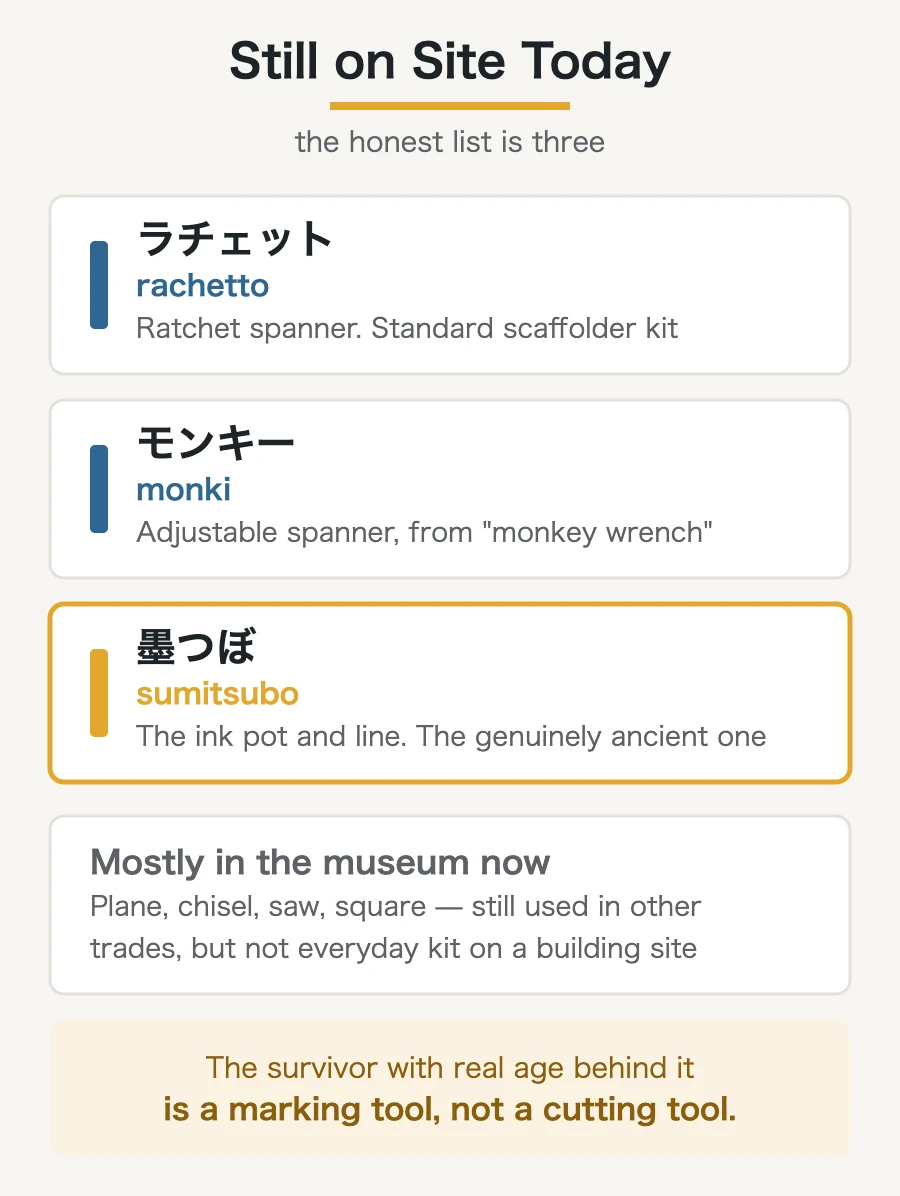
Japanese Carpentry Tools Still on Site Today
The honest list is short
If you walk onto an ordinary Japanese building site today and look for tools that would have been recognisable a century ago, you will not find many.
What I actually use and see is three things:
| Japanese | Say | Means |
|---|---|---|
| ラチェット | rachetto | A ratchet spanner, usually with a tapered spike on the end |
| モンキー | monkī | An adjustable spanner — “monkey,” from monkey wrench |
| 墨つぼ | sumitsubo | The ink pot and line, for marking out |
That’s it. Three.
I’d rather give you three than pad the list, because padding is how this subject usually goes wrong. The tools in the museum are extraordinary. Most of them are in the museum.
Two of the three aren’t really old
The ratchet and the adjustable spanner are standard kit for scaffolders, and they’re in every tool belt — I wrote about both in The Japanese Tool Belt and in the site vocabulary article. Neither is a Japanese invention and neither is ancient.
They’re on this list because they are hand tools in an era when most things have a battery, and they’ve resisted replacement for the simplest possible reason: nothing else does the job better. A spanner turns a bolt. There is no version of that problem left to solve.
The third one is genuinely ancient
The sumitsubo is a different matter, and it gets the whole of the next chapter.
A thing worth noticing now: of all the tools I could have put on this list, the survivor with real age behind it is a marking tool, not a cutting tool.
That’s not an accident, and it’s the quiet theme of this whole article. Cutting, drilling, fastening and tying have all been handed to motors. Deciding where things go has not — and when a machine finally came for that job too, as I wrote in the article on construction robots, it turned out to need a human to tell it where to start.
What this chapter is not claiming
I should be plain about the limits of what I’m telling you.
This is what I see on the sites I work on, which are building sites with reinforced concrete and steel. A temple carpenter restoring a roof, a joiner making fittings, a plasterer — these people work with tools I don’t handle, and some of those traditions are very much alive.
So read the list as “what an ordinary site looks like,” not “what Japan has left.” The second claim would be both bigger and wrong.
The Sumitsubo: One Tool, Fourteen Centuries
How it actually works
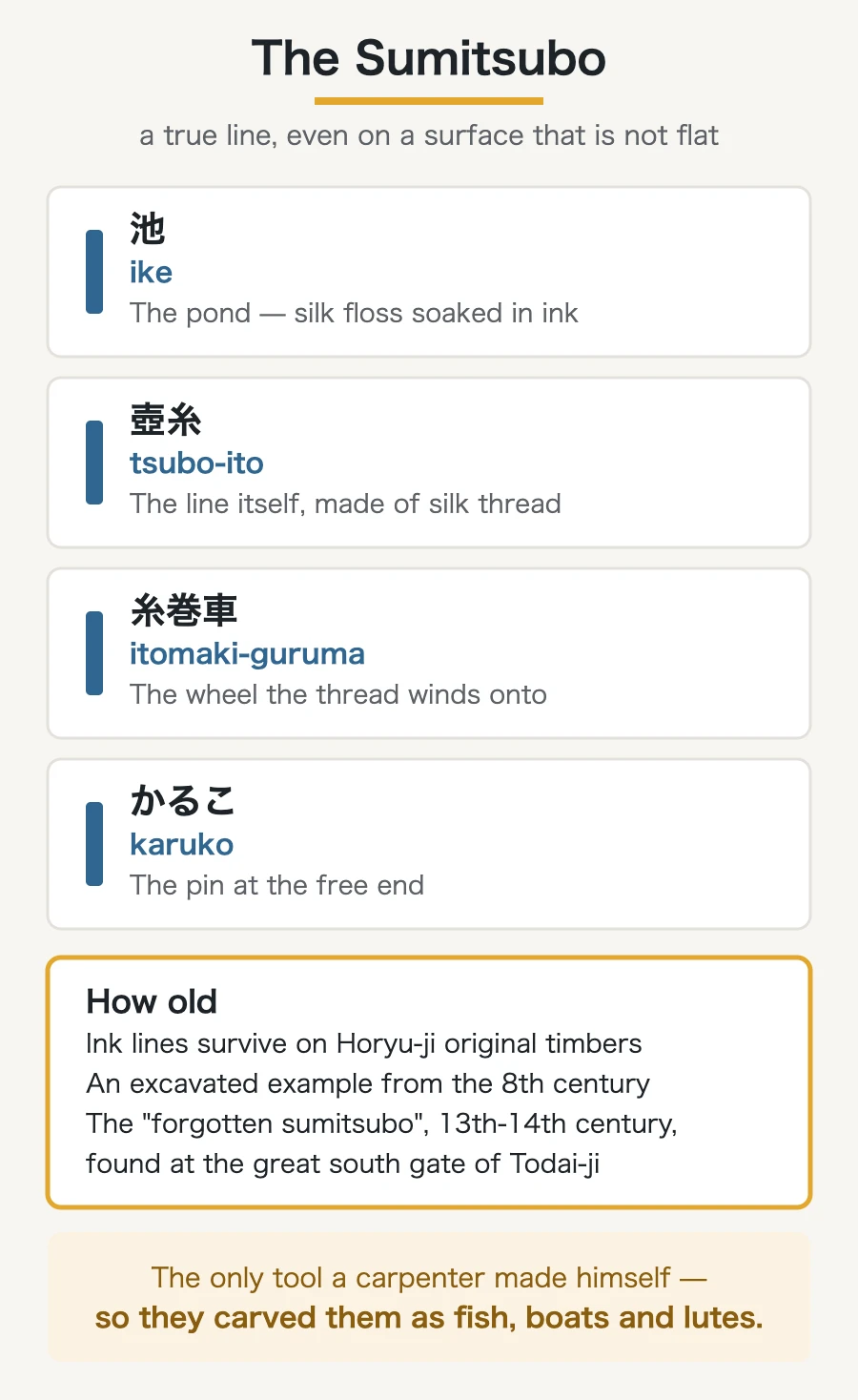
The sumitsubo is a wooden pot with four parts that matter.
| Japanese | Say | Means |
|---|---|---|
| 池 | ike | The “pond” — a reservoir holding silk floss soaked in ink |
| 壺糸 | tsubo-ito | The line itself, which is silk thread |
| 糸巻車 | itomaki-guruma | The wheel the thread winds onto |
| かるこ | karuko | The pin at the free end, pushed into the material |
You pin the karuko, draw out the length you need, stop the wheel with your thumb, press the thread into position with a finger, then pick the line straight up with your other hand and release.
And here is the clever part, in the museum’s own explanation: because the method uses the elasticity of the thread, you get an accurate straight line regardless of whether the material’s surface is even. (Takenaka Carpentry Tools Museum, checked October 3, 2026)
Think about what that solves. Timber is not flat. A straight edge laid on a warped surface lies to you. A line that is snapped through the air and lands by its own tension does not.
How old is it, really
Old enough that the dates stop feeling like numbers.
- Ink lines survive on the original timbers of Hōryū-ji — so a sumitsubo was in use when it was built.
- An excavated sumitsubo from around the eighth century was found at the Sakane site in Hyōgo Prefecture.
- One from the thirteenth or fourteenth century was found at the great south gate of Tōdai-ji, and the museum calls it the **”forgotten sumitsubo.”**
(Takenaka Carpentry Tools Museum, checked October 3, 2026)
I keep coming back to that last one. Seven hundred years ago, a carpenter finished at a temple gate, packed up, and left his marking tool behind. Anyone who has ever driven away from a site and realised what’s still sitting on the slab knows exactly how that happened.
For a long time, nobody would tell you how to use it
Snapping a line is easy. Knowing which lines to snap — working out from a drawing where every member of a building meets — is not.
The museum notes that marking out with a sumitsubo required advanced knowledge and technique, and that until the medieval period it is thought to have been treated as a secret transmission — passed within a lineage rather than explained. (Takenaka Carpentry Tools Museum, checked October 3, 2026)
That’s worth holding onto for chapter 3, where exactly the same thing happens again with a different tool.
The only tool a carpenter made himself
Now the detail that explains why these objects are so beautiful.
Unlike other carpentry tools, the sumitsubo was traditionally made by the carpenter who used it. The museum describes it as, for that reason, the one tool in which a carpenter’s sense of design and manual skill showed.
So they carved them. The museum’s own collection is catalogued by shape: boat, carp, crane-and-tortoise, tortoise, shrimp, shamisen, biwa, young-leaf, Hiroshima-type, Genji-type. (Takenaka Carpentry Tools Museum, checked October 3, 2026)
A tool catalogue that has to be organised by whether the object is a fish or a lute is not a normal tool catalogue.
East and west hold it differently
A small thing I like, because it’s the kind of difference that only shows up in tools.
Some sumitsubo have a handle on the winding wheel and some don’t. The museum notes that carpenters in the Kansai region are said to prefer the type without a handle, winding the thread by turning the wheel with a hand, while carpenters in Kantō are said to prefer one with a handle. (Takenaka Carpentry Tools Museum, checked October 3, 2026)
Same country, same job, two ways to wind a string.
The red one, and the bamboo pen
Two companions worth knowing.
A shutsubo is the same tool charged with red bengara pigment instead of ink. The reason is practical: the red washes off with water, so it’s used where you’re marking natural timber whose surface you intend to keep.
And the line isn’t drawn with a pencil. It’s drawn with a sumisashi, a bamboo pen — spatula-shaped at one end, pointed at the other for writing symbols. The spatula end is split into fine leaves, and the museum reports that skilled makers put in thirty to forty splits. (Takenaka Carpentry Tools Museum, checked October 3, 2026)
Thirty to forty, in a piece of bamboo about a centimetre deep, so that it holds ink and lays down a clean edge. Nobody sees that. The person who made it knew.
The Square That Does the Math — and the Part Nobody Uses
Where it came from, and the story that wasn’t true
The sashigane — also read kanejaku — is the L-shaped steel square. One long arm, one short arm, marked on both faces.
Nobody is certain when it started being used. In China, a relief in the Wu Family Shrine from the Later Han dynasty shows Fuxi, the legendary first emperor, holding a carpenter’s square — so the origin is very old, and it most likely came to Japan early, along with continental building technique.
And then there’s the part I enjoyed finding. Before the early modern period, Japanese building craftsmen widely believed that the square had been invented by Prince Shōtoku, whom they revered as an ancestral deity of the trade. The museum’s comment on this is one sentence long:
This is a superstition.
(Takenaka Carpentry Tools Museum, checked October 3, 2026)
I’m quoting that partly because it’s funny and partly because it’s the right instinct. A museum of carpentry tools, with every commercial reason to tell the romantic version, says plainly that the trade’s own origin story is not true.
It is not really a ruler
The square is said to have ten uses.
Measuring right angles and dimensions is the obvious one. But it also measures gradients, divides a straight line into equal parts, and — applying the wasan idea of kō-ko-gen, the three sides of a right triangle — works as a calculator for multiplication, division, square roots and cube roots. (Takenaka Carpentry Tools Museum, checked October 3, 2026)
A square root, on a piece of bent steel, with no moving parts.
The back scale
Here is how that’s possible, and it’s beautifully simple.
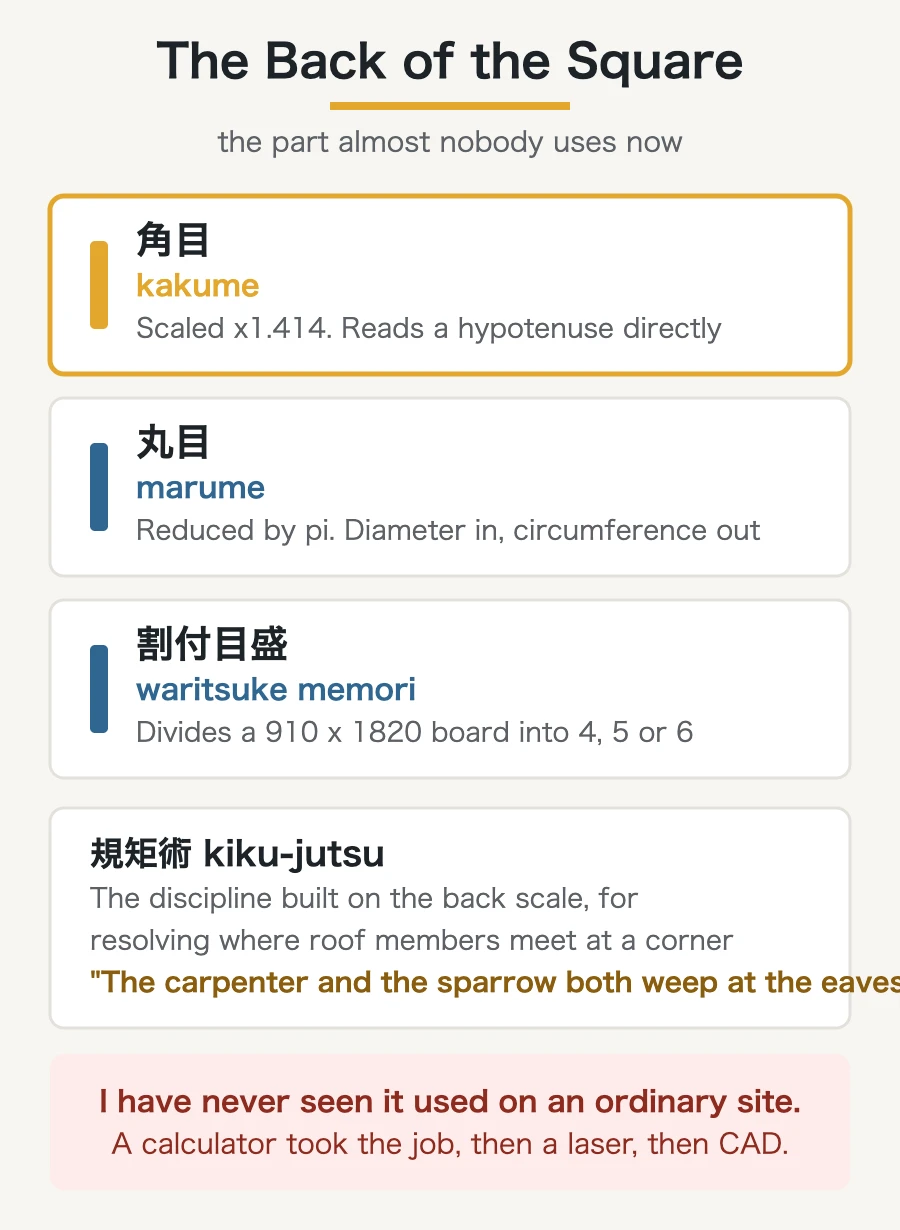
The back face carries a scale called 角目 (kakume) graduated at √2 times the front scale. Because the diagonal of a square is √2 times its side, you can read the hypotenuse of a right triangle directly, without calculating it. (Takenaka Carpentry Tools Museum, checked October 3, 2026)
A manufacturer of squares gives two more:
| Japanese | Say | Means |
|---|---|---|
| 角目 | kakume | ×√2. Measure a log’s diameter and read the side of the largest square beam you can cut from it |
| 丸目 | marume | Reduced by π. Measure a circle’s diameter and read its circumference |
| 割付目盛 | waritsuke memori | Divides a standard 910 × 1820 mm board into 4, 5 or 6 equal parts |
(Shinwa Rules, checked October 3, 2026)
That last row is the sabu-roku board from the site vocabulary article — the standard sheet size. Someone built the division of it into the ruler.
Kiku-jutsu, and the proverb
Japanese carpenters took the back scale and built a whole discipline on it.
Using kakume, they worked out how to resolve the complex geometry where roof members meet at a corner — hip rafters, valley rafters, compound angles — and systematized it into a body of technique called 規矩術 (kiku-jutsu).
It was, by all accounts, extremely hard to learn. Hard enough that it produced a saying, which the museum traces directly to this:
大工と雀は軒で泣く Daiku to suzume wa noki de naku — “The carpenter and the sparrow both weep at the eaves.”
(Takenaka Carpentry Tools Museum, checked October 3, 2026)
The eaves are where the geometry gets hardest. The sparrow is there too, and nobody is having a good time.
And now the part I have to be honest about
Everything above is true, documented, and brilliant.
I have never seen anyone use the back scale.
Not once, on an ordinary building site. The sashigane itself is around. The √2 scale on its reverse — the thing that makes it a calculator, the thing kiku-jutsu was built on — I have not seen in use.
What took the job? A calculator. Then a laser. Then CAD, and now the production drawings I write about in BIM and production design, where the corner geometry is resolved before anyone reaches the site at all.
What that actually tells us
This is the thing I’d keep from the whole article.
The tool survived. The hardest skill it was designed to carry did not — and the same thing happened in chapter 2, where the sumitsubo is still in use but the secret knowledge of how to mark out with it stopped being secret, then stopped being special.
A tool can outlive the skill it was built for. It sits in the belt, doing the simple half of its job, while the clever half quietly moves into a machine. That is not a tragedy and it isn’t decline. It’s what happened to the square, and it’s what’s happening now to setting out, as I wrote in the article on construction robots.
Nobody weeps at the eaves any more. It would be strange to wish they still did.
Why the Saw Pulls
The fact, stated carefully
Japanese saws cut on the pull stroke. Most of the world’s saws cut on the push.
I want to give you the museum’s own wording here, because it chooses its words well:
Saws in our country are generally made to cut when pulled. Looking at carpentry tools around the world, in most countries saws are used by pushing, so our country’s saws are a very unusual way of using them. (Takenaka Carpentry Tools Museum, checked October 3, 2026)
Unusual. Not better. A Japanese museum of Japanese tools, describing the most famous thing about Japanese saws, reaches for the word “unusual” and stops there.
I’m going to do the same, because the honest answer to “why?” is more interesting than the confident one.
What I can’t tell you
You will find explanations everywhere. A pulled blade is in tension rather than compression, so it can be thinner, so the cut is finer and takes less effort. Or: Japanese timber is softer. Or: the work is held differently, with the body rather than a vice.
Every one of those is plausible. I could not find any of them stated in a source I’d be willing to cite, and the museum, which would know, doesn’t offer a reason at all.
So: the explanations above are what people say. Treat them as reasonable guesses rather than settled fact, which is how I’m treating them.
What I can tell you — the blade isn’t flat
Here’s a sourced detail that I find more impressive than the usual story anyway.
A Japanese saw blade is not a uniform sheet of steel. The museum describes it as thicker through the middle — the “waist” — than at the teeth or the back, with the far end made thin and wide, growing thicker and narrower as it approaches the handle. The purpose: to give uniform strength across the whole blade. (Takenaka Carpentry Tools Museum, checked October 3, 2026)
That is a blade tapered in two directions at once so that it behaves the same everywhere along its length. Whatever the reason for pulling, somebody spent a long time on the consequences of it.
And before rolled steel plate was easy to get, these were forged from tamahagane — the same traditional steel associated with swords — which the museum notes made it hard to produce a blade of uniform quality.
The famous one is younger than you think
Two types to know:
| Japanese | Say | Means |
|---|---|---|
| 縦挽鋸 | tatebiki-noko | Rip saw — cuts along the grain |
| 横挽鋸 | yokobiki-noko | Crosscut saw — cuts across the grain |
| 両刃鋸 | ryōba-noko | Both-edge saw: rip teeth on one edge, crosscut on the other |
The ryōba is the one people picture when they picture a Japanese saw.
It came into use around 1897. (Takenaka Carpentry Tools Museum, checked October 3, 2026)
Not ancient. Younger than the Brooklyn Bridge. The iconic object is a modern convenience, and that is worth remembering every time a tool is sold to you as timeless.
The plane pulls too — and it’s also younger than you’d guess
Japanese planes are pulled toward the user, where most planes elsewhere are pushed.
But the familiar rectangular block plane — the dai-ganna — was only introduced around the middle of the Muromachi period. Before that, surfaces were worked with a yari-ganna, a spear-shaped blade on a shaft. (Takenaka Carpentry Tools Museum, checked October 3, 2026)
So the great Japanese planing tradition is working with a tool that arrived partway through the country’s building history, replacing something quite different.
The smiths and the carpenters
One last detail, because it says something about how these objects got so good.
The museum observes that many of the acknowledged master makers of Japanese carpentry tools were plane smiths, and suggests this may have come out of the tension between carpenters and smiths — carpenters are notoriously demanding about how a plane cuts, and the smiths competed on exactly that. (Takenaka Carpentry Tools Museum, checked October 3, 2026)
Not harmony. Pressure. The tools got better because the people using them were hard to satisfy, and said so.
Hard Edge, Soft Body
Two metals, forged into one
Pick up a Japanese chisel and you are holding two different metals welded together.
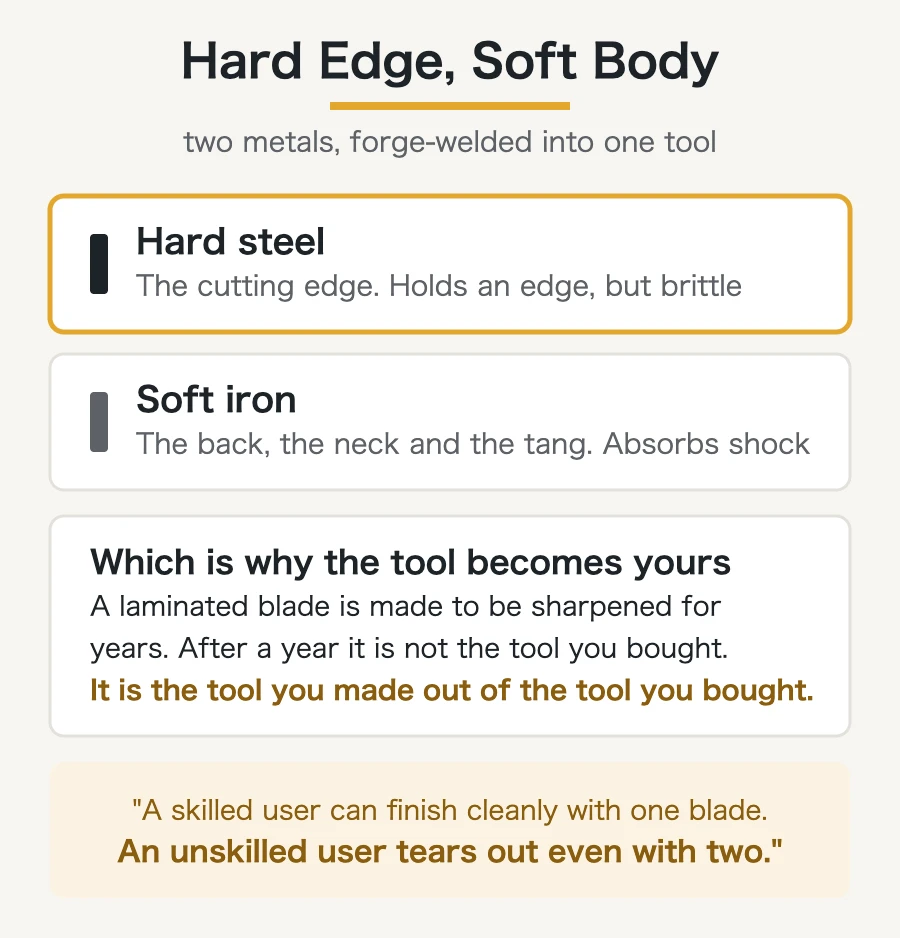
The museum describes it directly: the cutting edge is made by forge-welding steel for cutting wood onto a softer iron backing, and that soft iron then forms the back, the neck, and the tang that goes into the handle. (Takenaka Carpentry Tools Museum, checked October 3, 2026)
The plane blade is made the same way.
The logic is the kind that survives centuries because it has no weak point. Hard steel holds an edge but is brittle. Soft iron absorbs shock but won’t stay sharp. Weld a thin layer of the first onto a body of the second and each metal does only what it is good at.
Which is why the tool becomes yours
There’s a consequence that matters more than the metallurgy.
A laminated blade is made to be sharpened, repeatedly, for years. Every sharpening takes you a little further back into that hard steel layer. The tool gets shorter, the bevel becomes the one you grind, the handle wears to a hand.
After a year, it is not the tool you bought. It’s the tool you made out of the tool you bought.
That is the actual reason behind the rule I gave in the site vocabulary article — don’t pick up someone else’s tools. It isn’t superstition, and it isn’t only courtesy. You would be using an object that has been adjusted, by hand, to somebody else.
Chisels: big does not cover small
One line from the museum has stayed with me:
Only with chisels does a large one not substitute for a small one.
So you need the widths. The museum notes that the oire-nomi, one family of chisel, is used as a set of ten in assorted sizes — and that’s one family. (Takenaka Carpentry Tools Museum, checked October 3, 2026)
The two families are worth knowing:
| Japanese | Say | Means |
|---|---|---|
| 叩鑿 | tataki-nomi | Struck with a hammer. Built robust, with an iron ring — a katsura — on the handle head |
| 仕上鑿 | shiage-nomi | Pushed by arm strength alone. Longer handle, keener edge, for finishing |
A ring of iron around the top of a handle so it can be hit all day without splitting. Small solution, obvious once you see it, several hundred years old.
The sentence that keeps everyone honest
Japanese planes usually have two blades — a main blade and a cap iron — to stop the grain tearing out.
The museum adds this:
A skilled user can finish cleanly even with a single blade, while an unskilled user will produce tear-out even with two. (Takenaka Carpentry Tools Museum, checked October 3, 2026)
I’d put that on a wall. The tool does not save you. It never has.
And the same thing is true of a ¥2,000 tool today
Here’s why I don’t think any of this is only history.
Ask anyone who ties rebar about their hakkā — the hooked tool for twisting tie wire — and you’ll get an immediate opinion. A cheap one spins completely differently. Not slightly. Completely, to the person doing six thousand twists in a day.
Or ask about the cutters for bansen, the soft steel wire. The ones with a bent tip are easier to use.
Those are modern, mass-produced, inexpensive tools. No laminated steel, no smith’s name, nothing in a museum. And the discrimination is exactly the same as the one the chisel smiths were competing on: a difference that is invisible to everyone except the person holding it for eight hours.
So what actually carried over?
Not the materials. Not the techniques. Those really have changed, and chapter 6 is about how much.
What carried over is the standard. The expectation that a tool should be judged at a level of detail that looks absurd from outside, by the person who uses it, who will be specific and will not be talked out of it.
That didn’t come from the steel. It came from the people, and they’re still here.
What Changed, and What Didn’t
Two jobs that went to motors
On an ordinary site today, two tasks that used to be hand work no longer are.
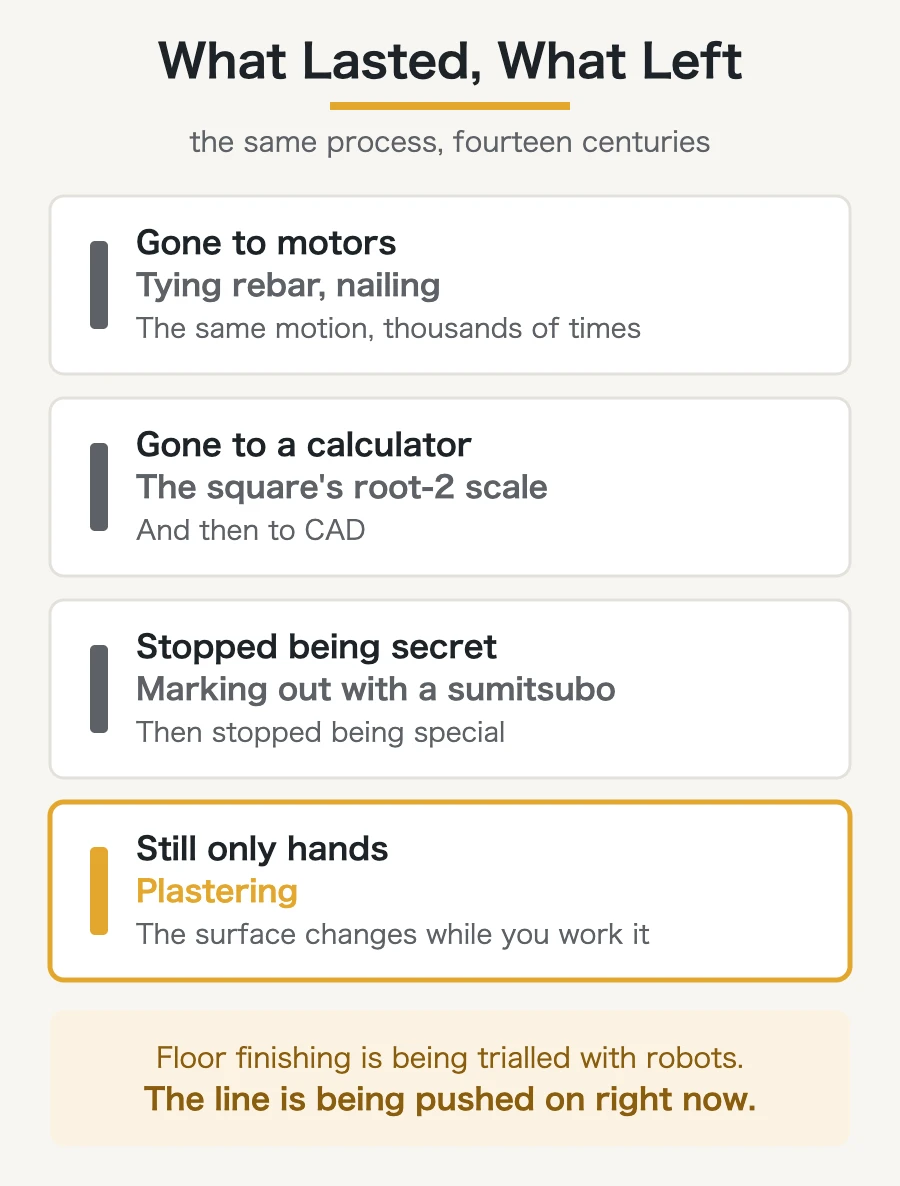
Tying rebar in a slab is now mostly done with powered tools. Not a hook and a wrist — a tool with a motor in it.
Nailing is going the same way. Carpenters increasingly use compressors, and you hear the gun before you see the work.
Look at what those two have in common. Both are the same motion, thousands of times a day, with almost no variation between repetitions. Of everything on a site, they were the most mechanical things a human was still doing.
Which is exactly why the robot works
This explains something I wrote in the article on construction robots and didn’t fully understand until I put it next to this chapter.
The rebar-tying robot is operated by setting a commercially available power tool into it — the one the steel fixer already owns.
That design only makes sense because the power tool was already standard. The robot did not replace a hand. It replaced the hand that was already holding a machine. The hard part — making a machine that ties wire — had been solved years earlier by the tool manufacturers. The robot is a carriage.
Automation didn’t arrive in one step. It arrived in two, and the first one was so undramatic that nobody wrote an article about it.
The job that hasn’t moved at all
Now the other side.
Plastering can only be done by human hands. Not “is usually,” not “is best done.” The sakan — the plasterers I described in the shokunin article — are doing something that has not been handed to any machine.
My own reading of why, and I’d flag it as a reading rather than a fact: plastering is not a repeated motion. The surface changes continuously as you work it. The material is setting while you’re on it, so the right pressure and angle three minutes from now are not the ones you’re using. Every stroke is a response to a condition that the previous stroke created.
That is the opposite of tying a wire six thousand times.
Except the line is being tested right now
And then, because nothing in this industry stays settled:
Floor concrete finishing — the power-trowelling of a fresh slab — is being trialled with robots.
Trialled. Not deployed, not standard, not something you’ll meet next week. But it is being attempted, and that is interesting precisely because it’s the nearest thing to plastering that anyone has gone after.
So the boundary between “machine work” and “work only hands can do” isn’t a fixed line in this trade. It’s a line somebody is currently pushing on, and it will be in a different place in ten years than it is today.
The pattern, across fourteen centuries
Put this chapter next to the three before it and a shape appears.
| What happened | Example |
|---|---|
| The repeatable half of a job leaves | Tying, nailing — gone to motors |
| The clever half of a tool leaves when a machine can do the arithmetic | The square’s √2 scale, replaced by a calculator |
| The secret becomes ordinary, then invisible | Marking out with a sumitsubo |
| What stays is the part where the material answers back | Plastering — for now |
None of that is decline, and I’d resist reading it that way. It’s a thousand years of the same process, running at different speeds in different decades.
What I’d take from it, if you’re choosing a trade
Here is the practical version, and it’s the most useful thing in this article.
The tasks that leave are the ones where you do the same thing again. The tasks that stay are the ones where the material behaves differently each time and somebody has to notice.
Plastering stays because the wall is changing while you work it. Setting out stayed for fourteen centuries because somebody had to decide where the line goes, and when a robot finally came for it, the robot still needed a person to tell it where to start.
If you want to know whether a skill has a future, don’t ask how traditional it is. Ask whether the work answers back.
Questions People Actually Ask
Do Japanese carpenters still use hand tools?
On an ordinary building site, three — and I listed them in chapter 1.
That is not the whole country. Temple carpentry, joinery, fittings, plastering: these are different trades with different kit, and some of them use hand tools all day. I don’t work in those trades, so I’ve stayed out of claims about them.
What I’d resist is the version where every Japanese carpenter is still planing hinoki by hand. On the sites I run, most things have a battery.
What is a sumitsubo actually used for now?
The same thing it was used for in the eighth century: snapping a long, accurate straight line onto a surface.
On a modern site that surface is usually a concrete slab, and the line is a setting-out line that every following trade works to. A chalk line does a similar job. The sumitsubo holds a finer line, and — because the method uses the thread’s own tension — it stays accurate over an uneven surface.
Is kiku-jutsu still taught?
I don’t know, and I’d rather say that than guess.
What I can tell you is what I’ve seen: I have never seen the back scale of a sashigane used on an ordinary building site. Whether the full discipline is still passed on inside temple carpentry training is a question for someone in that trade, and I’m not.
Are Japanese tools better than Western ones?
No, and the museum that keeps 30,000 of them doesn’t say so either.
Its description of the pull stroke is that it’s unusual — most countries push. Different tools, different traditions, different reasons. If you want a ranking, this isn’t the article, and I’d be suspicious of any article that offers one.
Why is the plane body made of wood?
It’s usually oak, chosen as a hard wood, though the museum notes the choice depends on the use and the preference of the user.
The body used to be made by the carpenter. These days it’s more often made by a specialist block-maker. (Takenaka Carpentry Tools Museum, checked October 3, 2026)
A trade that exists only to make the wooden bodies that other people’s blades sit in — that’s the level of specialization this field reaches.
I want to try one. Where do I start?
A pull saw, and I’m deliberately not naming a product.
It’s the cheapest way to feel the actual difference this article is about, because the difference is in your arm within about three strokes. Buy nothing else until you’ve done that.
If you’re working in Japan and want the vocabulary for the shop, the tool words are in the site vocabulary article.
Where can I actually see these tools?
The Takenaka Carpentry Tools Museum in Kobe, which is where most of the history in this article comes from. It’s the only museum of its kind in Japan, it has an English site, and its collection notes are published online — which is why I was able to cite specific objects and dates rather than general impressions.
If you ever have a spare afternoon in Kobe, I’d go.
Summary: What Outlives What
The short version
- Three old hand tools are genuinely still on an ordinary site: the ratchet, the adjustable spanner, and the sumitsubo. The rest of the famous ones are mostly in other trades, or in the museum
- **The sumitsubo is the genuinely ancient one** — ink lines survive on Hōryū-ji’s original timbers, and an eighth-century example has been excavated. It was the one tool a carpenter made himself, which is why they were carved as fish and lutes
- The carpenter’s square is a calculator, with a √2 scale on its back face that gives you a hypotenuse without arithmetic — and a whole discipline, kiku-jutsu, was built on it. I have never seen anyone use that scale
- Saws and planes are pulled, not pushed. The museum calls this unusual, not better, and offers no reason. Neither will I
- Blades are two metals forge-welded together so they can be sharpened for years, which is why a tool becomes personal
- The repeatable jobs have gone to motors; plastering hasn’t, and floor finishing is being trialled right now
The one idea I’d keep
A tool can outlive the skill it was built for.
The square is still in the belt. The thing that made it extraordinary — the back scale, the geometry, the years of study — has moved into a calculator and then into a drawing produced before anyone reaches the site. The object survived its own cleverness.
And the mirror image of that, from chapter 6: the work that stays is the work that answers back. Plastering stays because the wall changes while you’re working it. Setting out stayed for fourteen centuries because somebody had to decide where the line goes.
If you ever need to judge whether a skill has a future, that’s a better test than asking how old it is.
Two readings I’d resist
The reverent one, where nothing was lost and every Japanese carpenter is still hand-planing hinoki. That’s a photograph, not a site. Most things on my site have a battery.
The declinist one, where it’s all been thrown away. Also wrong. What carried over wasn’t the materials or the methods — it was the standard. The person who tells you a cheap hakkā spins differently is applying exactly the judgement the plane smiths were competing on four hundred years ago. They’re just applying it to a ¥2,000 tool, which is a less photogenic fact and an equally real one.
Where to go next
- The Japanese Tool Belt — what gets carried today, and why it’s so little
- Japanese Construction Terms — the names of these tools on a working site
- Shokunin: Who’s Who — the trades, including the plasterers in chapter 6
- Construction Robots in Japan — what came for setting out, fourteen centuries later
The forgotten sumitsubo
I’ll finish where I keep ending up.
At the great south gate of Tōdai-ji, somebody found a sumitsubo from the thirteenth or fourteenth century. The museum calls it the forgotten one. A carpenter put it down, went home, and didn’t come back for it.
Whatever he was doing that day, he was doing the same job as the machine in chapter 6 — deciding where the lines go and putting them there, so that everyone after him could work to them. Seven hundred years apart, same task, same reason.
I don’t find that sad, and I don’t find it quaint. I find it steadying. The tools will keep changing, faster now than they did for most of those centuries. The job underneath them has been remarkably patient.