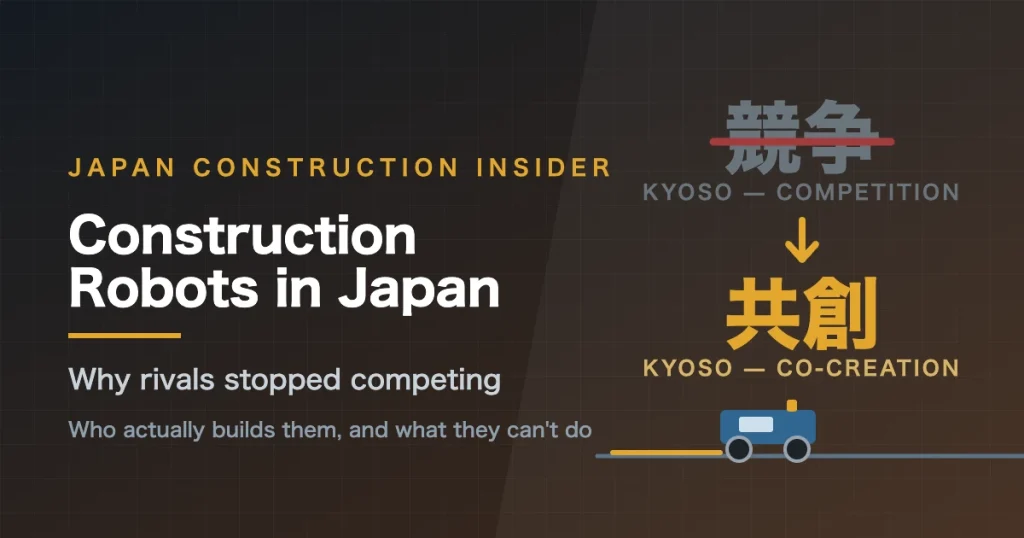
Construction Robots in Japan: Why Rivals Stopped Competing
The short version
- Japan did not invent this. The most established layout robot on the market is American and sold in North America.
- Three of the largest contractors in the country set up a consortium in 2021 to develop robots jointly, licensing included — and said openly that what finally moved them was a fear of being left behind.
- The machines are deliberately unimpressive. A rebar robot doing 1.3 times a person’s output won a national award for being simple, light, cheap and easy to use.
- The pressure here is a shortage of people, not a search for margin. Everything else follows from that.
Hi there, I’m Shirokuma!
If you’ve read the articles on this site about ICT construction, BIM and drones, you’ve seen the digital side of a Japanese site. This article is about the part that moves on its own.
Before anything else: this article is about construction robots in Japan, and I want to start by heading off the piece you might be expecting.
This is not a piece about Japanese robots being ahead of everyone else’s. When I went to check, that story didn’t survive contact with the facts — the most established commercial layout robots on the market are not Japanese, and I’ll show you that in the first chapter rather than quietly leave it out.
What is unusual here is something less obvious, and in my view more interesting: how these robots are being built, and by whom.
In this article, you’ll learn:
- Who actually makes the robots that draw layout lines on a floor, and where they’re sold
- Why Japan’s biggest rival contractors decided to stop competing on this and build together
- What a rebar-tying robot invented by a former rebar worker says about where this is going
A note on numbers. Everything with a figure attached below comes from a company’s own material or a government page, with the date I checked it. Several figures I found in news coverage are not here, because I couldn’t confirm them at the source. I’d rather give you five numbers you can check than fifteen you can’t.
No, Japan Didn’t Invent This
Start with the awkward part
If you search for construction robots and Japan, you’ll find plenty of material suggesting this is a Japanese specialty. Before I write three chapters about Japanese robots, I should be straight with you about where the technology actually sits.
Take the one people mention most: the layout robot. It drives across a finished floor slab and prints the lines that tell every following trade where their work goes — walls here, door opening there, this penetration at this dimension.
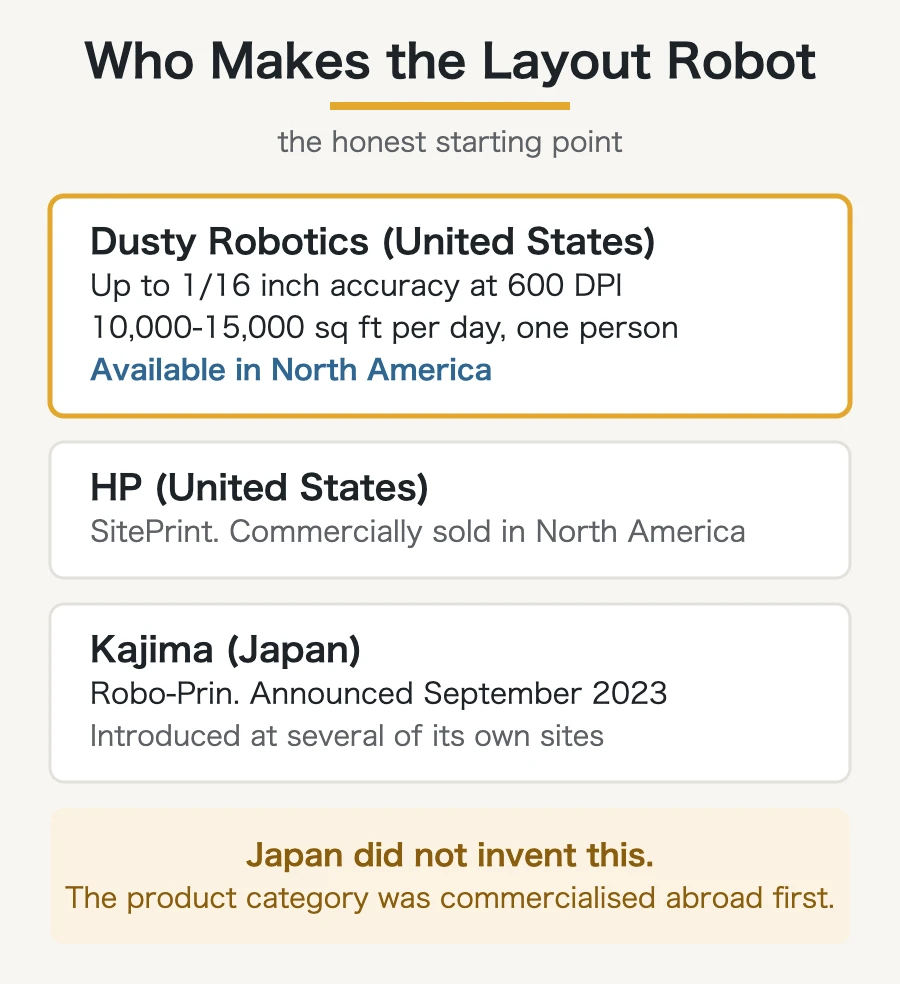
The most established commercial machine doing that is American.
What’s already on the market
Dusty Robotics, based in California, sells the FieldPrinter. On their own site they describe it as printing digital models directly onto the jobsite floor, with up to 1/16-inch accuracy at 600 DPI, able to print as close as 1¾ inches from an obstacle, and covering 10,000 to 15,000 square feet per day with one person. They also state plainly that the FieldPrinter is currently available in North America. (Dusty Robotics, checked October 3, 2026)
HP sells a comparable product, SitePrint, which has been commercially available in North America for some years.
So the honest position is this: a construction worker in the United States is more likely to have seen a layout robot at work than a construction worker in Japan, and the product category was commercialized there first.
Then what is this article about?
Not a league table.
Ranking countries by technology is a bad habit in this industry, partly because the data to do it properly rarely exists, and partly because it’s the wrong question. Every country automates what hurts it most. What hurts is different in each place, so what gets built is different.
Singapore automates because land and manpower are constrained by policy. Northern Europe leans on offsite work for energy performance. The United States has a large, repeatable commercial-interiors market where a machine that prints partition layout pays for itself quickly.
Japan automates because it is running out of people. That’s not a slogan — it’s the same labour shortage behind almost everything else on this site, from the specified skilled worker route to the overtime rules.
And when the pressure is a shortage of hands rather than a market opportunity, you get a different shape of response. That shape is the actual subject of this article, and it starts with something I still find slightly surprising: the biggest contractors in the country deciding to stop competing.
Competition, Then Co-creation
What you’d expect to happen
Put yourself in the position of a large contractor with a labour shortage and a robotics budget.
You build a machine that lets you finish a floor with fewer people. That machine is now a reason to win work. The last thing you do is hand it to the firm you were bidding against last month.
That is how this normally goes, in any country. Which is why what happened here is worth a chapter.
What happened instead
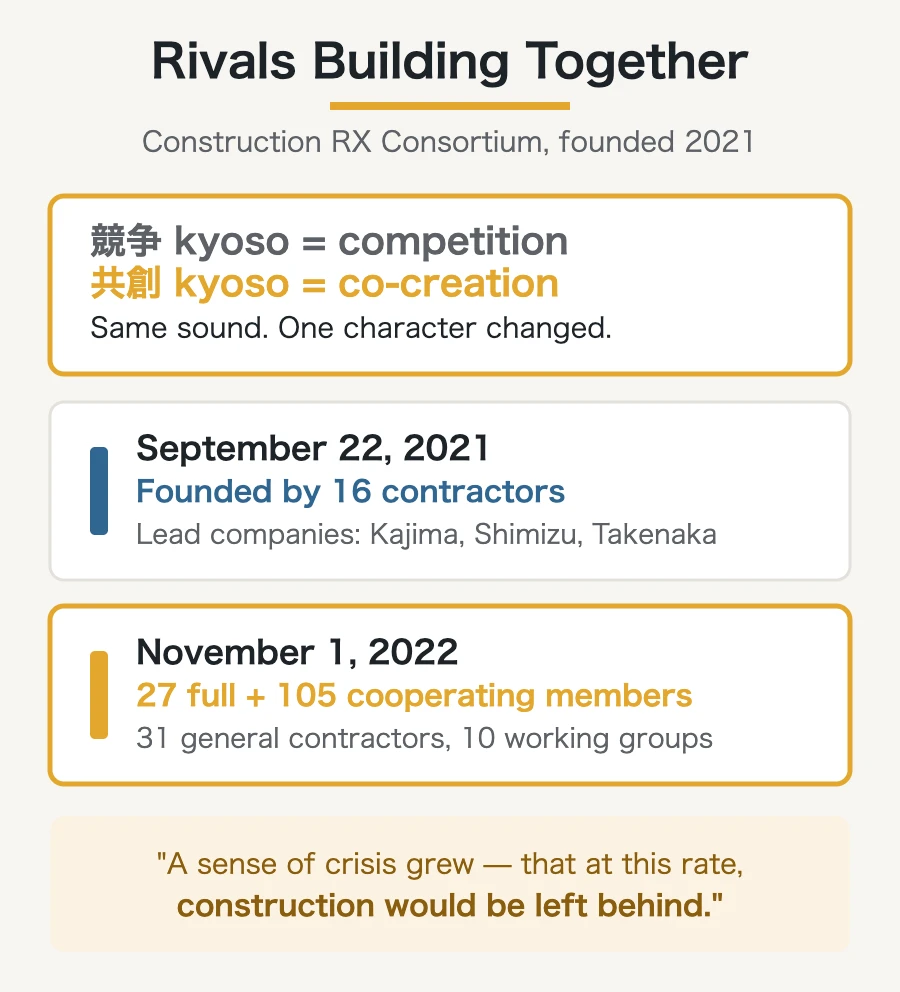
On September 22, 2021, sixteen construction companies formed a body called the Construction RX Consortium — RX for “robotics transformation,” built as a deliberate echo of DX, digital transformation.
The three lead companies were Kajima, Shimizu and Takenaka: three of the largest contractors in Japan, and direct competitors. The other thirteen founding members were general contractors too.
Their stated purpose was to “more strongly promote the productivity and appeal of the construction industry as a whole,” through joint research and development of construction robots and IoT applications — including improvement, practical implementation, and the licensing of what gets developed. (Kajima, checked October 3, 2026)
Read that last part again. Not a study group. Joint development, with the licensing arrangements worked out so the results can actually be used.
It grew quickly
| As of | Membership |
|---|---|
| September 22, 2021 (founding) | 16 construction companies |
| November 1, 2022 | 27 full members and 105 cooperating members — 31 general contractors in all, working through 10 working groups |
(Kajima, checked October 3, 2026)
In fourteen months it went from sixteen contractors to a hundred and thirty-odd organizations, including the equipment makers and software firms who sit in the “cooperating” category. It has continued to grow since; I’m giving you the dated figures I could confirm rather than a current number I couldn’t.
Why they say they did it
The consortium’s own site is unusually candid about this, and it’s worth quoting rather than paraphrasing.
Moves toward co-creation rather than competition have existed for some time in this industry, but they never quite came to anything. However, amid the rapid social changes of recent years, a sense of crisis grew — that at this rate, construction would be left behind. (Construction RX Consortium, checked October 3, 2026)
Two things in that are worth sitting with.
The first is the admission. They are not claiming this was foresight. They are saying people had talked about cooperating for years and never managed it, and what finally moved them was fear of being left behind.
The second is a pun that doesn’t survive translation. 競争 (competition) and 共創 (co-creation) are both pronounced kyōsō. They are the same sound, with one character changed — compete becomes create together. It’s the kind of wordplay a Japanese reader catches instantly and an English reader can’t see at all, which is exactly why I’ve put the characters here.
What it means if you’re the one on site
Three practical consequences, in increasing order of how much they’d affect you.
The same machine turns up at different companies. If robots are developed once and shared, moving between contractors doesn’t mean relearning everything.
Training transfers. This matters more than it sounds for anyone whose career crosses several employers — which, under the five-year status I wrote about in Construction Work in Japan, is a lot of people.
And the small firms are inside it, not outside. The hundred-plus “cooperating members” are not general contractors. A labour shortage is not a problem the big firms can solve alone, because most of the people on any site work for somebody smaller.
What Sumidashi Is, and Why a Robot Helps
The oldest job on the site
Before anything gets built on a floor slab, somebody draws on it.
The Japanese word is 墨出し (sumidashi) — setting out. Lines go down on the concrete showing where every wall, opening, column and penetration belongs, and every trade that follows works to them. I covered the word, and the ink pot it comes from, in Japanese Construction Terms.
It is also, by a distance, the oldest task on this list. The tool it’s named after is the sumitsubo, an ink pot with a line wound inside it, and Japan’s carpentry tools museum notes that ink lines survive on the original timbers of Hōryū-ji, with an excavated sumitsubo from around the eighth century. (Takenaka Carpentry Tools Museum, checked October 3, 2026)
So when a robot rolls across a slab printing layout, it is doing a job that has been done on Japanese sites for well over a thousand years. I find that worth a moment.
Why this is the right job to give a machine
Four reasons, and they stack.
It’s geometric. There is a correct answer, defined by a drawing. No judgement is required about how it should look.
It’s repetitive and slow. Hundreds of measurements, transferred by hand, usually by two people — one holding, one marking.
The floor is empty. This is the one window in the whole programme when a machine can drive around without negotiating with people and materials.
And everything downstream depends on it. A wall in the wrong place isn’t a wall problem. It’s a problem for the trades who build into that wall, and the ones after them.
What Kajima’s machine does
Kajima announced a layout robot called Robo-Prin on September 26, 2023.
Working from drawing data, and controlled at high speed by an auto-tracking total station set up on a control point, it prints full-size continuous lines and characters — characters at a size of 10 mm — onto the floor, with a measured accuracy of within about ±1 mm. Kajima reports roughly double the productivity on layout work, and has begun introducing it on several of its building sites. (Kajima, checked October 3, 2026)
Takenaka and others have built their own. And the consortium from chapter 2 has a working group on exactly this, which is the point of chapter 2 in one sentence: several rivals each built one, then sat down together about it.
The part I didn’t expect: it writes words
Lines I assumed. Text is the interesting bit.
A floor that has its own labels printed on it — not just a line, but what the line is — is a floor that explains itself. You don’t have to find the person with the drawing to know what you’re looking at.
Think about who that helps most. On a site where several trades and several first languages are working off the same slab, a printed label is the most language-independent instruction available, short of pointing. It’s the same principle I keep coming back to in the article on site vocabulary: on a construction site, the drawing is the shared language.
What it doesn’t do
Here’s the limit, and it’s the thing I’d want a young supervisor to understand before they get excited.
Somebody still sets the control point. The robot is positioned by a total station, which is positioned against reference points established by a human being from the site’s survey control.
The machine inherits your reference. It does not check it.
So if the datum is wrong, the robot will print that error beautifully, to within a millimetre, across the entire floor, in half the time it would have taken to do it wrong by hand. Automation doesn’t remove the need to verify what you started from. It raises the price of not doing it.
The Rebar Robot
Start with the work, not the machine
Reinforced concrete is steel in a grid, and at every intersection of that grid somebody ties the two bars together with wire.
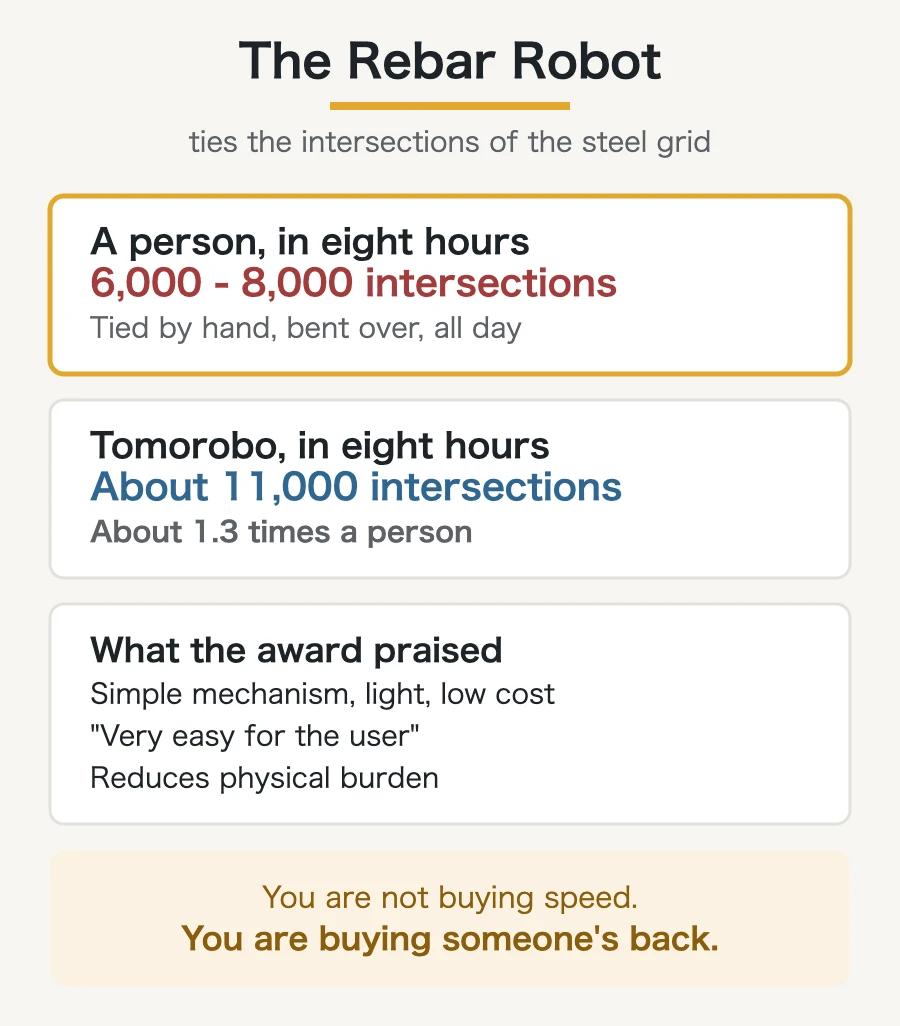
Here is what that means over a shift, in the words of the national robot award that this chapter is about: a person ties 6,000 to 8,000 intersections in an eight-hour day, and the work is done bent over, for long periods. (Robot Award, checked October 3, 2026)
Sit with that number before we get to any technology. Six thousand, at the low end. One twist of wire every few seconds, all day, at the waist.
If you were choosing one task on a construction site to hand to a machine on humane grounds alone, it would be hard to find a better candidate.
What the machine is
Tomorobo, a rebar-tying robot, went on sale in January 2020. It is made by Ken Robotech, a company in Kagawa — not Tokyo — founded in 2013 and renamed to its present name in 2019. (Ken Robotech, checked October 3, 2026)
The award describes it as a ***collaborative* robot — one that does the work “in place of a person” while working alongside them — and notes that you automate the tying by simply setting a commercially available power tool into it**. It moves along the bars by itself and ties as it goes. (Robot Award, checked October 3, 2026)
No special tool. The one the steel fixer already owns.
The number that makes this interesting
In eight hours of operation, Tomorobo ties about 11,000 intersections. Against a person’s 6,000 to 8,000, that is about 1.3 times the output. (Robot Award, checked October 3, 2026)
One point three.
I want to dwell on that, because it is the least impressive number in this article and the most honest one. A machine that replaced a crew would be a headline. This one does slightly more than a person does, and it won a national award anyway.
What’s being bought here isn’t speed. It’s the eight hours of somebody’s back.
And the award’s own assessment agrees — it praises the robot for a simple mechanism, light weight and low cost, for being “very easy for the user,” and for reducing physical burden while addressing the labour shortage. Not for sophistication. For being light, cheap, and usable by the person already doing the job.
A company with an odd mission statement
Ken Robotech states its mission as creating “the world’s most human-friendly construction site.” (Ken Robotech, checked October 3, 2026)
That is a strange thing for a robotics company to say, and I think it explains the 1.3. If your goal were productivity, you would build something that removes people. If your goal is a site that is kinder to work on, you build something that crouches so a person doesn’t have to.
And it left
In February 2023, Ken Robotech set up its first overseas base: a subsidiary in Singapore. (Ken Robotech, checked October 3, 2026)
Then in September 2024, Tomorobo won the Minister of Land, Infrastructure, Transport and Tourism Award at the 11th Robot Award, a programme co-hosted by several Japanese ministries.
Notice the direction of travel, and notice the destination. Chapter 1 said Japan was not the leader in construction robotics, and that remains true. But a small company from a rural prefecture, building a deliberately cheap machine for one unpleasant task, has taken it to a country with some of the most aggressive construction-productivity policy anywhere.
That’s not the story I expected to find when I started this article. It’s better than the one I expected.
Why Japan Is Pushing This Hard
The pressure is demographic, not commercial
I’ve referred to the labour shortage several times. Here is the version with a government target attached, because that’s what turns a worry into budgets.
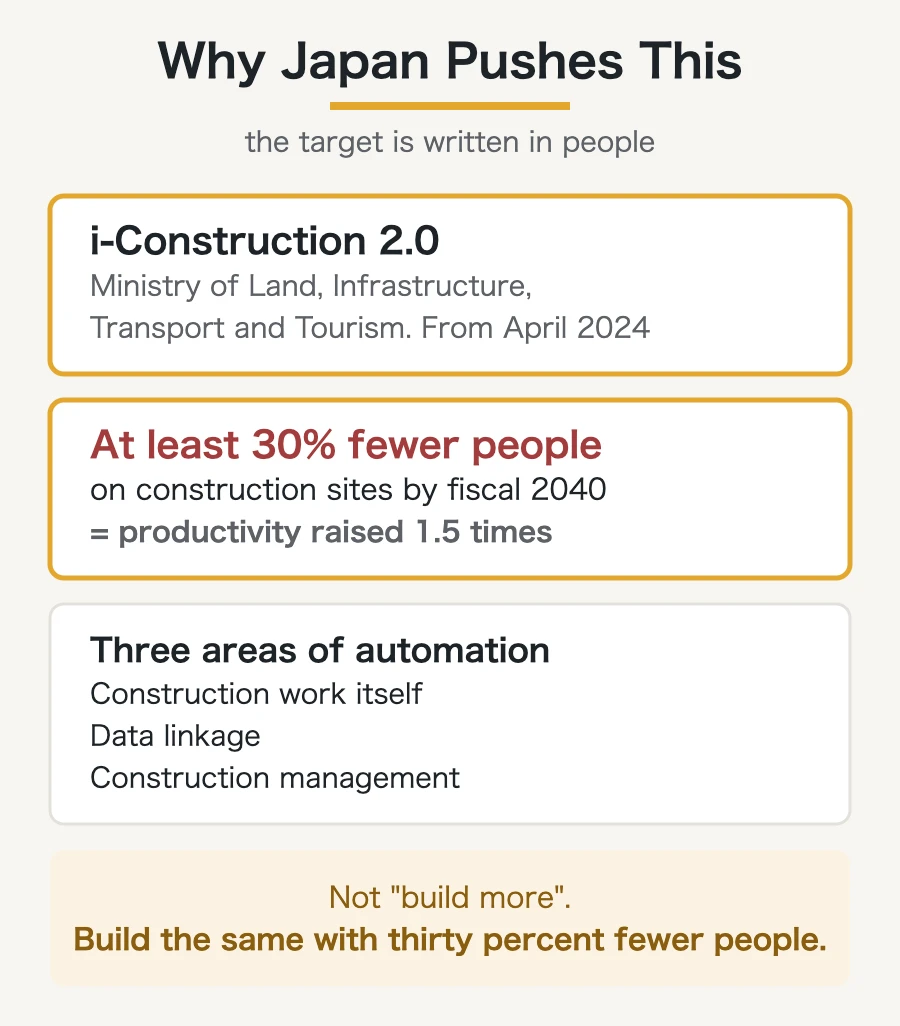
Japan’s Ministry of Land, Infrastructure, Transport and Tourism runs a programme called i-Construction 2.0, accelerated from April 2024. Its stated goal is to reduce the people needed on construction sites by at least 30% by fiscal 2040 — that is, to raise productivity by 1.5 times — through automation in three areas: construction work itself, data linkage, and construction management. (Ministry of Land, Infrastructure, Transport and Tourism, checked October 3, 2026)
Read the target carefully, because the wording matters. It is not “build more.” It is build the same with thirty percent fewer people. The productivity figure is derived from the headcount figure, not the other way round.
That is a policy written by people who have looked at who will be available to work in 2040 and done the arithmetic.
What that changes about the robots
It explains the shape of everything in this article.
It explains the 1.3. If the problem were margin, a 1.3× machine is unremarkable. If the problem is that the person doing that job will not exist in fifteen years, a machine that lets one person do the work of 1.3 and go home with a working back is directly on target.
It explains the consortium. Thirty percent is not a competitive advantage anybody wins alone. If every contractor needs it, and none of them can hire their way out, developing separately is just paying three times for the same answer.
And it explains the choice of tasks. The jobs being automated first — layout, rebar tying — are not the glamorous ones. They’re the ones that are repetitive, physically punishing, and hard to staff.
I’m not going to relitigate the rest here
The wider digital side of this — machine guidance, GNSS, the drawings behind it — I’ve already written about in ICT Construction in Japan and BIM and production design. If you want the fuller picture of where the 3D data comes from before a robot can use it, start there.
The honest caveat about targets
One thing I’d ask you to hold lightly.
A 2040 target is a long way out, and the gap between a ministry’s goal and what turns up on an actual site is usually wide. I’ve worked on plenty of projects where the newest thing present was the coffee machine.
What I’d take seriously is not the number. It’s that the number exists, that it’s framed around people rather than output, and that the companies responded by forming a consortium rather than a race. Those are signals about direction, and direction is the useful part. The pace will be whatever it turns out to be.
What Construction Robots in Japan Mean on Site
Ask what the half-day is made of
Here’s the number that reframed this article for me, and it comes from my own experience rather than a press release.
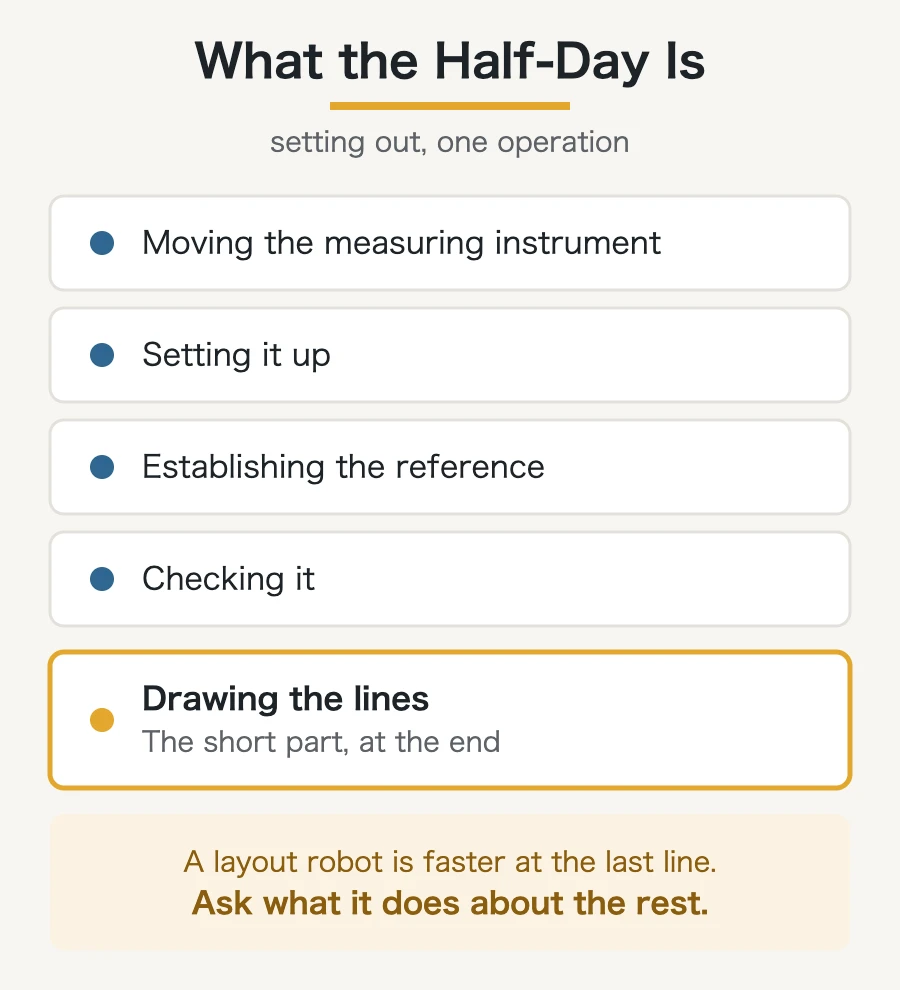
Setting out takes about half a day for one operation.
Not because marking lines is slow. Because of everything around it: moving the measuring instrument, setting it up, establishing the reference, checking it. The actual drawing of lines is the short part at the end.
Now put that next to chapter 3. Kajima’s layout robot is driven by an auto-tracking total station — the same instrument, on the same control point, set up by the same person.
So the honest question to ask about any layout robot is not “is it faster?” It is: faster at which part?
I’m not calling the figure wrong
Kajima reports roughly double the productivity on layout work, and I have no basis to dispute it. They measured it; I didn’t.
What I’d say is that a doubling of the printing does not halve the half day, if most of the half day was never printing. A robot that draws perfect lines at high speed still waits while somebody levels an instrument and verifies a control point.
This is the gap between a technology and a working day, and it is where most optimistic estimates go to die. If you are ever asked to evaluate one of these machines, that’s the question I’d put first: what does it do about the setup?
The thing nobody writes about
Now the observation that surprised me most, and I’d rather lead with it than bury it.
Almost no craftspeople know these robots exist.
Unless you work for a specialist contractor in that particular line of work, you haven’t heard of them. Not “have opinions about them” — haven’t heard of them.
I want to be clear that this is my own experience of ordinary building sites, not a survey. But it has held across the sites I’ve been on, and it changes how you should read every article about construction robotics, including this one.
What that does to the “will robots take our jobs” question
In chapter 7 I’ll answer that question. Here is the context for the answer.
That anxiety, where it exists, is largely a conversation happening outside the site — in trade media, in company strategy documents, in articles like this one. On the slab, the reaction to a layout robot isn’t fear. It’s “what’s that?”
You can read that two ways and both are true.
Optimistically: there’s no resistance to overcome, because there’s nothing to resist yet. When a machine does show up, it arrives as a curiosity rather than a threat.
Less comfortably: the gap between the policy in chapter 5 and the floor you’re standing on is wider than the press releases suggest. A national target for 2040 and a crew who have never seen one of these machines are both true at the same time.
So what should you actually expect?
If you come to work in Japan in the next few years:
- You will do setting out with a sumitsubo and a total station, like everyone before you
- You will probably not meet a layout robot, and definitely not every day
- If one turns up, nobody around you will be an expert either
- And the person who understands what the machine is working from — the control point, the drawing, the datum — will be the most useful person in the room
That last one is not a prediction about robots. It’s been true since the eighth century, which is roughly when somebody first snapped an ink line onto a Japanese building and everyone else worked to it.
Questions People Actually Ask
Are robots going to take construction jobs in Japan?
On the sites I’ve worked on, it isn’t being asked at all — because, as chapter 6 says, most craftspeople have never seen one.
When the question does get asked, the answer in Japan is shaped by the target in chapter 5: do the same work with at least 30% fewer people by 2040, set because the people are leaving anyway. The automation here is chasing a shortage, not creating one.
I’d be more careful about reading that across to your own country. Where the workforce isn’t shrinking, the same machine is a cost argument rather than a staffing one, and the conversation is different.
I’m a foreign worker. Does this affect me?
It’s worth thinking about honestly, because the two tasks in this article — layout and rebar tying — are jobs that foreign workers do.
My reading: the near-term risk is low and the medium-term shift is real. A machine that does 1.3 times a person’s tying, and needs someone to set it, load it, move it and check it, does not remove the crew. But over ten years, the part of the job that is pure repetition is the part most likely to shrink.
Which argues for the same thing the rest of this site argues for — the words, the drawings, the qualifications, the move toward leading a crew. I set that out in Construction Work in Japan.
Do you need to be a robotics specialist to operate one?
Apparently not, and that looks deliberate.
The award citation for Tomorobo praises it for being “very easy for the user,” and the robot works by having a commercially available power tool set into it — the tool the steel fixer already owns. That is a machine designed to be operated by the trade, not by a visiting engineer.
Are these humanoid robots?
No, and I’d gently retire that image.
The two machines in this article are a printer on wheels and a box that crawls along reinforcing bar. Nothing walks. Nothing has a face. The award jury’s praise was for a simple mechanism, light weight and low cost — the opposite of a showpiece.
Can smaller companies get access to them?
This is the right question to ask, and I don’t have a verified answer on pricing, so I won’t invent one.
What I can point at is the direction. The award specifically rewarded low cost, and the consortium in chapter 2 has over a hundred “cooperating members” who are not general contractors. Both of those are signals about who the market is meant to include. Whether that reaches a ten-person subcontractor is a different question, and I’d want evidence before answering it.
Will I actually see one on site?
Probably not yet, and I’d rather say so.
Kajima described its layout robot as being introduced at several of its building sites. That’s a rollout, not a standard. If you arrive in Japan tomorrow, expect chalk lines and a sumitsubo.
What should I learn, if this is coming?
The thing the robot can’t do.
From chapter 3: the machine inherits the reference point and does not check it. Someone has to establish the control, verify it, and be the person who notices when the printed line and the drawing disagree. That is a judgement job, it is getting more valuable rather than less, and it has almost nothing to do with robotics.
Summary: Modest Machines, Shared Development
The three things worth keeping
Japan did not invent this. The most established layout robot on the market is American and sold in North America. Any article telling you otherwise hasn’t checked.
The rivals are building together. Three of the largest contractors in the country set up a consortium in 2021 to develop robots jointly, licensing included, and said openly that what finally moved them was a fear of being left behind.
The machines are deliberately unimpressive. A rebar robot that does 1.3 times a person’s output won a national award — for being simple, light, cheap and easy to use, and for taking the strain off somebody’s back.
The thread running through all of it
Every one of those follows from the same fact: the pressure here is a shortage of people, not a search for margin.
That is why the target is written as headcount rather than output. It’s why competitors cooperate — nobody wins a demographic problem alone. And it’s why the machines are humble: when the goal is that the work can still be done at all, a modest machine that a tired person can actually use beats a brilliant one that needs a specialist.
If you take one idea from this article, take that one. It tells you what will get automated next, in any country: not the interesting work, but the work nobody can be found to do.
What I’d watch
- Whether the consortium holds. Cooperation under pressure is easy to announce and hard to sustain for a decade.
- Whether the small firms get the machines. Most people on any site work for someone small. If automation stops at the main contractor, it has solved the wrong half of the problem.
- Whether anyone still checks the datum. The failure mode of a good robot is a perfectly executed mistake.
Where to go next
- ICT Construction in Japan — machine guidance and the data these robots run on
- BIM and Production Design — where the 3D model comes from in the first place
- Japanese Construction Terms — including sumidashi, the job in chapter 3
- Construction Work in Japan — the routes in, if the labour shortage in this article is your opportunity
One last note on the numbers
Every figure in this article has a source and a date next to it, and several figures I found while researching are not here at all — a funding total, a count of sites, a claim about a founder’s background — because I couldn’t confirm them at the source.
I mention it because this is a field where impressive numbers travel faster than checkable ones. If a number matters to a decision you’re making, follow the link.
Another technology Japan adopted rather than invented: Seismic Isolation in Japan: Not a Japanese Invention — and what happened to trust in it.