Construction Work in Japan: How to Actually Get In
The short version
- Work out your category first — Civil Engineering, Architecture, or Infrastructure Facilities and Equipment. It decides which exam you sit.
- Pass two tests: the construction skills exam for that category, and JFT-Basic or JLPT N4. Both can be sat outside Japan.
- Check the company before you sign: JAC membership, an approved acceptance plan, CCUS registration, equal pay, the required training. A legitimate employer answers all of it in a minute.
- Treat your first five years as preparation for No.2 — no renewal limit, and your family can join you. That is the part that changes a life rather than a year.
Hi there, I’m Shirokuma!
If you’re wondering how to get construction work in Japan, this article is my attempt at an honest answer.
About six years ago, I started noticing something on my sites. More and more of the people around me weren’t Japanese. It happened gradually, and then one day I looked at the morning meeting and realized how much the crowd had changed.
The change showed up most clearly among the steel fixers — the crews who tie the reinforcing bar before the concrete goes in. That’s my own impression from my own sites, not a national statistic, so please take it as one supervisor’s view.
What I remember better than the numbers is the paperwork. We rewrote our new-entry safety briefing — the session every worker sits through before their first day on a site — into English, Vietnamese, and Tagalog, because that was who was actually walking through the gate.
I’ve spent nine articles on this site describing what a Japanese construction site is like from the inside. The question I kept coming back to was the obvious one I hadn’t answered yet: if you liked the sound of it, how would you actually get in?
In this article, you’ll learn:
- Which routes into Japanese construction work genuinely exist, and which one probably fits you
- What the Specified Skilled Worker status is, and the two tests behind it
- What a company is legally required to do before it can hire you — which turns out to be the best tool you have for spotting a decent employer
Routes Into Construction Work in Japan
Start from where you are, not from the visa
It’s tempting to begin with a list of visa names. I’d rather begin with you, because the route is decided almost entirely by what you can already do.
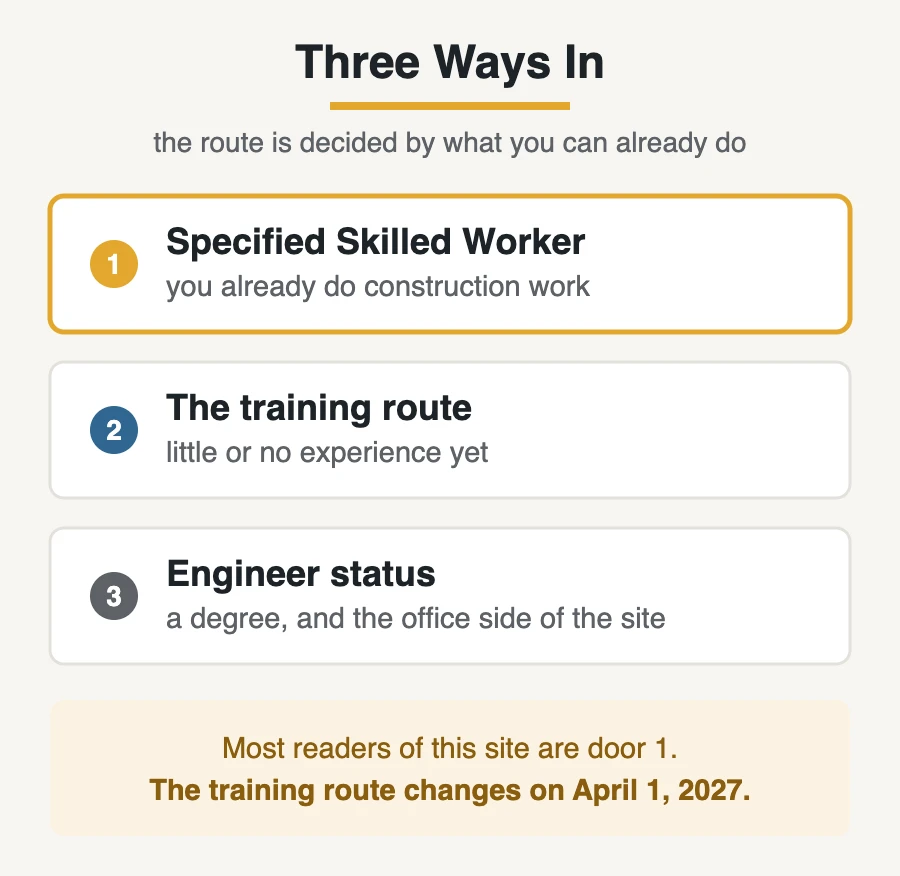
There are three realistic doors into construction work in Japan. They are not ranked, and they don’t lead to the same place.
Door 1: Specified Skilled Worker
This is the main door for someone who already works in construction and wants to come and do that same work here.
It’s a proper work status, not a training program. You’re an employee, you’re paid as an employee, and the law requires your pay to be at least equal to a Japanese worker with the same skills. (JAC, checked September 28, 2026)
To get it, you pass a skills test and a Japanese test. Chapters 2 and 3 are about this route, because it’s the one most readers of this site will be choosing.
Door 2: The training route
Japan has long had the Technical Intern Training Program — a program built around transferring skills rather than around employment. You may have heard of it, and you may have heard mixed things about it.
It’s being replaced. A new system called Employment for Skill Development (ikusei shūrō) was enacted on June 21, 2024 and takes effect on April 1, 2027. Its stated purpose is to develop workers over three years up to the level of Specified Skilled Worker (i) — in other words, it’s designed as a runway onto Door 1 rather than a separate destination. (Immigration Services Agency, checked September 28, 2026)
If you’re reading this before that date, the practical point is simple: the rules for this door are mid-change, so check the current official page rather than an article — including this one.
Door 3: The engineer’s door
If you have a university degree or equivalent experience in engineering, architecture, or a related field, there’s a separate status for professional and technical work. In construction, that’s the office side of the site — design, production drawings, BIM, planning, coordination.
It isn’t a “better” version of Door 1. It’s a different job. The person holding it usually isn’t the person on the scaffold.
Which door is yours
| If this is you | Your door |
|---|---|
| You already do hands-on construction work and want to keep doing it | Specified Skilled Worker |
| You’re starting from little or no construction experience | The training route (rules changing in 2027) |
| You have an engineering or architecture degree and want technical work | The engineer’s status |
The rest of this article follows the first row. If you’re in the third, you’ll still want chapters 5 and 6 — the company requirements and the daily reality are the same site either way.
What “Specified Skilled Worker” Means
It’s a status, not a rank
Tokutei Ginō — Specified Skilled Worker — is a residence status. It says what you’re allowed to do in Japan. It doesn’t say how good you are, and nobody on site will introduce you by it.
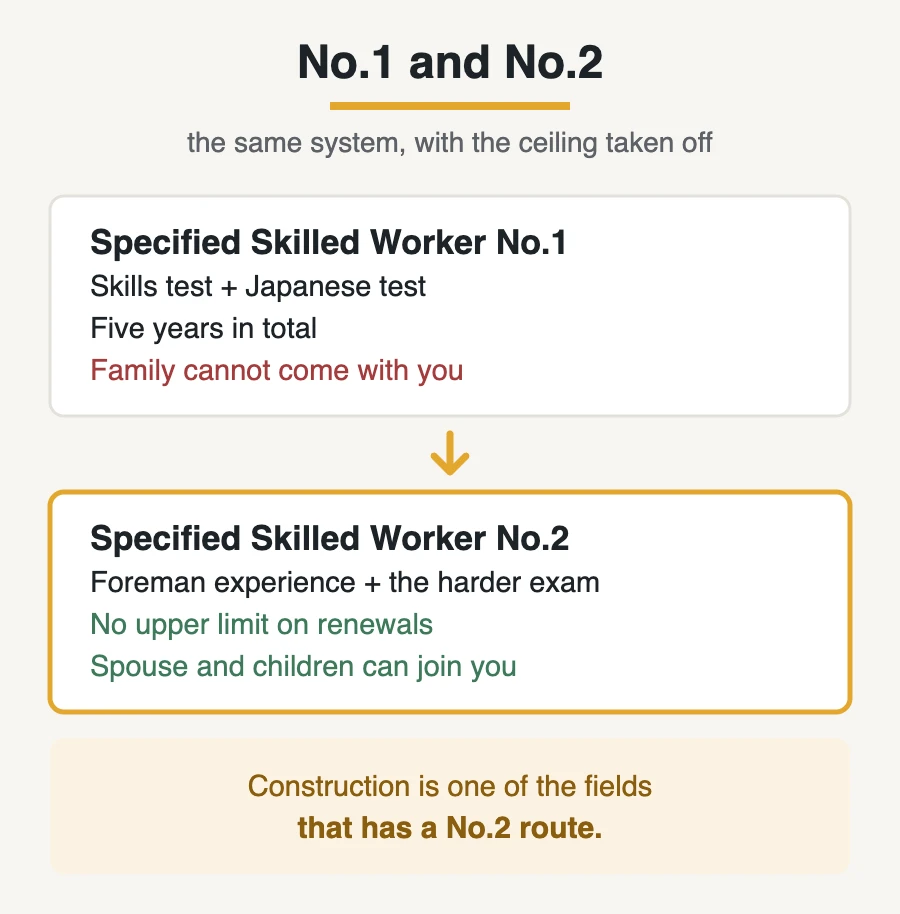
It comes in two versions, and the gap between them is the single most important thing on this page. One of them has a five-year ceiling. The other doesn’t.
No.1: five years, counted as a total
Specified Skilled Worker (i) is where almost everyone starts. You pass a skills test and a Japanese test, you get hired, you work.
Two things to understand before you plan around it:
The five years are cumulative. It isn’t five years per employer or five years per trip. It’s the total time you’re permitted to hold that status, added up. Going home for a year and coming back doesn’t reset the clock.
Your family can’t come with you on this status. A spouse and children can’t accompany you as dependents while you hold No.1. (Immigration Services Agency, checked September 28, 2026)
I want to be blunt about that second point, because it’s the one I’ve seen people discover late. If you have a family and you’re thinking in decades, No.1 on its own is not the plan. It’s the first half of the plan.
No.2: the half that changes things
Specified Skilled Worker (ii) is the same system with the ceiling taken off.
- There’s no upper limit on renewals. You can keep extending it.
- Your spouse and children can come with you as dependents.
What it asks for in return is real: practical experience as a team leader or foreman on site, plus the higher-level skills exam. Not just time served — experience running a crew. (JAC, checked September 28, 2026)
If you’ve read my article on shokunin and the trades, you’ll recognize the role. The shokuchō — the foreman who runs a crew and answers for its safety — is a recognized position on a Japanese site, with its own legally required training. No.2 is asking you to become that person.
Why construction is a good field to be in for this
Not every industry in the Specified Skilled Worker system has a No.2 route. Construction does, and it’s had one from early on.
That’s worth knowing when you compare offers across industries. In some fields, five years really is the ceiling. In construction, five years is a checkpoint.
The two side by side
| No.1 | No.2 | |
|---|---|---|
| How you qualify | Skills test + Japanese test | Foreman-level experience + higher skills exam |
| How long you can stay | Five years in total | No upper limit on renewals |
| Family with you | No | Spouse and children can come |
| What it’s for | Doing the work | Running the work |
The practical takeaway
Treat No.1 as a five-year window in which you are trying to become someone who qualifies for No.2. That reframes what you do with those years. It makes Japanese study, taking responsibility, and staying in one trade look less like effort and more like the actual job.
Chapter 7 comes back to this with the details. First, the tests.
The Two Tests You Need to Pass
Two tests, and they’re not the same kind of hard
For Specified Skilled Worker (i) in construction, you pass two separate tests: a skills test for the work, and a Japanese test for the language.
People tend to worry about the wrong one. Let’s take them in order.
Test 1: the construction skills evaluation exam
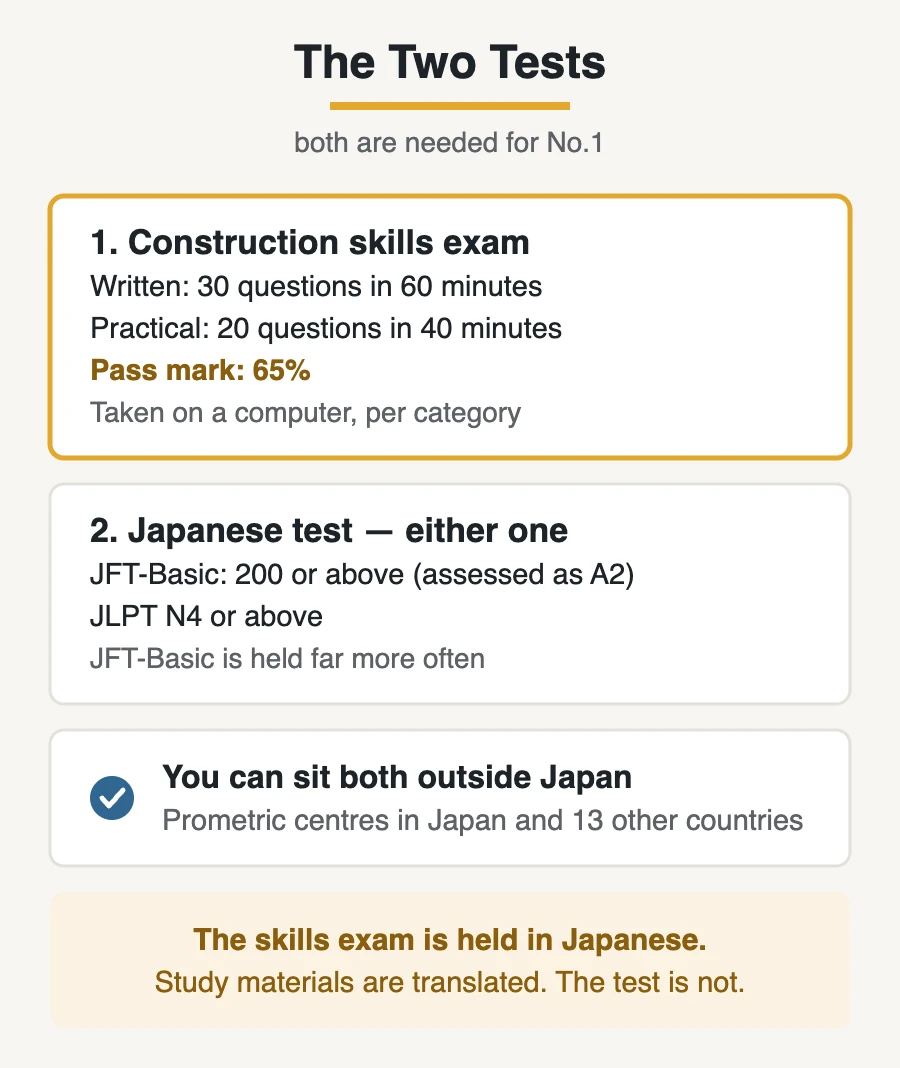
This is run by JAC, the industry body for construction, and it comes in two parts — both taken on a computer at a test center.
| Part | Questions | Time |
|---|---|---|
| Written | 30 | 60 minutes |
| Practical | 20 | 40 minutes |
You need 65% or more to pass the No.1 exam. (The No.2 exam, later in your career, is longer and needs 75%.) (JAC, checked September 28, 2026)
“Practical” here doesn’t mean you pick up a tool. It’s still on the screen — it tests whether you can read a situation and choose the right action, which is closer to the job than a pure memory test would be.
Where you can take it
You don’t have to already be in Japan. The exam is held at Prometric test centers in Japan and in Bangladesh, Cambodia, India, Indonesia, Mongolia, Myanmar, Nepal, Pakistan, the Philippines, Sri Lanka, Thailand, Uzbekistan, and Vietnam. (JAC, checked September 28, 2026)
The part that catches people out
The exam is conducted in Japanese. Study materials have been translated into several languages to help you prepare, but the test itself is not.
So the skills exam is also, quietly, a second Japanese exam. Plan your study that way and it stops being a surprise.
Test 2: the Japanese test
You have two accepted options.
JFT-Basic (the Japan Foundation Test for Basic Japanese). A computer-based test of about 50 questions in 60 minutes, scored from 10 to 250. A score of 200 or above is assessed as A2 — the everyday-conversation level the Specified Skilled Worker route is built around. (The Japan Foundation, checked September 28, 2026)
JLPT N4 or above. The official description of N4 is “the ability to understand basic Japanese” — reading familiar everyday topics in basic vocabulary and kanji, and following daily conversation when it’s spoken slowly. (JLPT, checked September 28, 2026)
Either one satisfies the requirement. JFT-Basic is held far more often, which usually decides it.
The shortcut
If you’ve completed Technical Intern Training (ii) in a related field, you’re exempt from both tests and can move to Specified Skilled Worker (i) directly. (JAC, checked September 28, 2026)
What the tests don’t measure
Here’s the thing I’d most want to tell you, and it isn’t on any syllabus.
The craftspeople you’ll actually work beside do not speak English. Not “a little” — none. And in my experience they won’t attempt it either, so there’s no meeting in the middle on the first day.
That sounds harsh. It’s really a scheduling problem. N4 gets you through the gate; it does not get you through a morning. What gets you through a morning is knowing the names of things — the materials, the tools, the parts of the structure — because if you don’t have the words, you can’t ask the question that would have taught you the answer. You end up unable to learn, which is a much worse place to be than unable to speak.
Two things follow from that, and I’d act on both:
- Start learning the vocabulary of your own trade before you arrive, not general Japanese alone. Fifty nouns you’ll hear every day beat five hundred you won’t.
- When you compare employers, weigh who actually trains you above almost everything else. A company that teaches you the words is handing you the ability to learn everything else on your own. Chapter 5 is about how to tell those companies apart — and it turns out the law gives you a checklist.
Which Category You’d Apply Under
Three categories, not thirty trades
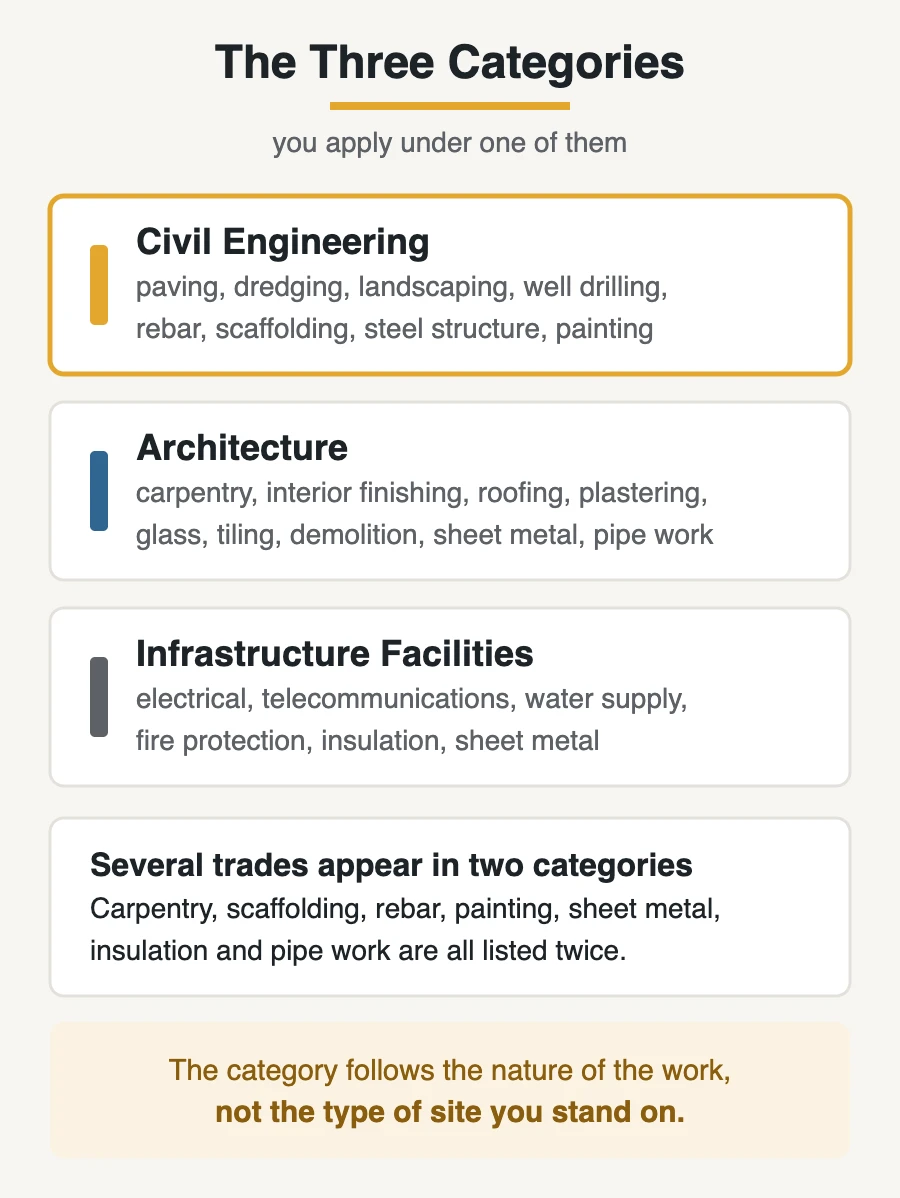
The construction field is divided into three categories, and you apply under one of them:
- Civil Engineering — roads, ground, water, outdoor infrastructure
- Architecture — buildings
- Infrastructure Facilities and Equipment — the systems that make a building work
Your trade sits inside one of these. The category is what appears on your status; the trade is what you actually do all day.
What’s inside each one
These are the work types JAC lists under each category. (JAC, checked September 28, 2026)
| Category | Work types include |
|---|---|
| Civil Engineering | Well drilling, paving, dredging, landscaping, carpentry, reinforcement (rebar), scaffolding, steel structure work, painting, waterproofing, masonry, machinery and equipment installation |
| Architecture | Carpentry, scaffolding, steel structure work, reinforcement, painting, waterproofing, masonry, machinery and equipment installation, interior finishing, fittings, plastering, roofing, glass work, tile and block work, demolition, sheet metal, thermal insulation, pipe work, sanitary facilities |
| Infrastructure Facilities and Equipment | Sheet metal, thermal insulation, pipe work, electrical work, telecommunications, water supply facilities, fire protection systems |
Read those columns again and you’ll notice something.
Several trades appear twice
Carpentry is in two categories. So are scaffolding, reinforcement, steel structure work, painting, waterproofing, masonry, sheet metal, thermal insulation, and pipe work.
That isn’t a mistake in the list. A carpenter on a bridge and a carpenter in an apartment building are doing recognisably different jobs with the same tools.
The rule that decides it
This is the sentence worth memorising, because it answers most of the questions people have here:
“The work classification for the status of residence is based on the nature of the work, not on the type of work site. If the work is included in the construction business that is approved for the status of residence, you can work regardless of the type of work site.” (JAC, checked September 28, 2026)
So the category follows what you’re doing, not where you’re standing. Once your work is covered by the approved category, the kind of site doesn’t restrict you.
Practically, that means you don’t need to worry that taking a job on a housing project has locked you out of infrastructure work forever. What you should actually check, carefully, is that the category you apply under matches the work you intend to spend years doing — because that’s the work your career, and later your No.2 application, will be built on.
Where this bites: the exam
The skills exam from chapter 3 is taken per category. Choosing a category isn’t only a paperwork decision — it decides which exam you sit.
So the order is: work out which category your trade belongs to, confirm it against the list above, and then look for the exam in that category. Doing it the other way around is how people end up studying for the wrong test.
A note if you’re a steel fixer
Reinforcement work — tying the rebar cages before concrete is poured — appears under both Civil Engineering and Architecture.
I mentioned in the opening that rebar crews are where I personally saw the biggest change on my sites. If that’s your trade, the practical consequence is that you have two doors rather than one, and the choice should follow the kind of structure you want to build: bridges and ground works, or buildings.
What the Company Has to Do (and Why You Should Care)
The chapter I’d read first
Everything so far has been about what you have to do. This chapter is about what the company has to do, and I’ve put it here on purpose.
Most guides treat this as back-office detail for employers. I think it’s the most useful thing on the page for an applicant, because it hands you something you otherwise wouldn’t have: a way to check, before you commit, whether a company is set up properly.
What a construction employer must have in place
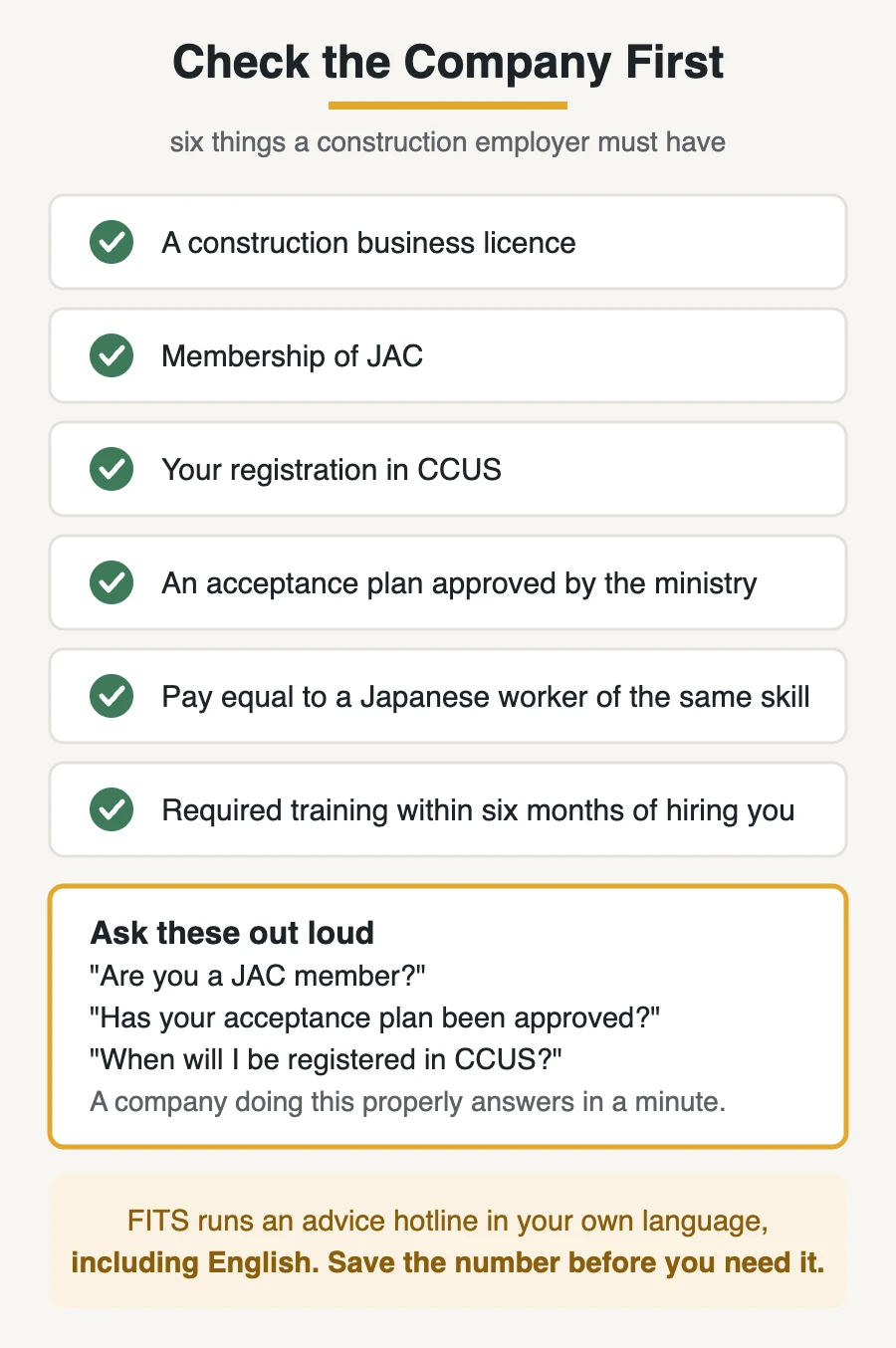
Before a company in construction can take you on as a Specified Skilled Worker, it has to:
- Hold a construction business licence.
- Belong to JAC — the industry body, joined directly or through an association. Membership is required before it can even apply.
- Register you in the Construction Career Up System (CCUS) — the national card that records who you are, what you’re qualified in, and every day you’ve worked.
- **Get an acceptance plan approved by the Ministry of Land, Infrastructure, Transport and Tourism.** This is specific to construction; most industries don’t have this extra step.
- Pay you at least the same as a Japanese worker with equivalent skills.
- Put you through the required training within six months of taking you on.
(JAC and the Ministry of Land, Infrastructure, Transport and Tourism, checked September 28, 2026)
Why this is your checklist, not theirs
Every item on that list is something a company either has or doesn’t. That makes it answerable.
You can ask, in an interview or through an agent:
- Are you a JAC member?
- Has your acceptance plan been approved?
- Will I be registered in CCUS, and when?
- What is the required training after I arrive, and who gives it?
A company doing this properly will answer these in a minute, because it has the paperwork sitting there. Hesitation on these questions is information.
And on wages, note the wording carefully: not “a fair wage,” not “the legal minimum,” but equal to a Japanese worker with equivalent skills. That’s a comparison you’re entitled to have made.
On CCUS, one extra reason to care
The card isn’t only administration. It accumulates a record of the days you’ve worked and the skills you hold, and that record is what your later career — your No.2 application, your move up the levels — is built on. I wrote about the card system and its levels in the shokunin article.
If a company is slow to register you, you’re not just missing paperwork. You’re working days that don’t count.
Someone independent is checking
Construction has a monitoring body called FITS (the Foundation for International Transfer of Skills and Knowledge in Construction). It makes patrol visits to accepting companies and runs the post-arrival training.
More importantly for you: it runs an advice hotline in your own language — Chinese, Vietnamese, Indonesian, Filipino, English, Khmer, and Burmese — by phone, fax, or email. (FITS, checked September 28, 2026)
Write that down before you need it, not after. The moment you need a hotline is rarely the moment you feel able to go looking for one.
What the checklist can’t tell you
Now the honest limit of all this.
Everything above is a floor. It tells you a company is legitimate. It doesn’t tell you whether the company is any good to work for, and those aren’t the same question.
Here’s what that looked like on my own sites. The new-entry safety briefing — the session every worker sits through before their first day — we had rewritten into English, Vietnamese, and Tagalog, because that was who was coming through the gate. Nobody made us produce a Tagalog version. We did it because the alternative was people nodding at a safety briefing they hadn’t understood.
That’s the kind of thing you can’t find in a certification. But you can ask about it. “What language will my safety induction be in?” is a small question that tells you a great deal about how much thought a company has given to people like you.
What the Work Is Actually Like
The shape of the day
If you get through all of the above, here’s what you’re actually signing up for.
A typical day on the sites I’ve run looks roughly like this: people arrive from about 7:00, the chōrei — the morning meeting — starts at 8:00, the craftspeople take a break at 10:00 and again at 15:00, the foremen meet around 11:30, lunch is at 12:00, and work finishes at 17:00.
Those two breaks have a name, ippuku, and they’re not optional extras that get skipped when things are busy. I’ve written the whole day out in detail in A Day on a Japanese Construction Site.
The parts that surprise people
Three things tend to catch newcomers, and none of them are about the physical work.
The morning meeting is a real event. Everyone on site, every day, standing in the same place at the same time.
KY comes before you touch anything. Kiken yochi — hazard prediction — is a short discussion of what could go wrong today, held in circles by company, so the group you stand in is your own crew. It isn’t paperwork you sign. Someone expects you to speak.
The instructions are written down. The work request sheet for the day exists before the day starts, and it exists because the alternative is people improvising near heavy machinery.
If any of that sounds unfamiliar, the safety rules article goes through the reasoning behind each one.
What you’ll wear and carry
You’ll be issued or expected to buy work clothing that looks different from what you may be used to, and a tool belt you’ll wear with your harness all day — the two go together here, and neither is optional while you’re working.
How we actually communicated
Back to the language problem from chapter 3, because I don’t want to leave it as a warning with no answer.
Two things worked on my sites.
A translation app, for direct instructions. Not elegant, and not something I’d rely on for anything safety-critical, but for “move this here, we’re pouring at two” it did the job. There’s no prize for struggling through in broken Japanese when a phone is right there.
Drawings and sketches, for everything else. This one is better than it sounds. I’d draw the detail — on the drawing itself, on a scrap of paper, whatever was to hand — and the conversation would simply move on. A sketch of a connection detail means the same thing in every language, and construction is one of the few industries where the shared professional vocabulary is genuinely visual.
If you take one practical habit from this article: learn to sketch what you mean. It’s faster to acquire than fluency and it works on your first day.
It isn’t the low-tech industry you might expect
One more thing worth saying, because the image of Japanese construction abroad tends to be either ancient carpentry or robots, with nothing in between.
Drawings on the sites I’ve worked on are increasingly produced in 3D, surveying is done by drone, and machine control is normal on earthworks. If you want to see what that actually looks like day to day:
None of that replaces the trades. It changes what the trades are handed in the morning.
The honest summary of this chapter
The work is structured, the days are long but bounded, the safety culture is strict, and the language will be the hardest part — not the job.
That last sentence is the one I’d want you to carry into the next chapter, because it’s also what decides whether you’re still here in six years.
Going Beyond Five Years
What No.2 actually asks for
Two things, and only one of them is a test.
The exam. The No.2 evaluation exam is longer and stricter than the one you took to get in: 40 written questions in 60 minutes, 25 practical questions in 40 minutes, and you need 75% rather than 65%.
The experience. You need a period of practical experience — JAC gives it as six months to three years, as specified by the Ministry of Land, Infrastructure, Transport and Tourism — working as a team leader or foreman. (JAC, checked September 28, 2026)
JAC also refers to the national Level 1 trade skills test in connection with No.2. If you already hold that qualification, it’s worth asking the ministry or JAC directly how it applies to you rather than assuming either way.
The requirement you can’t study for
Notice the asymmetry. You can prepare for the exam in the evenings. You cannot prepare for the second requirement at all — someone has to give you the role.
That reframes the whole five years, and it’s why chapter 5 mattered. The question to ask an employer isn’t only “is your paperwork in order?” It’s:
Do people in my position here ever end up leading a crew?
If the honest answer is no, that company is a five-year job, however good it is in other respects. You’d want to know that in year one, not in year four.
If you don’t pass the first time
There’s a provision here that isn’t widely known, and it’s new enough that older guides won’t mention it.
If you sit the No.2 exam and fail, but you scored 80% or more of the passing standard, and there’s a reason recognised as sufficient for staying beyond five years, your period of stay can be extended to a total of six years. It applies to exams taken on or after December 1, 2025. (JAC, checked September 28, 2026)
That’s a near miss turned into another year to try again, rather than a flight home. Worth knowing before you sit the exam, not after — and worth checking the current conditions with the Immigration Services Agency when the time comes, because provisions like this do change.
What separated the people who stayed
I’ve watched a fair number of foreign workers come through my sites. Some went home after their time was up. Some are still here.
The difference, honestly, was not skill. The people who stayed had a different level of Japanese comprehension than the people who didn’t. Not perfect Japanese — but they understood what was being said around them, including the half of it that wasn’t addressed to them.
For a long time I filed that away as an interesting observation. Writing this chapter, I realise it’s not an observation at all. It’s the requirement, showing up in real life.
Because think about what being a shokuchō involves. You take the day’s instructions and turn them into work for your crew. You run the KY discussion. You’re the person who says “stop” when something’s wrong, and you have to say it fast enough to matter. None of that is possible in a language you only half follow.
So the two requirements for No.2 aren’t really separate. The experience requirement is a language requirement wearing work clothes.
What that means for your first year
If you want the long version of this career, the useful thing to do in year one isn’t to work harder than everyone else. It’s to:
- Study Japanese continuously, not until you pass N4 and then stop
- Say things in meetings, badly, early, while the stakes are low
- Tell your employer you want to lead a crew eventually — so that when the chance comes up, your name is already attached to it in someone’s head
- Keep your CCUS record current, because that’s the evidence your experience actually happened
None of that is dramatic. It’s just aimed at the right target, which is more than most people manage in five years.
Questions People Actually Ask
Do I need to speak Japanese before I arrive?
Yes. You need either JFT-Basic at A2 or JLPT N4, and you’ll need it to apply — it isn’t something you pick up after you land.
But treat that as the floor, not the goal. As I said in chapter 3, N4 gets you through the gate. Knowing the names of the things in your own trade is what gets you through a working day.
Can I bring my family?
Not on Specified Skilled Worker (i). On No.2, yes.
The Immigration Services Agency puts it plainly: family accompaniment is permitted under No.2 but not under No.1. (Immigration Services Agency, checked September 28, 2026)
If bringing your family is the point of the whole plan, then chapter 7 is really the chapter about your family, not about your career.
Can I change employers?
Yes, but not freely and not instantly.
You can move within the same work category, or between categories whose skill level has been confirmed as common by the tests. And changing employer requires an application to change your residence status — it isn’t something you and your new company can simply agree between yourselves. (Immigration Services Agency, checked September 28, 2026)
The practical reading: you are not trapped, which matters if a job turns out to be wrong. But you also can’t treat a bad first choice as costless. Do the chapter 5 checks before you sign, not after.
Is there an age limit?
You must be 18 or over. (Immigration Services Agency, checked September 28, 2026)
There’s no upper limit stated. Construction is physical work, and you should be honest with yourself about that, but the rule itself is a floor rather than a window.
Do I have to be in Japan to take the exam?
No. The construction skills exam is held at Prometric test centers in Japan and in thirteen other countries, listed in chapter 3.
I’ve done Technical Intern Training. Do I still need the tests?
No. Completing Technical Intern Training (ii) in a related field exempts you from both the skills test and the Japanese test, and you can move to Specified Skilled Worker (i) directly. (JAC, checked September 28, 2026)
Can I switch to a different trade once I’m here?
Carefully, and not as a casual decision.
The skills exam is taken per category, so moving into work that sits in a different category is a bigger step than moving between sites. Chapter 4 explains how the categories are drawn — and remember that quite a few trades appear in more than one.
Where do I even start looking for an employer?
Two official places rather than the open internet.
JAC is the industry body every accepting company has to belong to, and it runs the exams. FITS — the monitoring body from chapter 5 — lists a free job introduction service alongside its hotline. (FITS, checked September 28, 2026)
Starting from the official side has a useful side effect: everyone you meet there is already inside the system that chapter 5 describes.
Is the work dangerous?
Construction is a hazardous industry anywhere. What’s different in Japan is how much structure is built around that fact — the daily hazard-prediction discussion, the harness rules, the induction before your first day.
I’ve written about all of it in the safety rules article. The short version: the rules will feel strict, and the reason they feel strict is that they were written after something went wrong.
Summary: What I’d Actually Do
The route in one page
If you already work in construction and you want to work in Japan, the path is this:
- Work out your category — Civil Engineering, Architecture, or Infrastructure Facilities and Equipment. Your trade may appear in more than one, and the category decides which exam you sit.
- Pass the two tests — the construction skills exam for that category, and JFT-Basic or JLPT N4. You can sit both outside Japan.
- Check the company before you sign — JAC membership, an approved acceptance plan, CCUS registration, equal pay, the required training. Any legitimate employer can answer these in a minute.
- Treat your first five years as preparation for the next thirty — because No.2, with no renewal limit and your family able to join you, is the part of this system that changes a life rather than a year.
The one thing I’d choose on
If I could give you one filter to apply to every job offer you receive, it wouldn’t be the wage.
Pick the company that will teach you.
The craftspeople you work beside won’t speak English and won’t try. That isn’t rudeness — it’s simply a site where everything runs in Japanese, at speed, between people who’ve known each other for years. If you arrive without the words for the things in front of you, the ordinary way of learning on a site, which is asking, is closed to you. You can be a skilled worker and still be stuck.
A company that puts real effort into teaching you — the vocabulary, the procedures, the induction in a language you actually read — isn’t being generous. It’s handing you the tool that makes every other tool work. On my own sites, the briefing materials in English, Vietnamese, and Tagalog weren’t charity either. They were how we got people to a point where they could learn from the work.
Wages you can renegotiate. Five years of not being able to ask questions, you can’t get back.
Where to go next
If you want to know what you’d actually be walking into:
- A Day on a Japanese Construction Site — the hours, the meetings, the breaks
- Safety Rules on Japanese Construction Sites — what you’ll be asked to do, and why
- Shokunin: Who’s Who on a Japanese Site — the trades, the ranks, and the foreman role No.2 asks you to reach
And the two official starting points, both with English pages: JAC for the exams, and FITS for advice in your own language.
One last note
Everything in this article was checked against official sources on September 28, 2026, and the dates and links are in the text so you can check them yourself.
Immigration rules change. The training route changes in April 2027. If you’re reading this a year from now, use this article for the shape of the thing and the official pages for the details.
Good luck. I hope I see you at a chōrei one morning.
The next step after this one: Japanese Construction Terms: The Words You’ll Hear on Site — the names of the things I said you’d need, and how to ask when you don’t follow.
Before you sign, look up the number: Construction Wages in Japan: Look Up Your Own Trade — the official rate for your trade, what it leaves out, and the five questions to ask about pay.