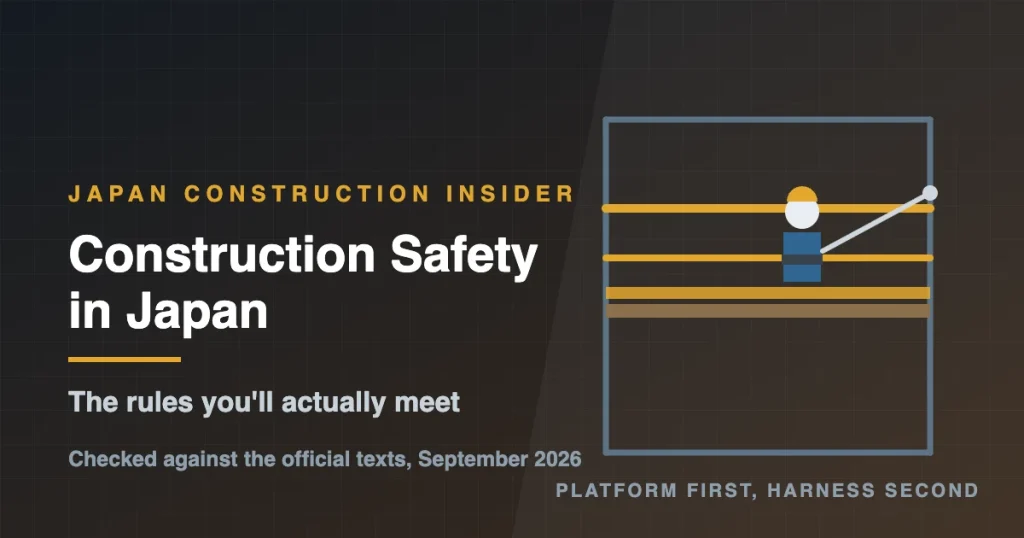
Construction Safety in Japan: The Rules You’ll Actually Meet
The short version
- One company answers for the whole site. The principal employer appoints an overall safety and health controller and must patrol at least once every working day.
- You prepare before you arrive: the new entrant induction, the right Japanese qualification for the work, and the certificate in your pocket.
- At 2 metres or more the first answer is a work platform. Nets and fall arrest equipment are the fallback, not the plan.
- Scaffolds are checked before work each day, and again after bad weather or an earthquake, with the result recorded and kept.
- Since June 1, 2025, heatstroke prevention is a legal duty, not good practice.
Hi there, I’m Shirokuma!
People who visit a Japanese construction site usually describe it the same way: strict.
Helmets and harnesses without exception. An induction before you’re allowed through the gate. Someone walking around all day checking. It can look like excessive caution from the outside.
It isn’t caution, though. Most of it is law, and the rest follows from how Japanese sites are organized — a lot of separate companies working in one space, with one company answerable for all of them.
In this article, you’ll learn:
- Who is legally responsible for safety on a Japanese site, and why that shapes everything else
- The rules you’d actually meet, from the gate to working at height
- The newest one: heatstroke measures became a legal duty in June 2025
I spent years as the person enforcing these rules, which also means I was the person who had to tell people they were doing something unsafe. I’ll be honest about that part too.
About this article. Everything here was checked against the official texts on September 20, 2026. Laws change, so use this as an introduction and check the current text before you rely on it. Links to the official sources are included throughout.
Who Is Responsible for Safety
The structure that explains everything
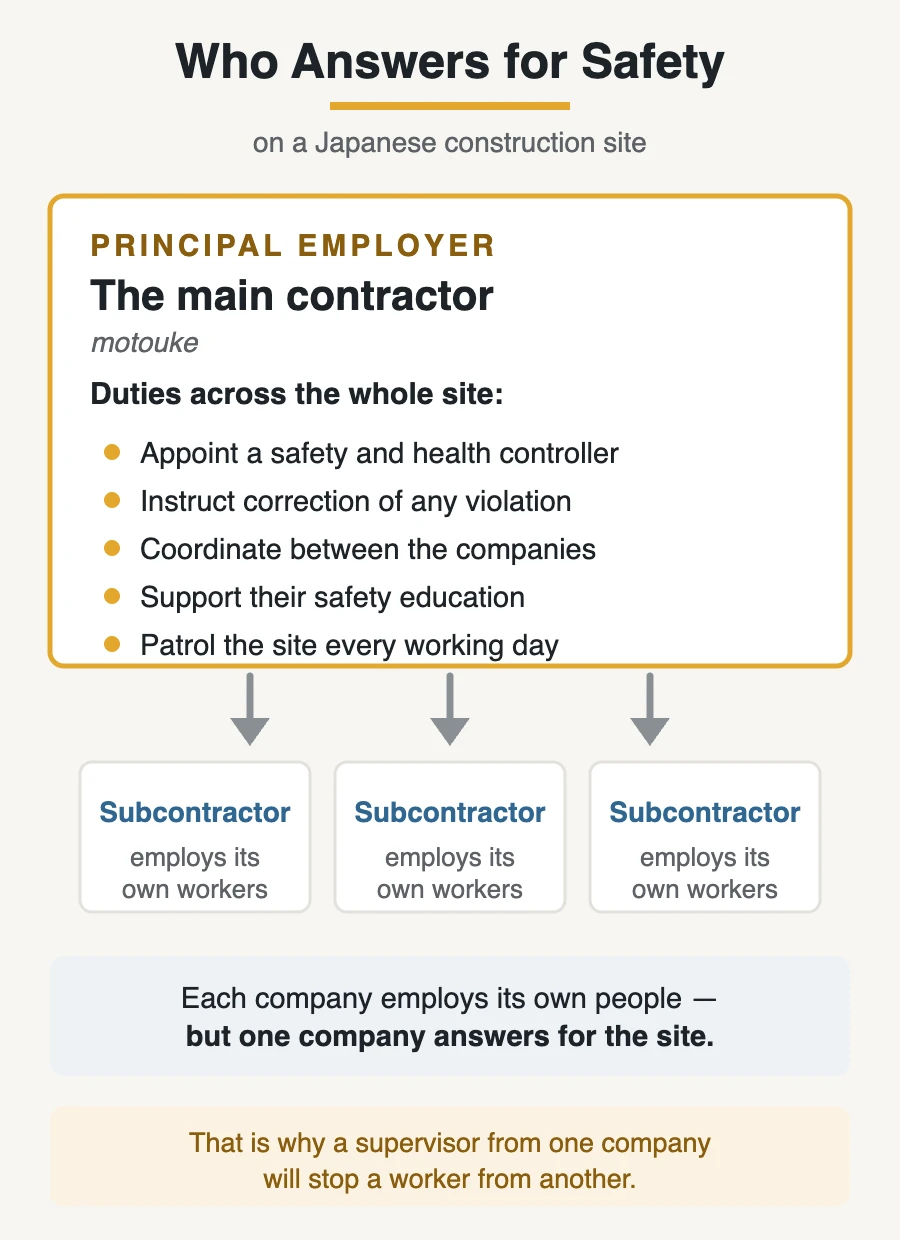
A Japanese construction site is not one company. It’s a main contractor — motouke, the general contractor — plus a chain of subcontractors, each with their own workers, all working in the same space on the same day.
Japanese law deals with that by making the company at the top responsible for what happens across the whole site. Not just for its own employees.
What the law actually requires
Three articles of the Industrial Safety and Health Act do most of the work here.
Article 15 requires the principal employer on a construction site — where its own workers and subcontractors’ workers are working at the same place — to appoint an overall safety and health controller for that site.
Article 29 is the one I’d point at if you only read one. It requires the principal employer to give subcontractors and their workers the guidance they need to avoid breaking the law. If it sees a violation, it must instruct them to correct it — and the subcontractor must follow that instruction.
Article 30 lists what the principal employer has to actually do to prevent accidents arising from everyone working in one place, including:
- Setting up and running a body where the companies meet and consult
- Liaison and coordination between the different work activities
- Patrolling the work area
- Guidance and support for the subcontractors’ own safety education
- Planning the work schedule and the layout of machinery and equipment
Source: Industrial Safety and Health Act, Articles 15, 29 and 30 (e-Gov, in Japanese), checked September 20, 2026
Why that makes the site feel strict
Read that list again and you’ll recognize the day I described in my article on a day on a Japanese construction site. The morning meeting, the foremen’s meeting, the supervisor walking the site — those aren’t habits someone invented. They’re how a contractor meets duties that are written down.
It also explains something visitors find odd: why a supervisor from one company will stop a worker from a completely different company. In many countries that would be overstepping. Here, saying nothing is the thing that’s out of line.
The uncomfortable part of the job
Here’s the honest version of what that means day to day.
You have to say something. Some people listen immediately. Some don’t. Telling an experienced tradesperson — often older than you, often better at their craft than you’ll ever be — that what they’re doing is unsafe is genuinely uncomfortable. You do it anyway, because the alternative is worse for everyone, including them.
And you can’t be the exception. The moment I take a shortcut — cross a barrier, skip a harness, stand somewhere I’ve told other people not to stand — every instruction I’ve given that month is worth nothing.
That’s the part people don’t expect about the role. The rules are not something you apply to other people. You are being watched, every day, by everyone you have ever corrected.
Before You Set Foot on Site
You don’t simply arrive at a Japanese site and start working. Several things have to happen first.
The new entrant induction
Anyone entering a site for the first time goes through an induction — shinki nyūjōsha kyōiku, new entrant education. It usually covers the layout, the hazards specific to this site, the rules, the emergency procedure, and who to report to.
The legal backbone is in two places. Employers must give workers safety and health education when they hire them and when their work changes, and special education for dangerous or harmful work (Article 59). Separately, the principal employer must guide and support the subcontractors’ education, which the Ordinance spells out as providing the place and the materials for it (Article 638).
Source: Industrial Safety and Health Act, Article 59 and Ordinance on Industrial Safety and Health, Article 638 (e-Gov, in Japanese), checked September 20, 2026
In practice: expect paperwork, expect a briefing, and expect it to take real time on your first morning. Build it into your plan rather than turning up at 7:55.
Qualifications, and carrying them
A lot of work in Japan can only be done by someone holding a specific qualification — a licence issued by the prefectural labour bureau, or completion of a registered skill training course.
Two details that catch people out:
- Someone without the qualification is not allowed to do that work at all.
- A qualified person must carry the licence or certificate while doing the work.
Source: Industrial Safety and Health Act, Article 61 (e-Gov, in Japanese), checked September 20, 2026
So “I’m trained, my certificate is at the office” isn’t a position you want to be in when the site does a check.
Foremen get their own training
If you’re going to directly instruct or supervise workers, there’s a separate education requirement for that role — covering things like how to decide work methods and assign people, and how to instruct and supervise them (Article 60).
That’s worth knowing if you’re joining a Japanese company in a leading role. The step up isn’t only a title.
And the daily patrol you’ll meet
One more thing about the principal employer’s duties, because you will definitely encounter it.
The Ordinance requires the site patrol under Article 30 to be carried out at least once every working day — and subcontractors are specifically forbidden from refusing, obstructing, or evading it.
Source: Ordinance on Industrial Safety and Health, Article 637 (e-Gov, in Japanese), checked September 20, 2026
That’s the legal basis for the person walking around your work area with a clipboard. They’re not being suspicious of you personally. They are required to be there, every single day.
What You Have to Wear
The basics you’ll see on everyone
Helmet, safety footwear, long sleeves, and the site’s required high-visibility or company clothing. On the sites I worked on, nobody passes the gate without the first two, visitors included.
Some of that is specific legal requirement for specific work, and some is site rule on top of it. In practice the distinction rarely comes up, because the site rule is stricter and it’s the one being enforced in front of you.
If you’re curious about the clothing itself — the baggy trousers, the split-toe boots, the fan jackets — I wrote about that in Japanese Construction Workwear.
Fall protection: the rule that shapes the site
This is the big one, and it’s worth understanding properly because it explains a lot of what a Japanese site looks like.
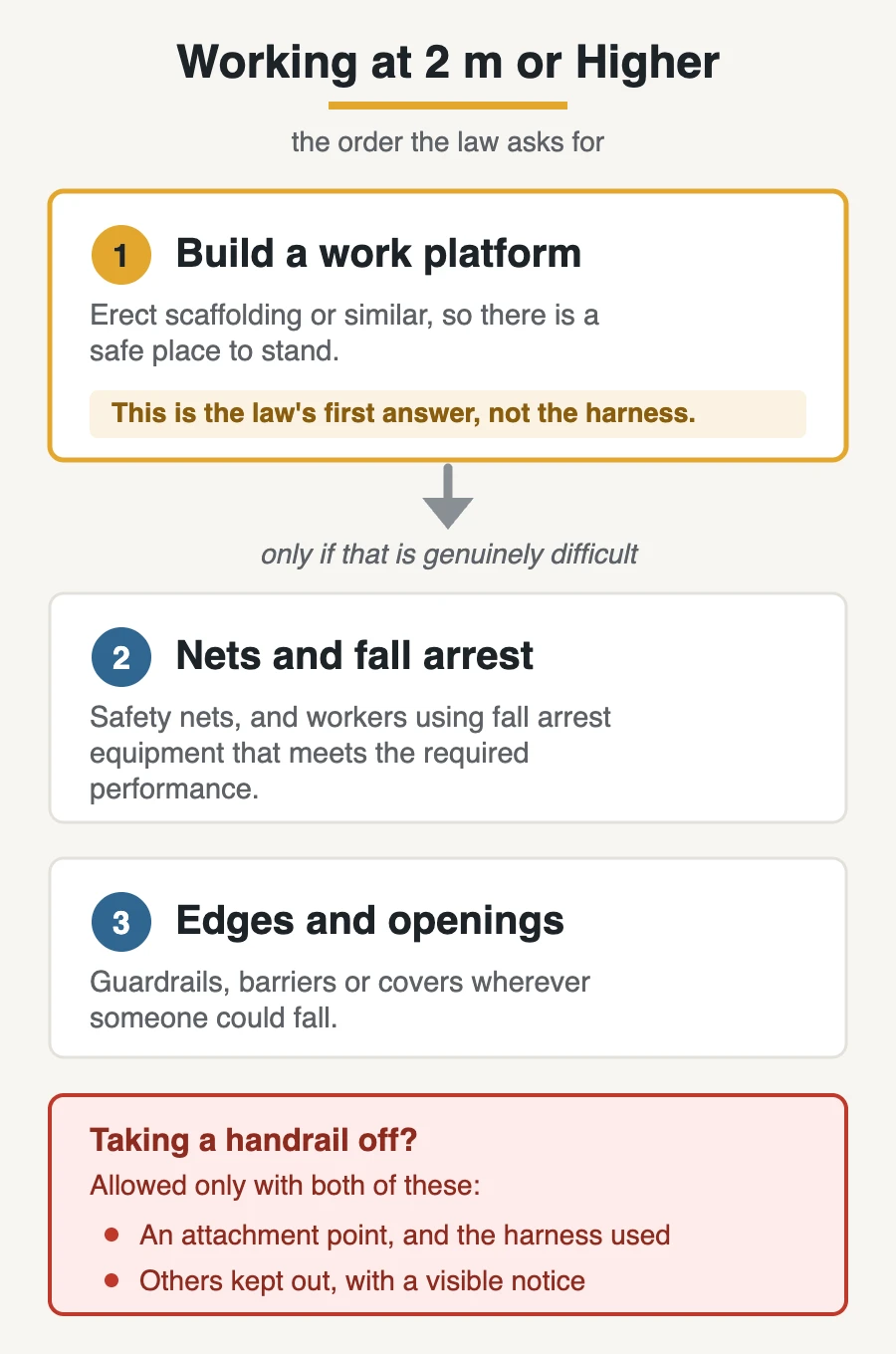
At heights of 2 metres or more, where a worker could fall and be injured, the employer must provide a work platform — by erecting scaffolding, for example.
If that’s genuinely difficult, then the employer must take other measures instead: safety nets, and having workers use fall arrest equipment that meets the required performance.
And at the edges and openings of a work platform 2 metres or more up, there must be guardrails, barriers or covers. If those are extremely difficult to fit, or have to be removed temporarily for the work, it’s back to nets plus fall arrest equipment.
Source: Ordinance on Industrial Safety and Health, Articles 518 and 519 (e-Gov, in Japanese), checked September 20, 2026
Notice the order. The law’s first answer is build a safe place to stand. The harness is what you do when that isn’t possible — not the default solution.
That’s why Japanese sites are full of scaffolding, handrails and covers over openings, and why removing a handrail “just for a minute” is treated as a real event rather than a convenience.
Full harness, and the training that comes with it
For work at 2 metres or more where a work platform is difficult to provide, using a full-harness type fall arrest device is work that requires special education — a defined training course, not an informal briefing.
Source: Ordinance on Industrial Safety and Health, Article 36, item 41 (e-Gov, in Japanese), checked September 20, 2026
Scaffolding work has its own special education requirement too: assembling, dismantling or altering scaffolding is on the same list (item 39).
So if you’re coming from abroad and you own a harness, owning it isn’t the qualification. The training is.
Why the harness and the tool belt go together
One practical note that connects to another article.
Your harness and your tool belt are worn as one setup, and both have to work while you move. I wrote about how that’s arranged, and about keeping tools from falling, in Japanese Tool Belt.
The short version: the harness is there to catch you. Nothing is there to catch your tools unless you arrange it yourself.
Working at Height
Falls are the reason for a large part of the rulebook, so the details here are specific. These are the ones you’d actually notice.
The scaffold platform itself
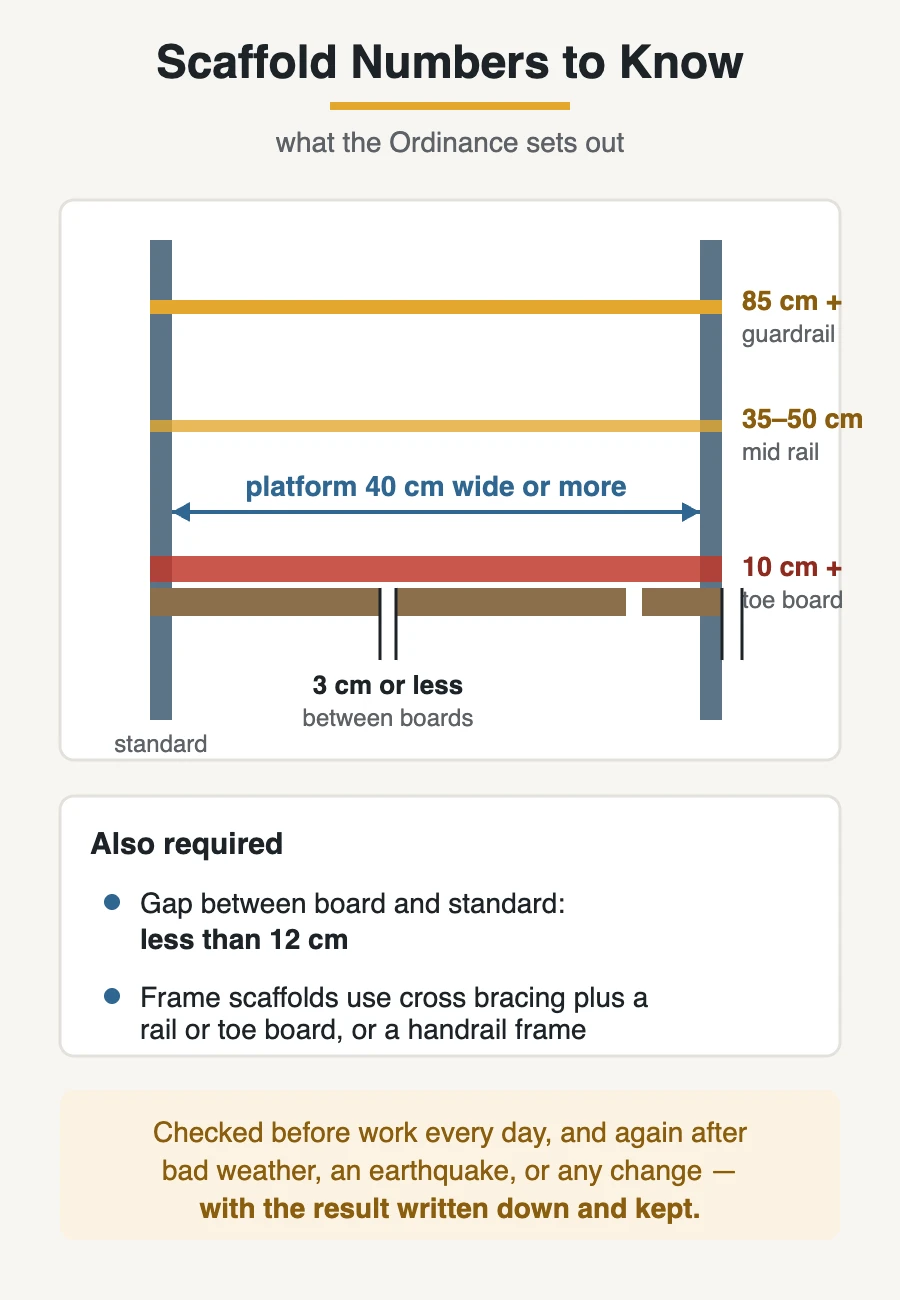
Where a scaffold has a work platform (other than a suspended scaffold), the Ordinance sets dimensions:
- The platform must be 40 cm wide or more
- Gaps between floor boards must be 3 cm or less
- The gap between the floor boards and the standards (uprights) must be **less than 12 cm**
Where someone could fall, the platform needs fall-prevention equipment — for frame scaffolds, cross bracing plus a rail 15–40 cm high or a toe board at least 15 cm high, or a handrail frame; for other scaffolds, a guardrail plus an intermediate rail.
And where objects could fall on people, toe boards at least 10 cm high, mesh sheets or safety nets (or equivalent), with limited exceptions.
Source: Ordinance on Industrial Safety and Health, Article 563 (e-Gov, in Japanese), checked September 20, 2026
Access routes
Temporary access routes have their own rules:
- Slope of 30 degrees or less (unless it’s stairs, or under 2 m with a sturdy handhold)
- Over 15 degrees, cleats or other anti-slip measures
- Where there’s a fall risk: a guardrail 85 cm or higher, plus an intermediate rail between 35 and 50 cm
- Ramps of 8 m or more used in construction work need a landing every 7 m
Source: Ordinance on Industrial Safety and Health, Article 552 (e-Gov, in Japanese), checked September 20, 2026
Taking a handrail off
This is the detail I’d most want a visitor to understand, because it’s where sites in different countries diverge most.
If the work genuinely requires the guardrail or intermediate rail to be removed temporarily, the exemption only applies when both of these are done:
- Equipment is provided to safely attach fall arrest devices, and workers actually use them (or an equally effective measure is taken)
- Everyone not involved in that work is prohibited from entering, with a notice displayed where it can be seen, or by another method
So removing a handrail isn’t a decision one person makes and quietly reverses later. It comes with an attachment point, a used harness, a barrier and a sign.
Source: Ordinance on Industrial Safety and Health, Article 552, paragraph 2 (e-Gov, in Japanese), checked September 20, 2026
Scaffold inspections
Two layers, and both show up in daily life on site.
Before work starts each day, the employer must name an inspector to check whether the scaffold’s fall-prevention equipment has been removed or has come off, and repair anything wrong immediately.
After bad weather — strong wind, heavy rain, heavy snow — or an earthquake of medium intensity or above, or after the scaffold has been assembled, partly dismantled or altered, a fuller inspection is required before work: floor boards, connections, fittings, toe boards, settlement and sliding of the base, bracing, damage to members, and so on. The result, the inspector’s name, and any repairs must be recorded and kept until the work using that scaffold is finished.
Source: Ordinance on Industrial Safety and Health, Article 567 (e-Gov, in Japanese), checked September 20, 2026
If you’ve ever wondered why the morning after a typhoon is slow on a Japanese site, this is why. Nobody is being cautious for the sake of it — the inspection is required before work restarts.
Heat: The Newest Rule
If you take one current thing from this article, take this one. It changed recently, and a lot of English-language material hasn’t caught up.
What changed
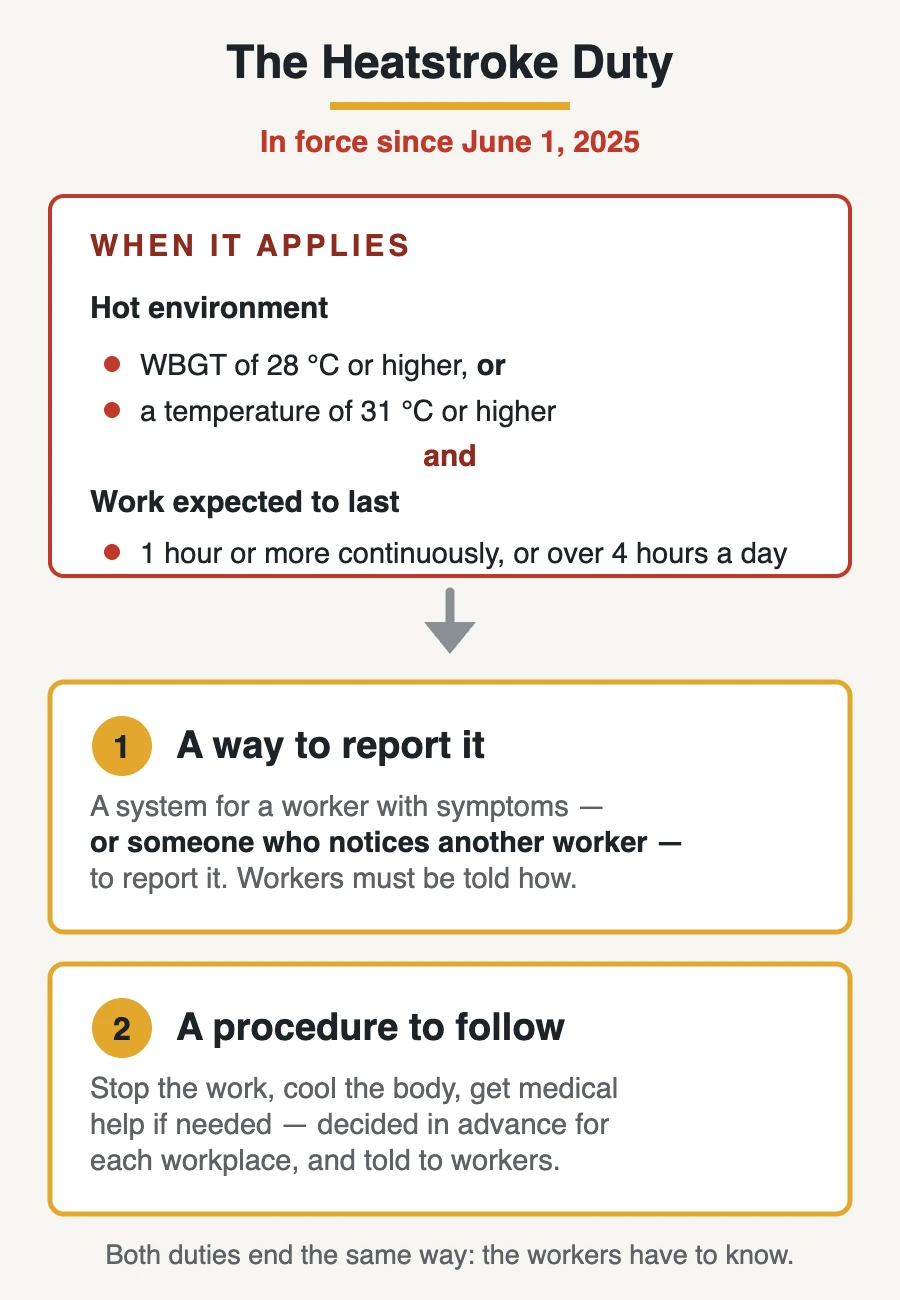
An amendment to the Ordinance on Industrial Safety and Health came into effect on June 1, 2025, turning workplace heatstroke measures into a legal duty.
Japan’s summers are genuinely dangerous for outdoor work, and construction is one of the most affected industries. The ministry’s own framing is that most fatal cases come down to early symptoms being missed, or the response coming too late — so the new duties are aimed squarely at those two failures.
Which work it applies to
According to the ministry’s guidance, the measures apply to work expected to be carried out:
- continuously for 1 hour or more, or
- for more than 4 hours in a day
in an environment with a WBGT of 28°C or higher, or a temperature of 31°C or higher.
Source: Ministry of Health, Labour and Welfare, “Strengthening of Measures against Heatstroke in the Workplace” (leaflet, in English), checked September 20, 2026
WBGT is the “wet bulb globe temperature” — a heat index that accounts for humidity, radiant heat and air movement, not just air temperature. On a Japanese site in August, you’ll see it posted somewhere near the gate.
What employers must actually do
The new article of the Ordinance sets out two duties, and both end with telling the workers about it.
1. A system for reporting. Before the work starts, the employer must set up a system so that a worker who has symptoms of heatstroke — or who finds another worker they suspect has heatstroke — can report it. Workers must be told how that system works.
2. Procedures for stopping it getting worse. Again in advance, and for each workplace, the employer must decide the measures and the procedure for carrying them out: removing the person from the work, cooling their body, and arranging medical examination or treatment where necessary. Workers must be told those procedures too.
Source: Ordinance on Industrial Safety and Health, Article 612-2 (e-Gov, in Japanese), checked September 20, 2026
Why the “report someone else” part matters
Read duty 1 again: it covers the worker who notices someone else in trouble.
That’s the part I’d underline. Heatstroke makes people poor judges of their own condition — the person who most needs to stop is often the last to say so. Making “I think he’s not right” a reportable thing, with a route to report it, is aimed exactly at that.
What it looks like on site
In practice you’ll see some combination of: WBGT posted daily, water and salt tablets available, a shaded or air-conditioned rest space, work rescheduled to the cooler hours, fan jackets and cooling vests, and a named person to tell.
Also more breaks. The 10:00 and 15:00 breaks I described in a day on a Japanese construction site are the baseline. In real heat, sites add to them.
If you work through a Japanese summer, take this seriously. The heat here combines high temperature with high humidity, which is worse than the number alone suggests. Drink before you’re thirsty, and tell someone the moment you feel wrong — reporting it is exactly what the system is designed for.
The Daily Controls
These are the ones you meet constantly — the small controls that shape how people move around a site.
Keeping people away from machines
Where construction machinery is operating, the employer must prohibit workers from entering any area where contact with the moving machine could be dangerous, with a notice displayed where it can be seen or by another method.
There’s one exception, and it’s specific: it doesn’t apply when a guide is posted to direct the machine. In that case the operator must follow the guide’s direction, and where a guide is posted, set signals must be decided and used — with the operator required to follow them.
Source: Ordinance on Industrial Safety and Health, Articles 158 and 159 (e-Gov, in Japanese), checked September 20, 2026
This is why an excavator working near people on a Japanese site usually has someone standing with it whose only job is directing. That person isn’t spare labour. They’re the legal condition that allows the work to happen at all.
Leaving the cab
When an operator leaves the operating position, they must lower the bucket or other working device to the ground, and stop the engine and apply the brake or otherwise prevent the machine running away. The duty is written twice — once on the employer to have it done, once on the operator to do it.
Source: Ordinance on Industrial Safety and Health, Article 160 (e-Gov, in Japanese), checked September 20, 2026
Exclusion zones in general
You’ll see a lot of rope, cones, tape and signs. The pattern repeats across the rules: where a hazard can’t be removed, the answer is to keep people out of the area and say so visibly.
Two you’ll meet often: not standing under a suspended load, and not entering the area below overhead work. If you see a barrier with a sign on a Japanese site, treat it as a rule rather than a suggestion — someone wrote it because a specific regulation required them to.
Permits, before certain work
Beyond the Ordinance, most sites run their own permit system for work that is hazardous or affects everyone else: hot works, work on live electrical installations, lifting operations, entry into confined spaces, work outside normal hours.
These aren’t universal law — they’re the site’s own control, agreed at the foremen’s meeting and written into the day’s work request sheets. Ask before you assume something is allowed.
And the qualification check
Machinery work, lifting, and many other tasks can only be done by someone with the right licence or completed skill training, who is carrying the certificate (chapter 2).
In practice this is checked. If your certificate is in a drawer at home, expect to be told to stop — not because anyone doubts you, but because the person telling you is under a legal duty to correct what they’ve seen.
When Something Goes Wrong
The first minutes
The response is the same anywhere: look after the person, make the area safe so nobody else gets hurt, call for help, and tell the site management immediately.
What’s specific to Japan is how fast the second part happens. Work in the affected area stops, and it usually doesn’t restart that day. Nobody has to approve that decision in advance — it’s the expected response.
Reporting is a legal duty, not a company decision
Two separate reporting duties sit in the Ordinance.
Accidents involving certain equipment or structures. Fires and explosions, the collapse of a building or structure, a crane overturning or dropping its load, a wire rope or chain breaking, and similar events must be reported without delay to the head of the competent Labour Standards Inspection Office.
Injuries to workers. Where a worker dies or has to take time off work because of a work injury, the employer must report it without delay, through the electronic reporting system, to the same office.
Source: Ordinance on Industrial Safety and Health, Articles 96 and 97 (e-Gov, in Japanese), checked September 20, 2026
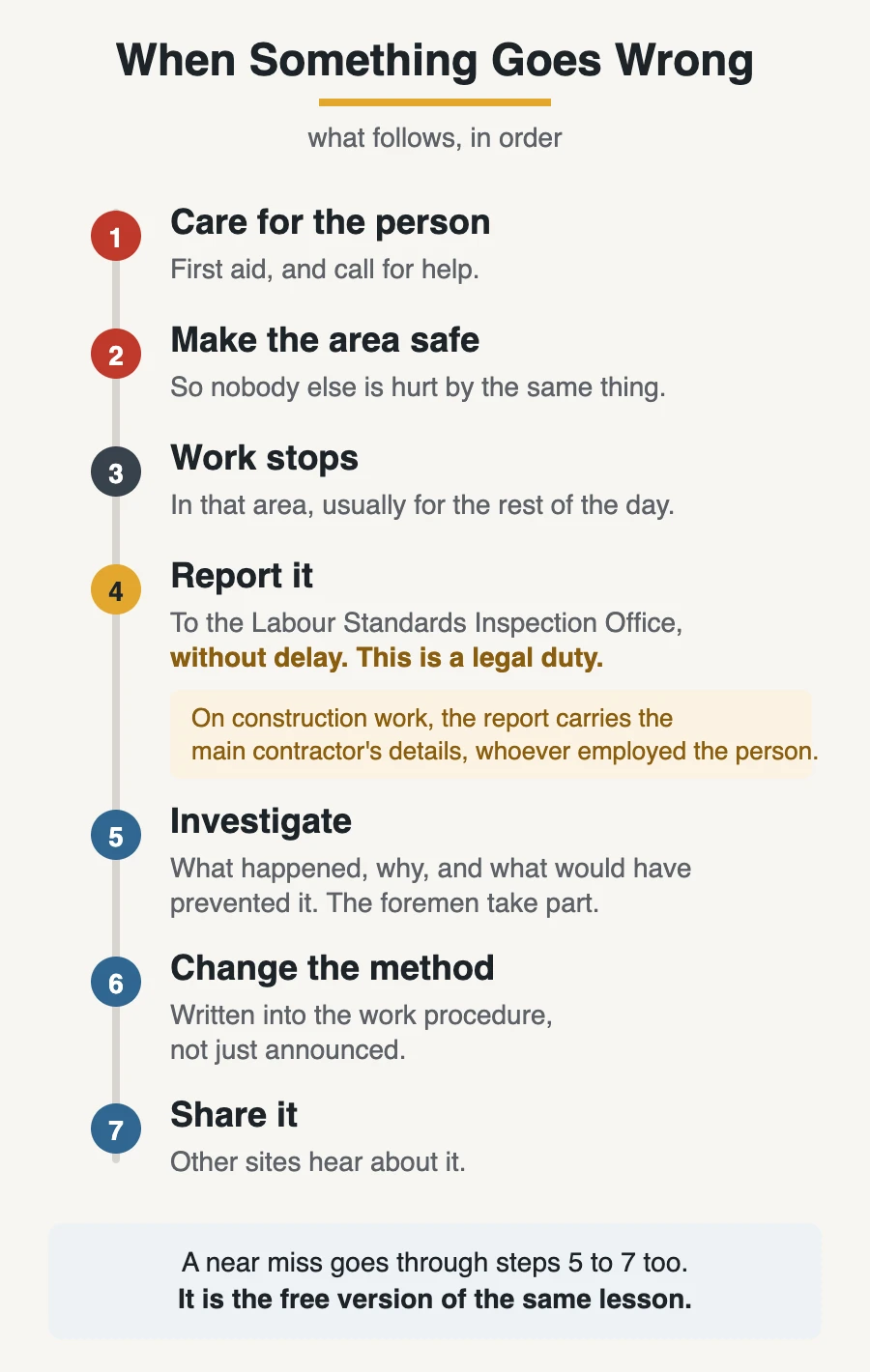
One detail in that second duty says a lot about how Japanese construction works. When the injured person is a subcontractor’s worker on a construction project, the report includes the principal employer’s labour insurance number and the name of the project.
The general contractor is in the paperwork, whoever the person worked for. That’s the same principle as chapter 1, showing up at the worst possible moment.
What happens next on site
From what I’ve seen, the pattern is consistent.
- Work in that area stays stopped until the cause is understood.
- The site investigates — what happened, why, and what would have prevented it. The foremen are part of that, not just the main contractor.
- The method changes, and the change is written into the work procedure rather than just announced.
- It gets shared. Other sites in the same company hear about it. A near miss at one site turns into a briefing point at another.
Near misses count
One thing I’d encourage anyone joining a Japanese site to take seriously: the near miss report — hiyari hatto, from the words for “startled” and “gasped.”
It’s the thing that nearly happened. Nobody was hurt, so there’s nothing to report legally, and it would be easy to say nothing.
Sites collect them anyway, because the near miss and the accident usually have the same cause — and the near miss is the free version of the lesson.
The honest part
Accidents still happen. Japan has a detailed rulebook and a strong safety culture, and people are still injured on Japanese sites every year.
Rules reduce risk. They don’t remove it, and anyone who tells you their site is completely safe has stopped paying attention. The value of a system like this isn’t perfection — it’s that when something does go wrong, it’s much harder for it to be quietly repeated somewhere else.
FAQ
Are Japanese construction sites really stricter than elsewhere?
I can only compare honestly to what I’ve read and been told, not from working abroad myself. What I can say is that a lot of what looks like strictness is written law with a named person responsible for it — so it’s applied consistently rather than depending on who is in charge that day.
Who is responsible if a subcontractor’s worker is injured?
The subcontractor is the worker’s employer, but the principal employer on the site carries duties across the whole site: appointing an overall safety and health controller, instructing subcontractors to correct violations, coordinating between companies, and patrolling. Its details even appear on the injury report.
Do I need a Japanese qualification, or does mine transfer?
Assume you need the Japanese one. Specified work can only be done by a person holding a Japanese licence or a completed registered skill training course, and that person has to carry the certificate while working. Check with the employer well before you arrive.
When is a full harness required, and do I need training?
Where a work platform is difficult to provide at 2 metres or more, using a full-harness type fall arrest device is work that requires special education. Owning the equipment is not the qualification; the course is.
What are the heatstroke rules?
Since June 1, 2025, employers must set up a system for reporting suspected heatstroke — including one worker reporting another — and must decide and communicate procedures for removing the person from work, cooling them, and getting medical help. The ministry’s guidance applies this to work of an hour or more continuously, or over four hours a day, at a WBGT of 28°C or above, or 31°C or above.
Do these rules apply to visitors?
The site’s rules apply to everyone who passes the gate. Expect an induction, expect to be given a helmet, and expect to be told where you may and may not walk. If a rule seems excessive for a ten-minute visit, follow it anyway — the person escorting you is accountable for you.
What happens if I refuse a safety instruction?
On a Japanese site, the principal employer is legally required to instruct correction of a violation, and the subcontractor is legally required to follow that instruction. Refusing isn’t a disagreement between two people; it puts the other person in breach of a duty. Realistically, you’ll be removed from the work.
Where can I read the official rules in English?
The heatstroke measures have an official English leaflet from the Ministry of Health, Labour and Welfare, linked in chapter 5. Most of the rest — the Act and the Ordinance — is published in Japanese on e-Gov, which is what I’ve cited throughout. If you’re planning to work here, ask your employer for the site’s own rules in writing; they’re usually happy to provide them.
Summary
Here’s the short version.
- One company answers for the whole site. The principal employer appoints an overall safety and health controller, must instruct subcontractors to correct violations, and must coordinate, educate and patrol. The patrol is required at least once every working day.
- You prepare before you arrive. A new entrant induction, the right Japanese qualification for the work, and the certificate in your pocket.
- Height rules shape the site. At 2 metres or more the first answer is a work platform, with nets and fall arrest equipment as the fallback. Handrails come off only with an attachment point, a used harness, a barrier and a sign.
- Scaffolds get checked before work each day, and again after bad weather, an earthquake, or any change — with the result recorded and kept.
- Heat is now law. Since June 1, 2025, employers must have a reporting system and written procedures for heatstroke, and must tell workers about both.
- Accidents are reported to the labour standards office, and on construction work the principal employer’s details go on the report.
If I had to give one piece of advice to someone coming to work on a Japanese site, it wouldn’t be about equipment. It’s this: when someone tells you to stop, stop first and ask afterwards. They may be doing it because the law requires them to, and the conversation is much easier once nobody is standing in the wrong place.
And the part I learned the hard way, as the person doing the telling: the rules only hold if the person enforcing them follows them too. You cannot ask a crew to wear a harness while you lean over an open edge to look at something. They will remember that longer than they remember anything you said.
A reminder about this article. Everything here was checked against the official texts on September 20, 2026, and the sources are linked in each chapter. Laws are updated — the heatstroke duties are recent proof of that — so check the current text, or ask your employer, before relying on anything here.
If you have questions about working safely on a Japanese site, or anything else about construction in Japan, feel free to reach out anytime! You can read more about who I am and what I’ve worked on on my About page.
Read next: A Day on a Japanese Construction Site: Hour by Hour
Also worth reading: If you are thinking of working here: Construction Work in Japan: How to Actually Get In — the routes in, the two tests, and what a company must have in place before it can hire you.
A supervisor’s own near-misses: Three Mistakes I Made on a Japanese Construction Site — why the reporting system in this article only works when nobody gets blamed.
What keeps a building standing when it moves: Seismic Isolation in Japan: Not a Japanese Invention — the layer under the building, and the part that failed an inspection it never had.
Where the time pressure on a site comes from: Construction Schedules in Japan: Who Actually Sets Them — the length of the job is settled before the site starts, and the official standard now tells you to count hot days.