Japanese Construction Workwear: From Baggy Pants to Fan Jackets, and Why
The short version
- Nikkapokka are baggy on purpose — easier to squat, climb and move all day, with narrow ankles to keep the hems clear.
- Jika-tabi give a real feel for the ground, and many wearers add a steel-plate insole against nails.
- Fan jackets cool you by evaporating sweat, not by blowing cold air.
- Japan’s heat rules changed in June 2025. Heatstroke prevention is now a legal duty for employers.
This post contains affiliate links.
Hi there, I’m Shirokuma!
If you’ve ever seen photos of a Japanese construction site, you might have wondered: Why are those pants so baggy? Why do their jackets puff up like balloons? And what’s with the split-toe shoes?
In this guide to Japanese construction workwear, you’ll learn:
- What Japanese construction workers typically wear, from head to toe
- The reasons behind the baggy pants, split-toe shoes, and fan jackets
- How Japan’s new heat safety rules, which started in June 2025, are changing what people wear on site
I’m in my 12th year in Japanese construction, and I spent years working on sites as a site supervisor. I’ll share what these clothes are really like to wear, not just what they look like.
Japanese Construction Workwear at a Glance
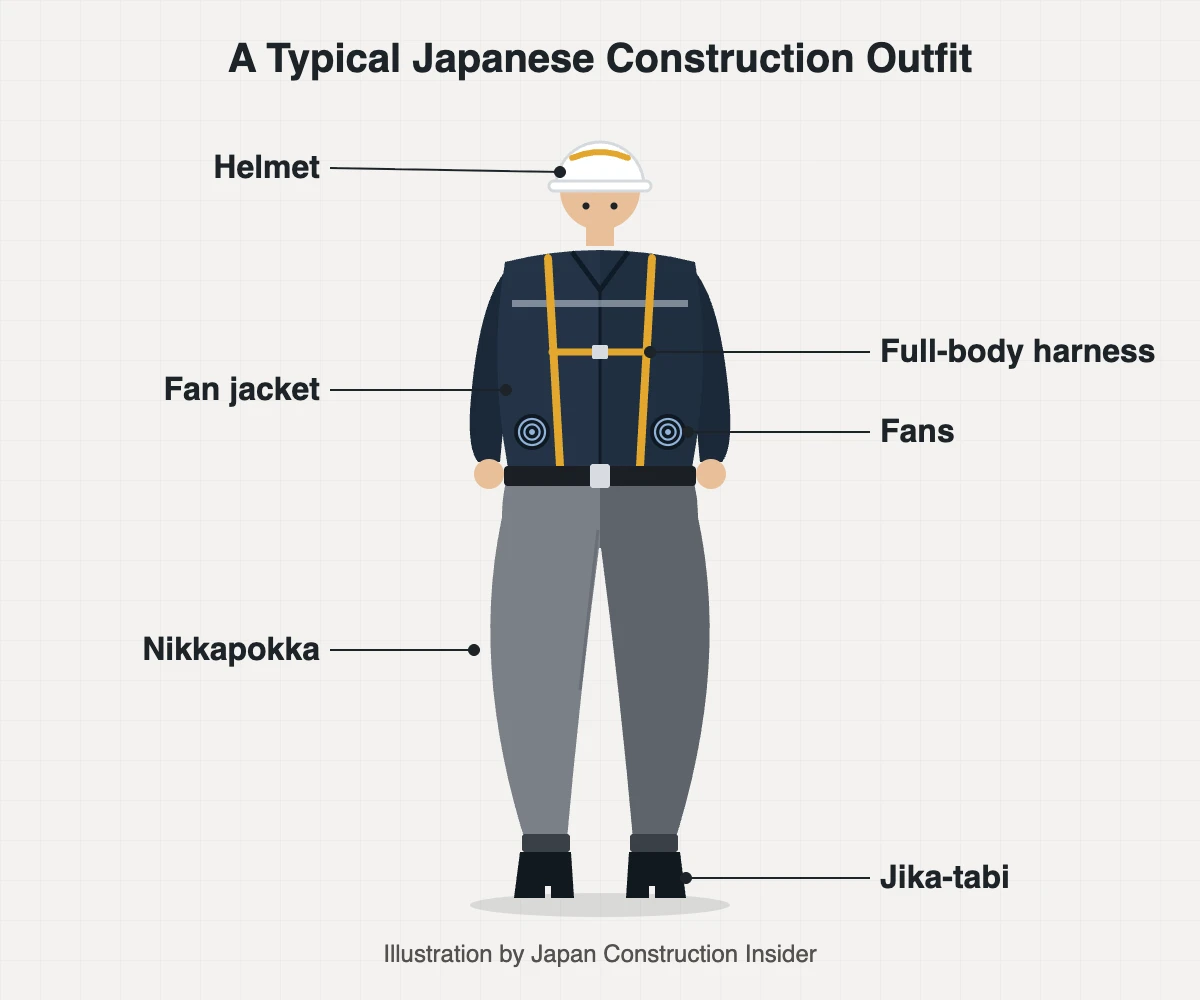
Walk past a construction site in Japan, and a few things usually stand out. Here’s a quick look at a typical outfit, from top to bottom:
- Helmet: A must — you always wear it whenever you step onto the site. Many companies put their logo or the worker’s name on it.
- Full-body safety harness: Worn by anyone working at height, with hooks that clip onto safety lines.
- Jacket: In summer, it’s often a fan jacket — a jacket with small fans built into the back.
- Pants: Some workers wear wide, baggy pants called nikkapokka or tobi pants, while others wear slimmer work pants.
- Footwear: Either safety shoes, or jika-tabi — work shoes with a split between the big toe and the other toes.
At first glance, some of these might look a little unusual. But almost every piece has a practical reason behind it. Let’s go through them one by one.
Baggy Pants: Nikkapokka and Tobi Pants
What they’re called
These wide pants go by a few names. The most common is nikkapokka, and workers often shorten it to just nikka. The name comes from the English word knickerbockers — the loose, knee-length trousers that became popular in the West long ago.
You’ll also hear them called tobi pants. Tobi are skilled workers who put up scaffolding and steel frames, often working high above the ground. The baggy pants have become closely linked to them.
Source: Nippon.com, “Nikkapokka Pants in Style on the Construction Site”
Why so baggy?
The shape isn’t just for looks. Here are the main reasons:
- Easy to move in. Construction work means squatting, climbing, stepping over things, and standing up again — all day long. The extra room around the thighs and knees makes those movements easier.
- Tight at the ankle. The pants are wide at the top but narrow at the bottom, so the hems are less likely to catch on tools, materials, or scaffolding.
- A little extra “feel.” It’s often said that the loose fabric helps workers sense the wind or brush against obstacles before their legs do. I’d call this more of a well-known saying than a proven fact — but you’ll hear it on many sites.
Who wears them today
Tobi aren’t the only ones who wear them. In my experience, when I picture someone in nikkapokka, the first person that comes to mind is actually a daiku — a carpenter. On the sites I’ve worked on, carpenters in baggy pants were a very familiar sight.
That said, not everyone on a Japanese site wears nikkapokka. You’ll also see plenty of workers in slimmer, more modern work pants.
From my own experience, though, one thing is true: a lot of Japanese tradespeople are quite stylish. The ones who care about their look really care — the color of their pants, the brand of their jacket, how everything fits together. For them, work clothes are part of their pride in the job.
Jika-tabi: Split-Toe Work Shoes
Jika-tabi are work shoes with a split between the big toe and the other four toes. They come from tabi, the traditional Japanese split-toe socks. Add a tough rubber sole, and you get a shoe made for working outdoors.
Instead of laces, they’re fastened at the back of the ankle with small metal hooks called kohaze. You hook each one into a loop, one by one, until the shoe fits snugly.
So why would anyone choose these over regular work boots?
- Better feel for the ground. The sole is thin and flexible, so you can feel the surface under your feet. That helps when you’re walking on narrow beams or scaffolding boards.
- Better grip. Because the sole bends with your foot, it grips uneven surfaces well.
- Your big toe can move on its own. That split gives you a bit more control when you’re balancing or pushing off.
The trade-off is protection. A thin, flexible sole can’t protect your feet the way a stiff safety boot with a toe cap can. The biggest worry is stepping on a nail — a thin sole won’t stop it.
That’s why, from what I’ve seen on site, jika-tabi wearers often slip a steel-plate insole inside. It’s a thin insole with a metal plate built in, so a nail can’t go straight through into your foot. It’s a simple trick that keeps the good feel of jika-tabi while adding some protection.
You’ll also see plenty of workers in safety shoes — the choice often depends on the job and the rules of each site.
Source: Wikipedia, “Jika-tabi”
Fan Jackets
If you visit a Japanese construction site in summer, you’ll notice something odd: a lot of workers look a little puffed up. That’s because they’re wearing fan jackets — jackets with small fans built into the back or sides, powered by a rechargeable battery pack.
In Japan, people often call them kuchofuku. Strictly speaking, that’s a registered brand name from the company that developed them, but it’s become the everyday word for any jacket like this.
How do they work?
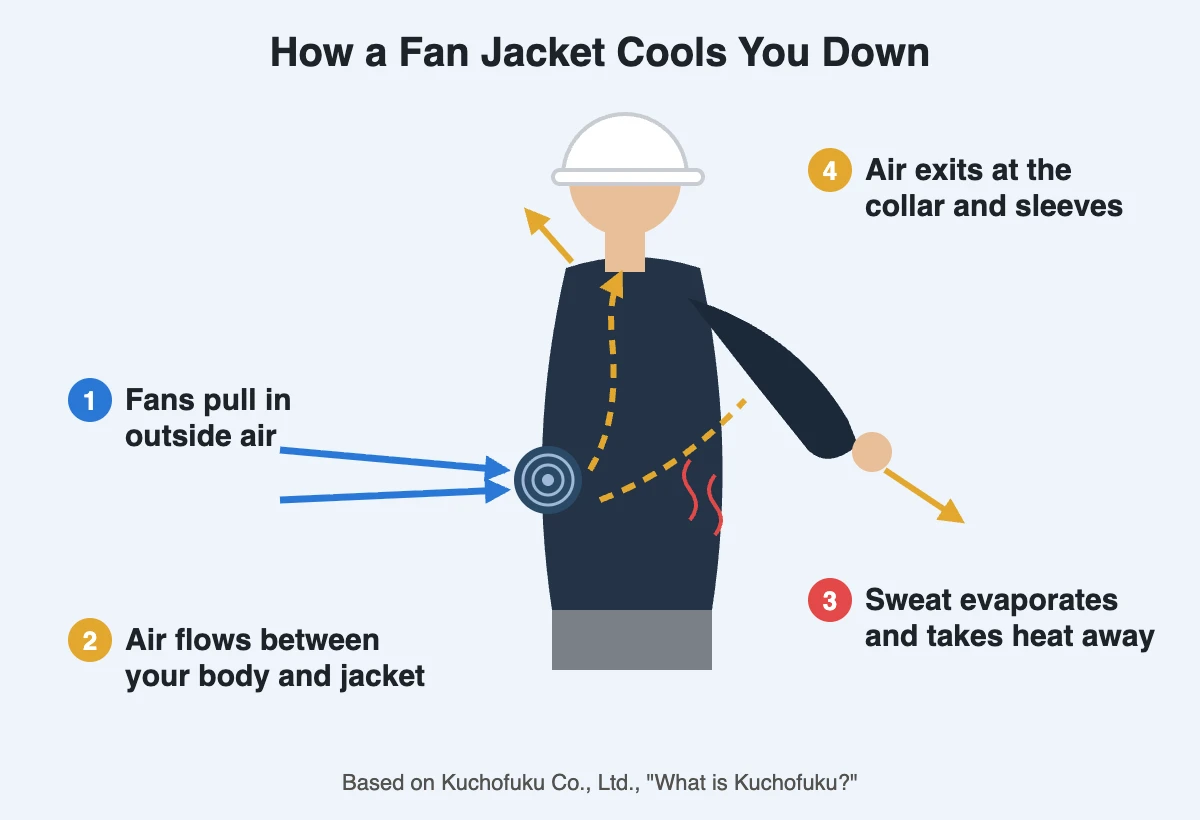
A fan jacket doesn’t have an air conditioner inside. It works with something your body already does: sweating.
- The fans pull outside air into the jacket.
- The air flows between your body and the fabric, then out through the collar and sleeves.
- As the air moves over your skin, your sweat evaporates faster — and evaporation carries heat away from your body.
In other words, it doesn’t cool the whole room. It just helps you cool down, right where you’re working.
Source: Kuchofuku Co., Ltd., “What is Kuchofuku?” (in Japanese)
Why they’re so popular on Japanese sites
Japanese summers are hot and humid, and construction work is often done outdoors, in direct sun, with helmets and safety gear on. Fan jackets are easy to wear, don’t need any setup on site, and work anywhere — all you need is a charged battery pack. From what I’ve seen on site, for many workers they’ve become just as normal as a helmet.
A tip on batteries
Many fan jackets let you change the fan speed. The stronger you set it, the faster the battery runs down. Depending on the setting, one battery may not last a full working day.
That’s why, from what I’ve seen on site, some workers carry two batteries — one in the jacket, and a fully charged spare to swap in during a break.
My favorite moment
Here’s something I’ll never forget. After working in the heat wearing a fan jacket, I walked straight into an air-conditioned room — with the fans still running. Suddenly, the jacket was pulling in cold air and blowing it all over my body.
Honestly, the feeling was amazing. For a few seconds, it was like standing inside a refrigerator. If you ever try a fan jacket, I highly recommend this experience!
That said, a fan jacket isn’t magic. On extremely hot days, the air it pulls in is hot, too. It helps a lot, but it doesn’t replace drinking water, taking breaks, and resting in the shade — which brings us to Japan’s new heat rules.
Japan’s New Heat Rules (2025)
What changed
On June 1, 2025, Japan updated its workplace safety rules to make heatstroke prevention a legal duty for employers. Before that, many measures were only recommended. Now, they’re required.
The rules apply when work is done in hot conditions — specifically, when the WBGT is 28°C or higher, or the air temperature is 31°C or higher, and the work is expected to continue for one hour or more in a row, or more than four hours in a day.
In those conditions, employers must:
- Set up a way to report — so that anyone who feels sick, or notices a coworker who looks unwell, knows exactly who to tell.
- Prepare clear steps — such as stopping work, cooling the body, and getting medical help when needed, along with emergency contacts and nearby hospitals.
- Make sure everyone knows — all workers involved must be told about these systems and steps in advance.
Source: Ministry of Health, Labour and Welfare, notice on strengthening heatstroke prevention in the workplace (May 20, 2025) (PDF, in Japanese)
What is WBGT?
WBGT stands for Wet Bulb Globe Temperature. You can think of it as a “heat stress index.” Instead of looking at the air temperature alone, it also takes humidity and heat from the sun into account.
This matters because 30°C on a dry day and 30°C on a humid, sunny day feel very different to your body. WBGT is a better way to judge how dangerous the heat really is. Some sites check it with a WBGT meter and post the day’s level on a board, so everyone can see it.
Tools on site
To keep workers safe, sites combine several simple tools:
- WBGT meters to check the heat level during the day
- Fan jackets, as we saw earlier
- Plenty of water and breaks in a shaded or cool area
And there’s one more tool I want to introduce: a wristband called Canaria.
Canaria is a watch-like device you wear on your wrist. It estimates changes in your core body temperature, and when your risk of heatstroke goes up, it warns you with a sound, a light, and vibration. Its name brings to mind the canary birds that miners once used as an early warning of danger.
What makes it useful is that it can warn you before you notice anything is wrong yourself. When you’re focused on your work, it’s easy to miss the early signs.
In my experience, some general contractors in Japan actually require workers on their sites to wear it during the hot season. It’s a good example of how the new rules are turning into real, everyday changes on site.
Source: Biodata Bank, Inc. (maker of Canaria) (in Japanese)
Where to Buy
This section contains affiliate links. If you buy through them, this site may earn a small commission at no extra cost to you. As an Amazon Associate I earn from qualifying purchases. I also earn from qualifying purchases made through Rakuten links.
Want to try Japanese workwear for yourself? Here are some places to start. Each product below has two buttons: one for Amazon Japan (amazon.co.jp), where you can switch the display to English, and one for Rakuten Ichiba (rakuten.co.jp), a Japanese online shopping mall. Many Rakuten shops only ship within Japan, and some Amazon Japan items can’t be shipped overseas either, so please check the product page before you order.
Fan jackets
If you’re looking for a fan jacket that looks good, too, here are two brands worth checking out:
- BURTLE AIR CRAFT — From a Japanese workwear brand, with sharp, modern designs. If you care about style on site, this is a great place to start.
- Makita fan jackets — From the Japanese power tool maker. They run on Makita’s 18V batteries, so they’re especially handy if you already use Makita tools.
Tip: Many fan jackets are sold as “jacket only,” and the fans and battery are sold separately. Check what’s included before you buy.

BURTLE AIR CRAFT jacket (AC2011)
Jacket only. Fans and battery are sold separately.

BURTLE AIR CRAFT fan & battery set (AC10)
The fans and battery that power BURTLE AIR CRAFT jackets.

Makita fan jacket (FJ430D)
Jacket only. Runs on Makita power tool batteries.
Spare batteries
As I mentioned earlier, one battery may not last a full day on a high setting. A spare can make a big difference.
Important: Batteries are usually not interchangeable between brands. Always choose one made for your jacket’s brand and fan model.

BURTLE AIR CRAFT battery (AC10)
For BURTLE AIR CRAFT fans. Check your fan model before you buy.
Tobi pants (nikkapokka)
Want the classic baggy look? You can find tobi pants online, in many colors and lengths. Some shops ship directly from Japan.

Toraichi tobi pants (nikka)
A classic Japanese brand for tobi workwear.
Steel-plate insoles
If you wear jika-tabi or other thin-soled work shoes, a puncture-resistant insole adds protection against nails. Look for the words “puncture resistant” in the product description, and choose a thin one so it fits comfortably inside your shoes.

Steel-plate insole for jika-tabi
A thin insole with a stainless steel plate, made to fit inside jika-tabi.
Canaria wristband
Canaria is mainly sold in Japan. You can find it on Amazon Japan, on Rakuten, or through the maker, Biodata Bank. Please note that it may not ship to every country.

Canaria Plus heatstroke alert watch
Made by Biodata Bank, Inc. in Japan.
FAQ
What are Japanese construction pants called?
They’re usually called nikkapokka, or nikka for short. You’ll also hear tobi pants, because they’re closely linked to tobi — the workers who build scaffolding and steel frames. The name nikkapokka comes from the English word knickerbockers.
Why are Japanese construction pants so baggy?
Mainly to make movement easier. The extra room around the thighs and knees helps when you’re squatting, climbing, and stepping over things all day. The narrow ankles keep the hems from catching on tools or scaffolding.
Do fan jackets really work?
Yes, they help — but they’re not air conditioners. The fans push outside air through the jacket, which helps your sweat evaporate and cools you down. On extremely hot days, the air coming in is hot too, so you still need water, breaks, and shade.
Is heatstroke prevention mandatory in Japan?
Yes. Since June 1, 2025, employers in Japan must take specific heatstroke prevention measures when work is done in hot conditions. This includes setting up a way to report symptoms, preparing clear steps for what to do, and making sure all workers know about them.
Can I buy Japanese workwear outside Japan?
In many cases, yes. You can find items like fan jackets, tobi pants, and puncture-resistant insoles online. Some products are mainly sold in Japan and may not ship to every country, so check the product page before you order. See the “Where to Buy” section above for some starting points.
Summary
Here’s a quick recap of what we covered:
- Nikkapokka (tobi pants) are baggy for a reason: they make it easier to squat, climb, and move all day, while the narrow ankles keep the hems out of the way.
- Jika-tabi give workers a great feel for the ground and good grip — and from what I’ve seen, many wearers add a steel-plate insole to protect against nails.
- Fan jackets use small fans and a rechargeable battery to help your sweat evaporate and cool you down.
- Japan’s heat rules changed in June 2025, making heatstroke prevention a legal duty for employers. Tools like WBGT meters and the Canaria wristband are part of that change.
What looks like an unusual fashion choice is really a mix of practical design, safety, and a bit of personal pride. And I think workwear in Japan will keep changing to better protect the people who build our cities from the summer heat.
If you have any questions about Japanese workwear or life on Japanese job sites, feel free to reach out anytime!
Read next: Japan’s Construction Industry: Challenges Today and What’s Changing | Construction Drones in Japan: What Sites Use Them For, and the Rules
Also worth reading: Japanese Tool Belt: What a Site Supervisor Actually Carries