Concrete Pour in Japan: The Clock Starts at the Plant
The short version
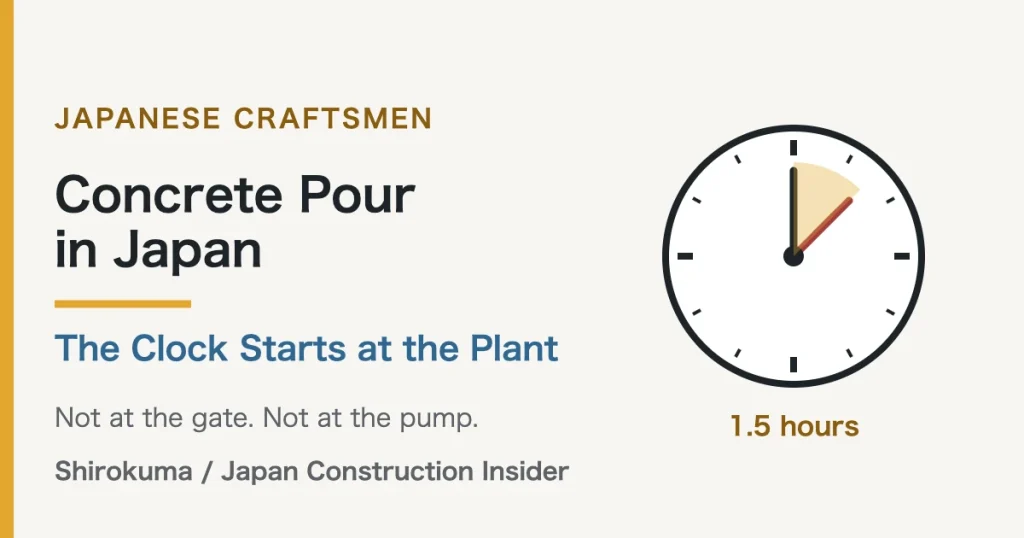
- The clock starts at the plant, not at your gate. Transport is capped at 1.5 hours, and mixing to the end of placing at 1.5 or 2 hours depending on the temperature.
- Placing is meant to happen when the daily mean temperature is above 4°C and 25°C or below. In a Japanese summer, that window is often closed.
- You order roughly 1.1 times the calculated volume, because concrete always runs over the geometry.
- The day is won the day before: the sequence, the cover and spacers, the joints, the power and water, and where the break will fall.
- A formwork burst once cost us a whole section — not because of the burst, but because the concrete’s release time passed while we fixed it.
Hi there, I’m Shirokuma!
Most days on a construction site can be recovered. You can re-sequence, you can work late, you can move a trade to tomorrow. A concrete pour in Japan is the exception. Once the first truck discharges, the day runs to the end on its own terms, and nothing about it can be undone.
What I want to show you is the reason that’s true — and it isn’t the usual one people give. It’s not that concrete is heavy or expensive or awkward. It’s that concrete is a material with a clock running. The clock starts at the plant, before anything arrives on site, and most of what a Japanese pour looks like is people working around that clock.
In this article, you’ll learn:
- The two time limits that govern a pour in Japan, and where they come from
- The temperature window concrete is supposed to be placed in
- How the quantity gets decided, and why both too much and too little are failures
- Who does what on the day, and what the supervisor is actually watching
- What goes wrong, and what it looks like afterwards
A note on sources before we start, because it matters for how you read the numbers. The time and temperature rules I quote come from the Ministry of Land, Infrastructure, Transport and Tourism’s common specification for civil engineering works. That’s a specification, not a law, and building work in Japan follows different documents. I’ll come back to that in the FAQ rather than blur it here.
The Clock Starts at the Plant
Ready-mixed concrete — nama-kon (生コン) in everyday site speech — is mixed at a plant and delivered in an agitator truck, a torakku ajitēta, whose drum keeps turning so the material stays uniform and can be discharged completely.
That journey is not treated as logistics in Japan. It’s treated as part of the specification.
Two limits, not one
MLIT’s common specification for civil engineering works sets two separate clocks, and it’s worth separating them carefully because people conflate them.
| What is measured | Limit |
|---|---|
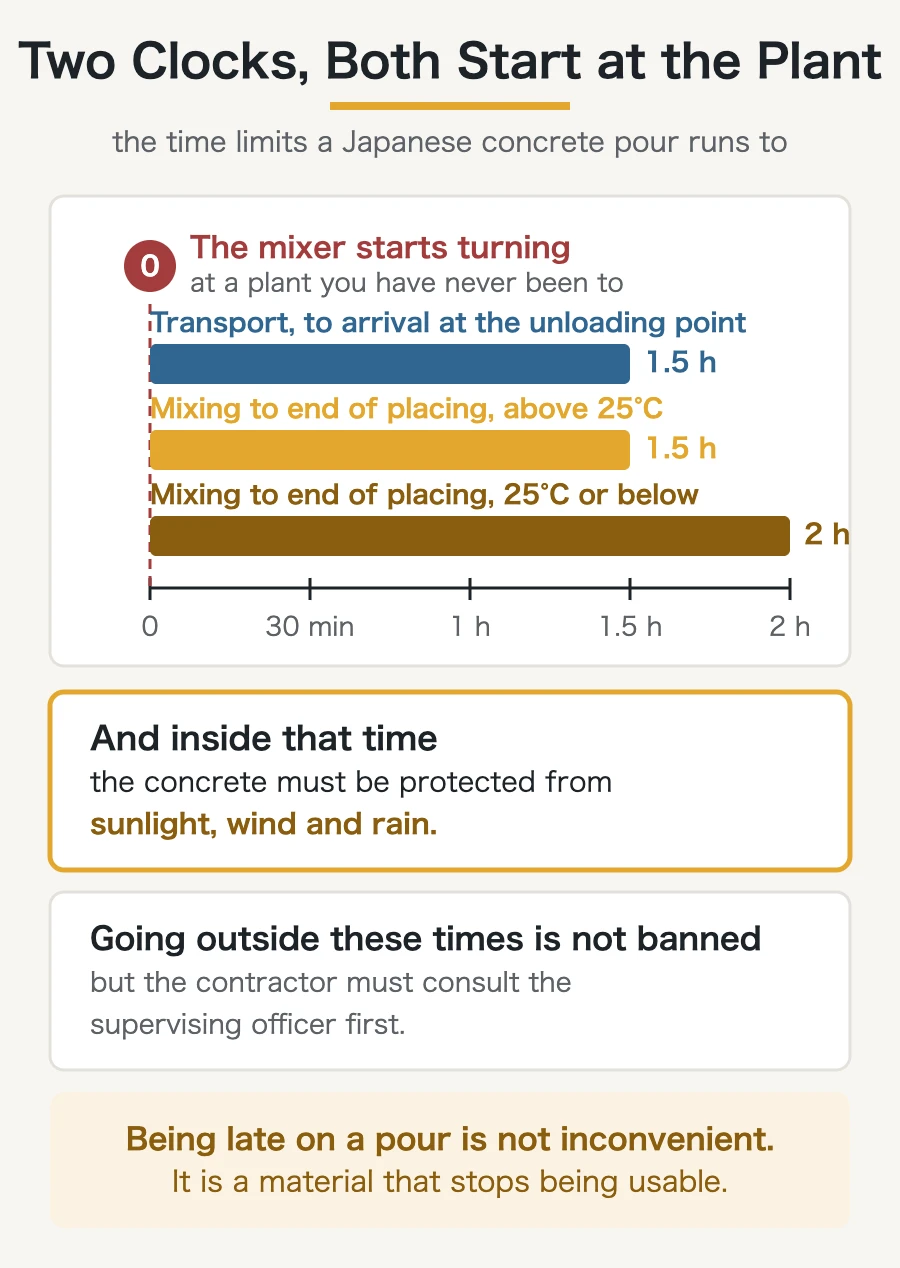
| Transport time — from the start of mixing at the plant to arrival at the unloading point | 1.5 hours |
| Mixing to the end of placing — the whole operation | 1.5 hours if the daily mean air temperature is above 25°C, 2 hours if it is 25°C or below |
Read the first one again, because it’s the one that surprises people. The clock does not start when the truck arrives, or when the pump starts, or when you begin placing. It starts when the mixer begins turning at a plant you’ve never been to.
By the time a truck reaches the gate, part of the allowance is already spent.
And it has to be protected on the way
There’s a third requirement in the same clause that’s easy to skip past. During the period from mixing to the end of placing, the concrete has to be protected from sunlight, wind and rain.
So it isn’t only a time limit. It’s a time limit with conditions attached to how the material is treated inside it.
What happens if you can’t meet it
This is where I want to be accurate rather than dramatic, because the specification is more reasonable than a flat prohibition.
It doesn’t say the work is forbidden outside those times. It says that where there is a possibility of working outside them, the contractor must consult the supervising officer. The limits are the default case, and departing from them is a conversation that has to happen in advance, not a decision taken at the gate with a truck waiting.
Here’s the practical consequence, and it’s the thing I’d want an overseas reader to take from this chapter. On most of a construction site, being late is inconvenient. On a pour, being late means the material stops being usable. That difference is why a Japanese pour is organised the way it is, why the ordering is done the way it is, and why nobody on site is relaxed until the last truck has discharged.
Source: Ministry of Land, Infrastructure, Transport and Tourism, common specification for civil engineering works, Part 3 Chapter 3 Section 6 — transport and placing, clauses 1-3-6-3 and 1-3-6-4.
The Temperature Window
The same clause sets out when concrete is supposed to be placed at all.
Placing is to be carried out when the daily mean air temperature is expected to be above 4°C and 25°C or below. If the forecast falls outside that range, the work moves to the provisions for hot weather concrete (shochū konkurīto) or cold weather concrete (kanchū konkurīto) instead.
Why 25°C turns up twice
You’ll have noticed that 25°C appeared in the previous chapter too, as the switch between the 1.5-hour and 2-hour limits.
That isn’t a coincidence, and holding the two together tells you something about how the material behaves. Above that temperature, concrete stiffens faster. So the same threshold does two jobs: it shortens the time you have, and it moves the whole operation into a different set of provisions.
One number, two consequences, both pointing the same way — you have less room than you think.
And in Japan, that window is often closed
I’ll put this as an observation from working here rather than as a statistic, because I don’t have a figure I’d stand behind.
If you have worked through a Japanese August, you already know how rarely the plain case applies in summer. The same is true at the other end in the parts of the country that get real winters. A large share of pours in Japan are not “ordinary” pours at all — they’re being run under the hot-weather or cold-weather provisions, with the extra requirements that come with them.
So when you read “4 to 25 degrees” as a comfortable-sounding range, read it the way a site does: as the condition under which the simple rules apply, and as a reminder to check the forecast before you confirm the order.
Source: Ministry of Land, Infrastructure, Transport and Tourism, common specification for civil engineering works, clause 1-3-6-4.
Ordering Is a Number You Have to Get Right
Before any of this happens, somebody has to decide how much concrete to buy. That somebody is usually the supervisor, and the number is not negotiable afterwards.
Where the quantity comes from
You take it off the structural drawings — the kutai-zu, the drawing that shows the frame and nothing else. These days I mostly take it off the model instead, which is the same arithmetic done by software that can’t forget a beam.
Then you add to it.
The part nobody outside the industry expects
The volume you calculate is not the volume you order. Concrete always comes out higher than the geometry says it should — formwork deflects a little under the pressure, surfaces aren’t perfectly true, some is lost in the line and the bucket. On site we talk about fuke (フケ), the amount by which the real figure runs over the drawn one.
So the ordered quantity is roughly the calculated quantity multiplied by 1.1.
About ten percent, deliberately, on purpose, every time.
Both errors are failures
It’s worth being clear that this is not a “round up to be safe” situation, because rounding up has a cost too.
Order short and the pour stops. You get a joint where you never planned one, in a position nobody chose, at whatever height the concrete happened to reach. Chapter 8 is about what that costs.
Order over and you’ve bought material you can’t use and now have to deal with, on a day when everyone is already busy. I’ve written about the worst version of that I’ve been responsible for, and I won’t repeat the story here — it’s in my article about mistakes I’ve made.
The 1.1 is an attempt to be wrong in the cheaper direction, by a known amount.
The Day Is Won the Day Before
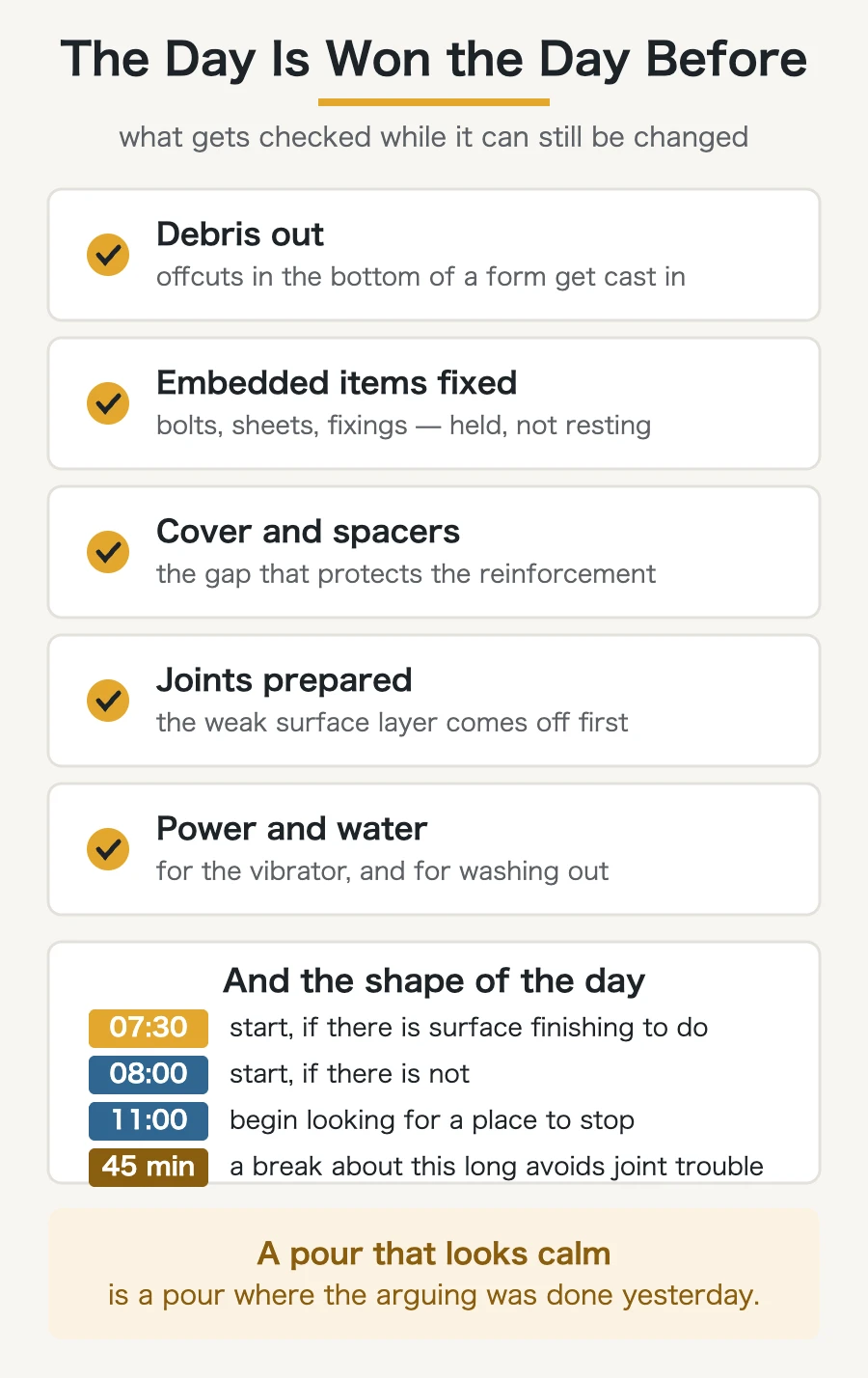
If you watch a Japanese pour and it looks calm, that’s not because pouring concrete is calm. It’s because the arguing was done yesterday.
The briefing
There’s a meeting before a pour — the dasetsu shūchikai (打設周知会) — where the sequence is agreed. Which section first, where the joints will fall, where the pump sits, how many trucks and when.
The point of agreeing it is so that it can be held to. Changing the placing order in the middle of a pour is one of the reliable ways to produce a cold joint or a void, because the sequence was what guaranteed that fresh concrete met fresh concrete.
So part of my job on the day is to say no to a reasonable-sounding request to do something in a different order. It isn’t obstruction. The order is the plan.
What gets checked before anyone pours
I run the check in the late afternoon the day before, when the other supervisors have time to help. Once concrete is in, none of this can be inspected again.
- Debris out. Offcuts and rubbish in the bottom of a form end up cast into the structure. A high-pressure washer blows timber scraps out of corners.
- Embedded items fixed. Anchor bolts, waterproofing sheets, fixings — anything that has to end up inside has to be held where it belongs, not resting there.
- Cover and spacers. The gap between the formwork and the reinforcement is the concrete cover protecting the steel. If it’s short somewhere, that’s spacers, now.
- Joints prepared. Where new concrete will meet old, the weak surface layer — the laitance — has to come off first.
- Power and water. A dedicated supply for the vibrator, and water for washing out. Both are the kind of thing nobody misses until the morning.
The start time
We usually start at 8:00. If there’s no surface finishing to do, that holds. If there is, 7:30, because the finishing has to happen at the right moment later in the day and that moment moves earlier if the pour starts earlier.
Two things I refuse on the day
Adding water to the mix. It will be asked for, because wetter concrete is easier to place. It also changes the water-cement ratio, and the strength goes with it. The answer is no.
Rebar that’s been splashed and left. If reinforcement gets contaminated before the next lift goes in, it gets washed first. Bond is the whole reason the steel is in there.
And the break
This one surprises people. A pour has a lunch break in it, and where that break falls is a decision, not an accident.
I aim to finish the morning’s placing before lunch. From around 11:00 I’m looking for a suitable place to stop — a position where a joint is acceptable. A break of about forty-five minutes generally passes without joint trouble.
Then I announce the break and restart times early, so nobody is guessing, and if a crew is ready before the restart they can go.
Compaction: The Part You Cannot Inspect Later
Once concrete is being placed, the single most important thing happening is the one that looks the least skilled: somebody walking around with a vibrator.
Evenly, and properly
The rule is simple to say and easy to do badly. The vibrator has to be worked over the whole pour, evenly and thoroughly. Not concentrated where it’s convenient, not skipped where access is awkward, not rushed because the next truck is waiting.
Under-vibrate and you get voids — jonka (ジャンカ), honeycombing, the coarse pitted patches you see on a stripped surface where the mortar never filled in around the aggregate. Over-vibrate and the material separates, the heavy aggregate sinks and the fines rise.
The place people forget
Here’s the specific one I’d tell a newcomer.
Where there’s a horizontal construction joint, the vibrator has to work that joint too. Fresh concrete placed on top of a previous lift doesn’t knit itself to it. You have to drive the vibrator down through into the layer below so the two become one piece.
Miss that, and you’ve made a cold joint — a plane inside the structure where two pours never properly joined. It’s in Chapter 8, because it’s the failure I most want you to understand.
The reason compaction carries so much weight is simple: concrete is the only material on a site that hides its own workmanship. Steel you can look at. Bolts you can check. Once concrete has set, the inside is gone from view forever, and the only record of whether the vibrator was worked properly is what happens to that structure over the next fifty years.
Finishing: Waiting for the Concrete to Tell You
After the placing is done there’s a gap, and then the floor gets finished — the osae (押さえ), the trowelling that produces the hard flat surface you end up walking on.
The signal is the concrete, not the clock
Nobody can tell you in advance what time this happens.
You start when the concrete has stiffened enough that you can just about stand on it. Too early and you’re working a surface that’s still moving under you. Too late and it’s gone past you, and a surface that’s gone hard unfinished is a repair job, not a finishing job.
The time between placing and that moment depends on the mix, the air temperature, the wind, whether the sun is on it. Which is why it isn’t in the programme as a time. It’s in the programme as a wait.
What the supervisor does during the wait
I’ll be honest about this because I think the honest version is more useful than the heroic one.
I do paperwork.
The most anxious hour of a concrete pour, for the person responsible for it, is spent at a desk doing the admin that’s been piling up, getting up every so often to go and press a boot into the slab. That’s the job. It isn’t dramatic and it doesn’t photograph well, and it’s exactly how the day actually goes.
And the method is not optional
One thing I hold the finishers to: the finishing method specified for that surface is the one that gets used.
It matters because the alternative is expensive. A floor finished the wrong way doesn’t get re-finished — it gets chipped back and repaired, which costs more than the finishing did and leaves a surface nobody is happy with.
I’ve written elsewhere about plastering being work that only hands can do, and about the machines now being trialled on floor finishing. This is the job those trials are aimed at.
Curing: The Week After Matters More Than You Think
Placing concrete takes a day. Making it strong takes considerably longer, and what happens in that period is called yōjō (養生) — curing, protection, looking after it.
The specification I quoted earlier already requires the concrete to be protected from sunlight, wind and rain during the placing operation itself. Curing is the continuation of that idea after the pour is finished.
| Season | What you are fighting | What you do |
|---|---|---|
| Summer | Rapid drying, helped along by the concrete’s own heat | Wet curing, or a surface retarder |
| Winter | Freezing, which costs strength permanently | Heat the space, spread the heat, ventilate the exhaust |
Summer: stop it drying too fast
In hot weather the enemy is rapid drying.
Concrete generates its own heat as it sets. Add summer air to that and the surface can dry far faster than it should, which produces early cracking — cracks that appear in the first day or two and are nothing to do with load.
So in summer the work is wet curing (shitsujun yōjō, 湿潤養生): keeping the surface damp, or using a surface retarder to slow things down. On my sites, with ordinary Portland cement and an average temperature of 15°C or above, I keep it moist for at least five days.
Winter: stop it freezing
In cold weather the enemy is different and less forgiving.
If fresh concrete freezes, the damage is permanent. It isn’t a delay to the strength gain — strength is lost and doesn’t come back.
Below freezing we heat the space, usually with jet heaters, and two cautions come with that:
- Don’t let the heat be local. A heater pointed at one area dries that area and cracks it. The heat has to be spread.
- Ventilate the exhaust. Combustion gases in an enclosed space cause carbonation of the fresh surface.
And keep off it
One more, because it’s the one that gets broken by people who mean no harm.
I keep loads off a new slab for at least a week — and that includes the surveyors who want to get on it the day after the pour to set out. It looks solid. It takes weight. That isn’t the same as being ready to carry it.
What Goes Wrong
Everything above is the pour working. Here is the pour not working, including the one that still bothers me.
The formwork burst
This is the failure that connects back to Chapter 1, and it’s the reason that chapter is first.
On one pour, the formwork burst.
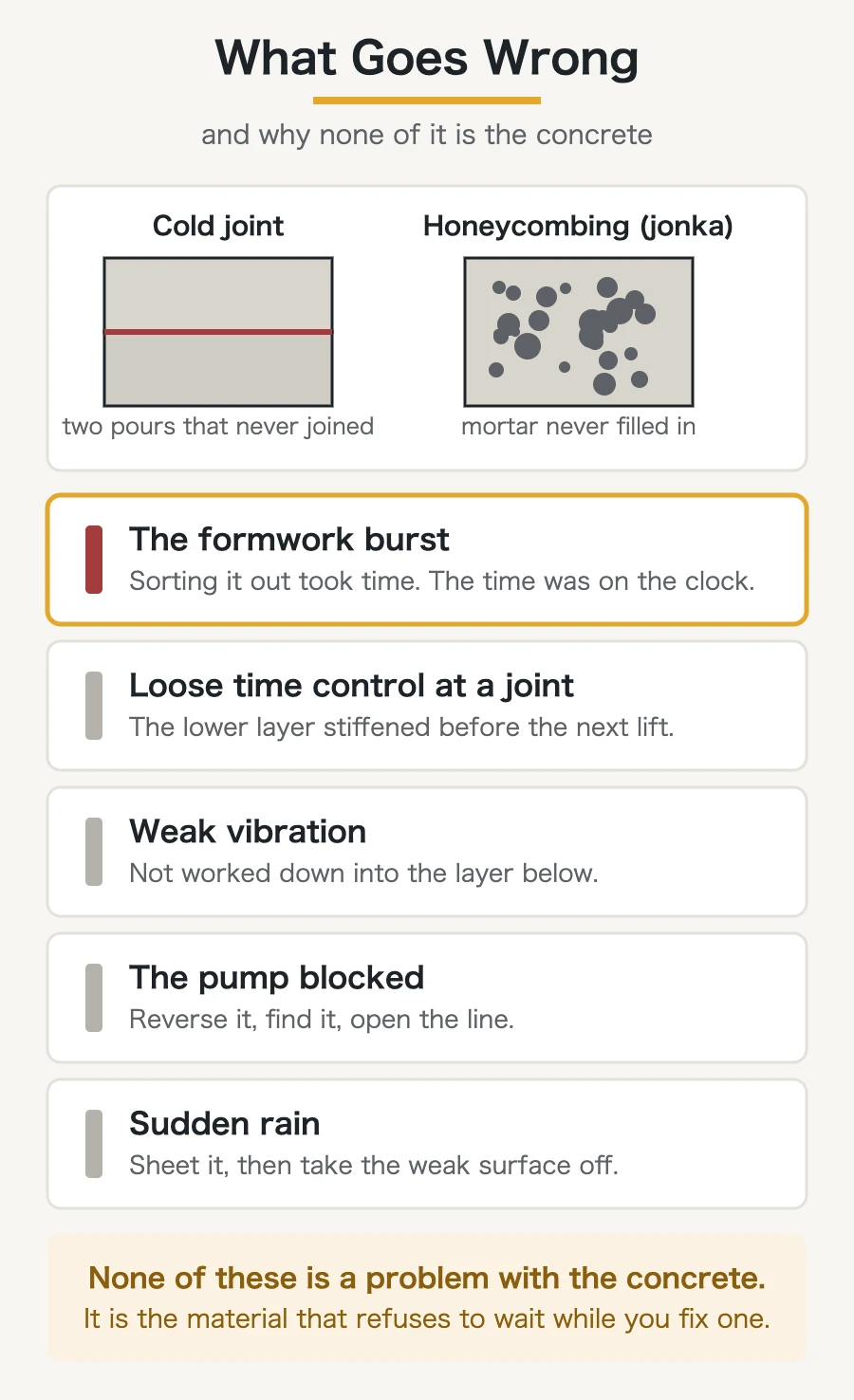
Dealing with it took time — and the time it took was time on the clock that started when the mixer began turning. By the time the form was sorted out, the concrete’s release time from the plant had passed, and that section could not be poured at all.
Read that in the order it happened. The problem was a carpentry problem. The consequence was a concrete problem. And the thing that turned one into the other was the clock.
That is the whole argument of this article in one incident. You cannot solve a problem on a pour by taking longer over it, because the material does not wait.
Cold joints
A cold joint is a plane inside the concrete where two placements never properly became one piece. From the outside the structure looks finished. Inside, there’s a surface.
I’ve seen them. In my experience they come from two causes, and both are management failures rather than material failures:
- Loose time control at the joints. The gap between one lift and the next grew longer than it should have, and the lower layer had stiffened too far to take the new concrete.
- Weak vibration. The vibrator wasn’t worked down into the layer below — the thing I flagged in Chapter 5.
Neither one is bad luck. Both are decisions about attention.
Honeycombing
Jonka — the coarse, pitted patches on a stripped face where the mortar never worked its way in around the aggregate. Under-compaction, usually in the awkward corner where the vibrator was harder to get into.
Two that happen on the day
The pump blocks. You reverse the pump to take the pressure off, find where the blockage is, and if you have to, break the line open at that point. Meanwhile the trucks are still arriving, and the clock is still running.
It rains, suddenly. You stop placing and get sheeting over the fresh surface. When it stops, the weakened surface layer has to come off before you re-trowel. You will be doing repair work afterwards; the question is only how much.
Notice what all of these have in common. None of them is a problem with the concrete. A burst form, a blocked line, a rain shower, a vibrator not pushed deep enough — every one is a site problem, and concrete is simply the material that refuses to wait while you solve it.
Frequently Asked Questions
How long does concrete have, once it leaves the plant?
Two limits, and they measure different things. Transport time — from the start of mixing to arrival at the unloading point — is 1.5 hours. Mixing to the end of placing is 1.5 hours when the daily mean air temperature is above 25°C, and 2 hours when it’s 25°C or below. Both are from MLIT’s common specification for civil engineering works.
What happens if a truck is late?
Part of the allowance is gone, because the clock started at the plant and not at your gate. If there’s a possibility of working outside the stated times, the specification requires the contractor to consult the supervising officer — in advance, as a decision, not at the gate with a truck waiting.
Can you do a concrete pour in Japan in summer?
Yes, but usually not under the plain rules. Placing is to be carried out when the daily mean temperature is expected to be above 4°C and 25°C or below; outside that, the hot weather or cold weather concrete provisions apply instead. In a Japanese summer, the hot weather provisions are the normal case rather than the exception.
Who decides when the floor gets trowelled?
The concrete does. You go and stand on it, and when it’s stiff enough to just about take your weight, that’s the moment. There’s no time you can put in a programme, because it depends on the mix, the air temperature, the wind and the sun.
What is a cold joint?
A plane inside the concrete where two placements never became one piece — because too long passed between them, or because the vibrator wasn’t worked down into the layer below. From outside, the structure looks finished.
Is all of this the same for building work?
No, and I want to be straight about it. Every time and temperature figure in this article comes from the common specification for civil engineering works. Building work in Japan follows its own documents. The physics doesn’t change and the shape of the day doesn’t change, but if you need the governing numbers for a specific job, read the specification that job is contracted under rather than this article.
Summary: The Material Does Not Wait
Three things to take with you.
The clock starts at the plant. Not at the gate, not at the pump. Transport is capped at 1.5 hours and the whole operation at 1.5 or 2 hours depending on the temperature, and the placing temperature window itself is above 4°C and 25°C or below. Everything else on a pour is arranged around those numbers.
The day is won the day before. The sequence, the checks on cover and embedded items and joints, the power and the water, where the break will fall. A pour that looks calm is a pour where that work was done yesterday.
And concrete hides its own workmanship. It is the one material on site whose quality disappears from view the moment it sets. Compaction, joint timing and curing are all decisions whose results nobody can inspect afterwards — which is exactly why they’re the ones worth being strict about.
The thing I find hardest to get across
If you’re joining a Japanese site from abroad, I’ll tell you the item I’ve had the most trouble explaining: the waterstop (shisuiban, 止水板).
It’s a strip set into a construction joint, and its only job is to stop water passing through that joint later. The difficulty is that nothing about it looks important. It’s a piece of material sitting in the way of where you want to put concrete, on a dry day, in a structure that isn’t holding back anything yet.
If it gets displaced or damaged during the pour, the joint will leak — and nobody finds out until the building is in use and the water has somewhere to go. It’s worth asking what the strip in the joint is for before you work around it.
What I left out
- The text of JIS A 5308. It’s a paid standard and I couldn’t obtain the clause itself, so I’ve quoted only the ministry specification I could read in full.
- Slump values, truck capacity, standard curing periods. The curing figures in Chapter 7 are what I do on my sites, not a standard I’m citing.
- Building specifications. See the last FAQ.
Where to read next
The time I ordered a whole truck too many: Three Mistakes I Made on a Japanese Construction Site — what happened next, and what I was asked first.
Why the finishing is still done by hand: Japanese Carpentry Tools — the trades that machines haven’t taken, and the ones they have.
How to read the drawing you take the quantity off: Japanese Construction Drawings: How to Read One — the grid, the levels, and the kutai-zu.
Thanks for reading. If you run pours somewhere else and your clock works differently, I’d genuinely like to know how.
— Shirokuma
What the people on that pour are paid: Construction Wages in Japan: Look Up Your Own Trade — the published rate by trade, and why the supervisor is paid on a different basis entirely.