A Day on a Japanese Construction Site: Hour by Hour
The short version
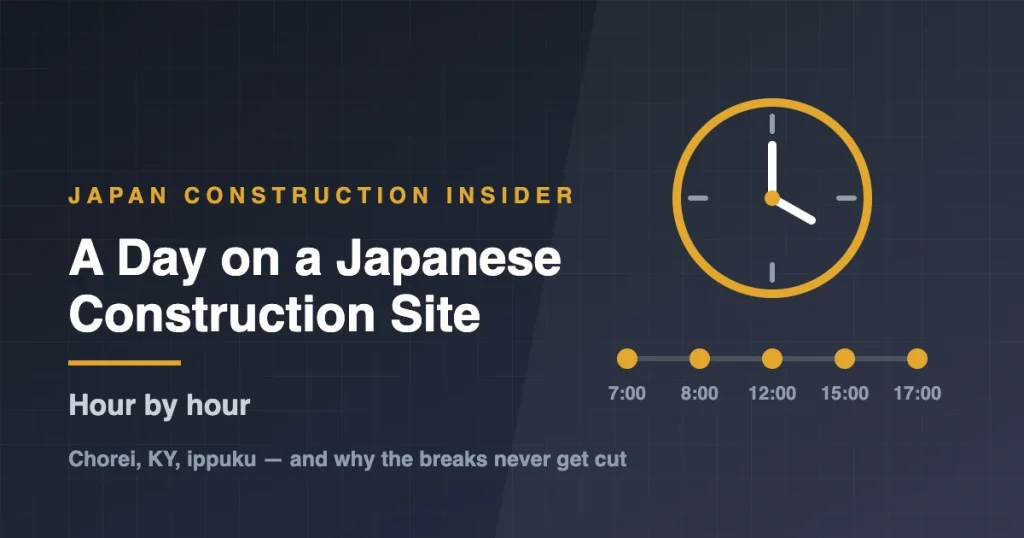
- The clock runs the site. 8:00 start, breaks at 10:00 and 15:00, lunch at 12:00, finish at 17:00 — whether or not the job is behind.
- The supervisor’s day is longer at both ends. Mine started at 7:00 and ended after the crew had gone.
- Two meetings, not one. Chorei at 8:00 gives the whole site the same picture. The foremen’s meeting at 11:30 is where tomorrow actually gets arranged, and visitors never see it.
- KY comes before the work: each company stands in its own circle and says out loud what could go wrong.
- Cleanup is part of the work. You cannot see what is wrong with a site you cannot walk through.
Hi there, I’m Shirokuma!
If you dropped onto a Japanese construction site tomorrow morning, the first thing you’d notice isn’t the equipment or the scaffolding. It’s the clock.
The day has a shape here, and almost everyone follows it. Work starts at the same time, stops at the same time, breaks at the same time — and the breaks happen whether or not the job is behind schedule.
In this article, you’ll learn:
- What a normal day on a Japanese construction site actually looks like, hour by hour
- What happens in the two meetings that bookend the morning
- Which parts surprise people who’ve worked on sites in other countries
This is the schedule I worked to as a site supervisor, so I’ll also tell you where my day was different from the crew’s — starting with the fact that I didn’t get the breaks.
The Shape of the Day
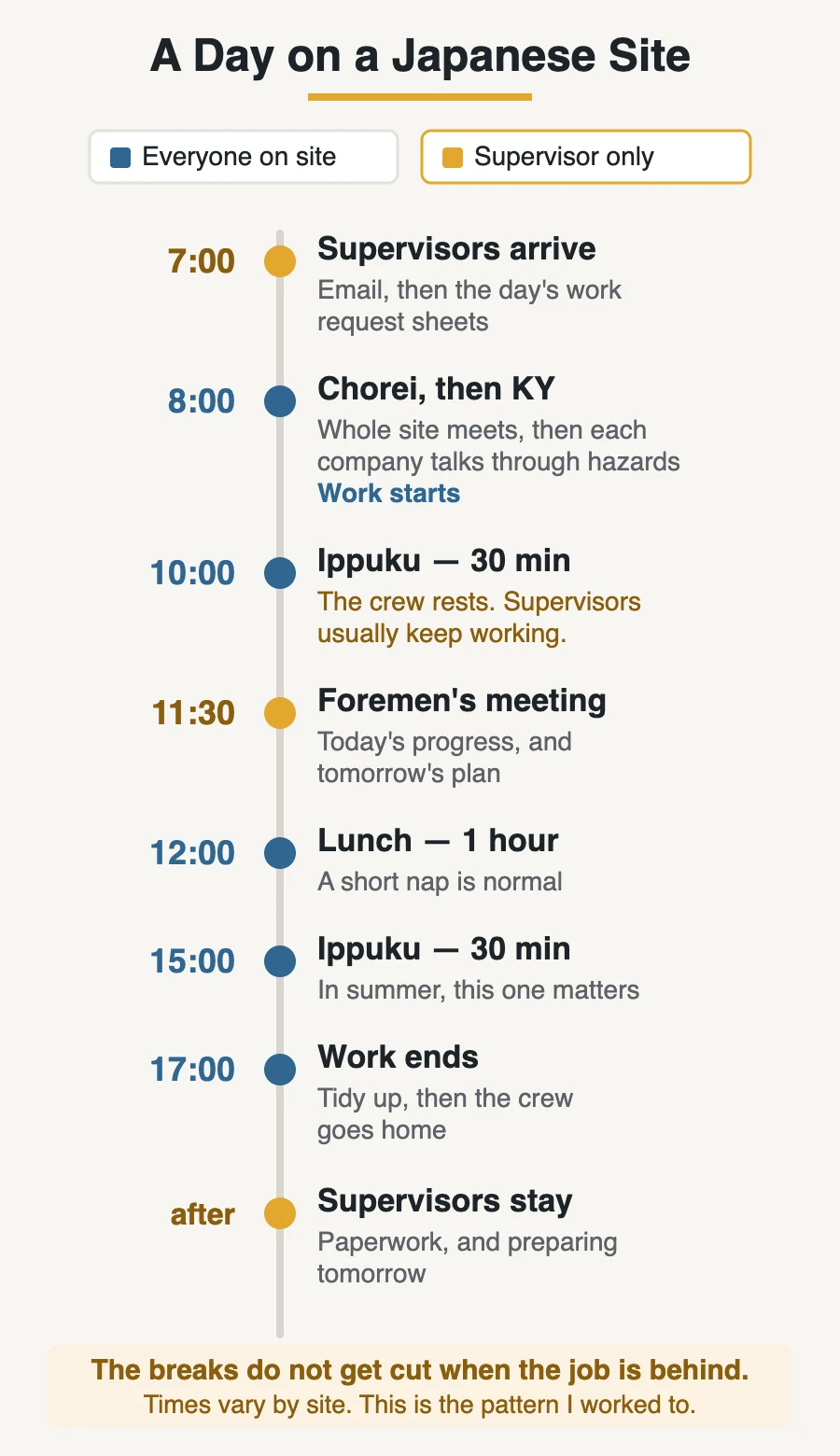
Here’s the timeline, and then we’ll walk through it.
| Time | What happens |
|---|---|
| 7:00 | Supervisors arrive. Preparation, checks, setting up |
| 8:00 | Chōrei — the morning meeting, then KY, then work starts |
| 10:00 | Ippuku — 30-minute break for the crew |
| 11:30 | Foremen’s meeting with the supervisors |
| 12:00 | Lunch, one hour |
| 15:00 | Ippuku — 30-minute break for the crew |
| 17:00 | Work ends. The crew goes home |
| after | Supervisors stay for paperwork and tomorrow’s preparation |
Three things to notice
The crew’s day is fixed. 8:00 to 17:00, with two half-hour breaks and an hour for lunch. Not “roughly.” Those times are the same tomorrow.
The supervisor’s day is longer at both ends. I arrived at 7:00 and left after the crew did. That gap is the job: the hour before is preparation, and the time after is everything the day generated.
There are two meetings, not one. The morning meeting gets everyone pointed in the same direction. The foremen’s meeting at 11:30 is where the real coordination happens — and it’s the one outsiders don’t know about.
A note on the breaks
The two ippuku breaks are for the craftspeople, and they’re not optional extras. When 10:00 comes, work stops.
Supervisors are a different story. I didn’t take them. That’s not a rule — it’s just that a break is when you can walk the site without interrupting anyone’s work, take the phone call you’ve been putting off, or catch up on the paperwork that piled up since 7:00.
I’m not recommending it. I’m telling you what happens, because if you visit a Japanese site at 10:15 and wonder why one person is still walking around with a folder, now you know.
Before the Gate: The Early Start
Why 7:00 when work starts at 8:00
That hour isn’t overtime culture for its own sake. It’s the hour that decides whether the other nine run smoothly.
At 8:00, everyone starts working at the same moment. On a small job that’s a few dozen people. On a large one it can be several hundred. Either way, if something they need isn’t ready, they all wait — and you can’t buy that time back later in the day.
What actually happens in that hour
Less walking around than you’d think. Most of it is desk work, and the most important piece is a document.
Email first. Overnight replies from the designer, the client, suppliers, head office. Some of them change what today looks like, so you want to know before you tell everyone the plan.
Then the work request sheets. In Japan we write a sagyō irai-sho — a work request — for the day. It sets out, for each trade, what work is being done, where, and anything that affects the people around it.
Writing it is the point, not the paperwork. To fill it in honestly you have to think through the whole day: who’s working above whom, which two trades want the same space, what needs the crane, and what can’t start until something else finishes. Problems that would have shown up at 2 p.m. tend to show up while you’re writing this instead.
Then the site, if it’s needed. If yesterday ended with something unresolved, or today’s work depends on a condition I haven’t seen myself, I go and look. Not every morning — only when there’s a reason.
None of this is glamorous. All of it is the difference between a day that works and a day that spends itself on small stoppages.
This is what “dandori” means in practice
I wrote about dandori — preparation — in my article on the Japanese tool belt. This hour is where it lives.
It’s also why supervisors here carry tools. If a morning check turns up something small and fixable, the fastest solution is to fix it now, alone, before anyone arrives to be blocked by it.
The honest part
An hour before and an unspecified amount after means the supervisor’s day is long. That’s a real issue in this industry, and it’s part of why fewer young people are choosing it — something I covered in my first article.
It’s changing, slowly. But if you work with a Japanese site team, it’s worth knowing that the person you’re emailing at 7:15 in the morning is not being dramatic. They’re just already there.
Chōrei: The Morning Meeting
Everyone, in one place, at 8:00
Chōrei means the morning assembly. Everyone working on the site that day stands together in one place — every trade, every company, the supervisors, the new arrivals — and the day officially begins.
It’s a normal part of working life in Japan, not just construction. Offices and factories do it too. But on a site it does something specific: for a few minutes, every person on the job has the same picture of what today is.
The stretching
On most sites I’ve worked on, it starts with rajio taisō — radio exercises. A short, familiar sequence of stretches done to a recording, the same one most Japanese people learned as children.
Foreign visitors usually find this the most surprising thing in the whole day. There are two reasons behind it. One is physical: people are about to do demanding work, often in the cold. The other is that it puts everyone in the same rhythm before anyone says anything — which sounds soft, but it does work.
What gets announced
After that, the announcements. Usually short, usually in this order:
- What’s happening today, and where. Which trades are working in which areas — the same picture as the work request sheets, said out loud.
- Anything that affects other people. Lifting, deliveries, a road closed inside the site, power or water going off, work overhead.
- Safety points. Whatever the current risk is. Weather, heat, a temporary condition that isn’t obvious.
- New arrivals. Anyone on the site for the first time gets introduced. In Japan, first-time entrants also get a separate induction before they start work.
Why it’s worth the time
It costs the whole site a few minutes. That’s not nothing when everyone is standing there.
What you get for it is that nobody can honestly say I didn’t know. If a crane lift is happening over the east side at 10:00, the people working on the east side heard it this morning, from the person responsible, in front of everyone else.
On a site where several companies work in the same space, that shared picture is the thing that prevents most of the collisions — the scheduling kind and occasionally the literal kind.
And then it gets specific
Chōrei is the whole site. The next part is each team talking about their own work, and that’s where the real safety conversation happens.
KY: Predicting the Hazard Before It Happens
What KY stands for
KY is short for kiken yochi — hazard prediction. Right after the morning meeting, each team gathers and talks through the specific job they’re about to do, and what could go wrong doing it.
Not safety in general. This job, today, in this location, with these people.
Where it comes from
This isn’t something each site invented. It’s a national method, promoted by the Japan Industrial Safety and Health Association (JISHA) as part of a long-running campaign called zero-sai undō — the zero-accident campaign.
The formal training version is KYT (kiken yochi training). JISHA describes it as small-group training where people discuss the hazards hidden in a workplace or task and what those hazards could cause, confirm the key points by pointing and calling, and resolve them before acting.
The four rounds
The standard method has four steps. JISHA calls them the basic four-round method, and each round has a question attached to it:
- Grasp the situation — what hazards are hidden here?
- Get to the heart of it — this is the critical risk point
- Decide the countermeasures — what would you do?
- Set the target — this is what we will do
Source: JISHA, “How to carry out hazard prediction training (KYT)” (in Japanese)
The order matters. Most safety talks jump straight to round three — here’s the rule, follow it. The Japanese method spends the first two rounds getting the crew to say the hazard out loud themselves, in their own words, about the task in front of them.
What it looks like on an ordinary morning
Each company forms its own circle, so the groups are whatever size that company brought that day — a pair on one side of the site, a dozen on the other. The foreman says what the team is doing today, and the question goes round: what’s dangerous about this?
Someone says the obvious thing. Someone else says the thing nobody had thought about — the delivery arriving at the same time, the surface that’s slippery in the morning, the other trade working directly above.
Then they agree on what they’ll actually do about it, and they say that out loud too, together.
Does it work, honestly?
Yes and no, and I’d rather be straight about it.
When it’s done properly, it’s the most useful five minutes of the day. The person who spots the real hazard is usually the one doing the work, not the one writing the plan.
When it’s done badly, it becomes a ritual — the same three answers every morning, said quickly so everyone can get started. I’ve seen both. The difference is whether the people running it ask about today’s job or recite yesterday’s answers.
What I’d say to anyone skeptical of it: the value isn’t the form you fill in. It’s that the crew has said, in their own words, what could hurt them in the next few hours. That sticks in a way a printed rule doesn’t.
Ippuku, Lunch, and the Rhythm of the Day
10:00 — the first ippuku
At 10:00, work stops for thirty minutes.
Ippuku originally meant a smoke, and it’s now just the word for the break. The crew sits down, drinks something, and rests. Then at 10:30 they start again.
The part I’d underline for anyone used to a different system: this break isn’t negotiable because the job is busy. It’s in the rhythm, not in the budget for the day. A site that skips it because it’s behind schedule isn’t a site that’s working hard — it’s one that’s managed badly.
11:30 — the foremen’s meeting
This is the meeting outsiders never hear about, and it matters more than the morning one.
Before lunch, the shokuchō — the foremen leading each company’s team — sit down with the supervisors. The morning meeting was about today. This one is mostly about tomorrow.
What gets covered:
- How today is actually going. What’s ahead, what’s behind, what turned out to be harder than expected.
- Tomorrow’s work. Who needs which area, how many people they’re bringing, what materials arrive.
- The collisions. Two trades wanting the same space at the same time is resolved here, by the people who’d otherwise both turn up tomorrow and find out the hard way.
- What I need to prepare. Anything a foreman needs from me before their crew can work.
Holding it at 11:30 is deliberate. Whatever gets decided, the foremen can pass it to their own teams over lunch, and I have the afternoon to arrange whatever I just agreed to.
12:00 — lunch
One hour, and it genuinely stops. People eat, and a lot of them sleep — a short nap in a break room or a vehicle is completely normal and nobody thinks less of you for it.
At 13:00, work starts again.
15:00 — the second ippuku
Another thirty minutes. Same as the morning.
By this point in the day, in summer especially, the break is doing real work. The afternoon heat in Japan is serious, and heatstroke prevention is a genuine part of site management — cooling, water, salt, and time out of the sun.
17:00 — the crew goes home
Work ends. Tools away, area tidied, and the crew leaves.
This part surprises people too. The finish is as fixed as the start. If something needs to run late, that’s arranged in advance, not decided at 16:45.
And why the rhythm helps
Fixed times sound rigid. In practice they make the site predictable, and predictable is what lets a lot of separate companies work in one space.
Everyone knows when the crane is free. Everyone knows when the noisy work stops. Everyone knows that at 10:00 the site goes quiet and at 10:30 it doesn’t. You can plan around a rhythm. You can’t plan around “whenever we finish.”
Cleanup: Why the Site Gets Tidied Every Day
The last job of the day is putting the day away
Before 17:00, the work changes. Tools go back, offcuts and packaging get collected, materials get stacked properly, and walkways get swept clear.
Not a deep clean. But the site is left in a state where someone could walk through it in the dark without hurting themselves — and where tomorrow morning starts on a clear floor instead of yesterday’s mess.
Where the habit comes from
Japanese workplaces talk about seiri seiton — sorting and arranging. It’s the same thinking you’ll find in Japanese factories, and it isn’t specific to construction.
Part of it is cultural in a more ordinary way: in Japan, schoolchildren clean their own classrooms. Nobody on a site thinks cleaning is beneath them, because everyone has been doing it since they were six.
The practical reasons
Culture explains why nobody argues about it. These are why it’s worth doing.
- Most site injuries are boring. Tripping over material, standing on something, slipping on a wet offcut. A tidy floor removes a large share of what actually hurts people.
- Mess hides problems. You can’t see a crack, a leak, or a damaged edge under a pile of packaging.
- Looking for things is expensive. Ten minutes a day per person, spent hunting for a tool or a material, is a cost nobody writes down.
- Fire. Offcuts, packaging, and a hot works permit are a bad combination overnight.
- It shows. Clients and inspectors read a tidy site as a well-run one, and they’re usually right.
Whose job is it?
Each company clears up after its own work. That’s the rule, and it’s also where the friction is: the last trade in an area often inherits everyone else’s leftovers.
Sites usually deal with that by scheduling a joint cleanup — everyone, same time, whole site — on a fixed day. It works better than arguing about whose bag of offcuts that is.
The part I’d take to any country
Here’s what I’d actually defend about this habit.
Cleaning up at the end of the day isn’t about appearances. It’s that you can’t see what’s wrong with a site you can’t walk through. The morning check I do at 7:00 only works because the site was left in a readable state the night before.
Tidying isn’t the opposite of productive work. It’s the thing that makes the next day’s work possible.
What Surprises People From Overseas
Some of these are small. Together they’re most of what makes a Japanese site feel different from the first hour.
Pointing and calling
You’ll see people point at something and say it out loud — a switch, a signal, a condition they’ve just checked. It’s called shisa kosho, pointing and calling, and it comes from the railways.
It looks theatrical until you understand what it’s for. Pointing and saying it forces you to actually look, rather than glance at something you expect to be fine. Japanese hazard prediction training uses it to confirm the key points of the day’s work.
Source: JISHA, “Hazard Prediction Training (KYT)” (in Japanese)
The greetings
People greet each other constantly. Ohayō gozaimasu in the morning — to everyone, not just the people you know — and otsukaresama desu as you pass during the day and when you leave.
Otsukaresama has no clean English equivalent. It roughly means “thank you for your effort,” and it’s said to anyone, in any direction: junior to senior, senior to junior, contractor to client.
If you visit a Japanese site, this is the single easiest thing to do that will change how people treat you. You don’t need good Japanese. You need to say hello.
The day starts exactly on time
Not around 8:00. At 8:00.
People arrive early to be ready at 8:00, rather than arriving at 8:00 and then getting ready. The same applies to every meeting during the day.
Shoes come off
The site office usually has a step at the door where you change out of your work boots. Inside is a clean floor, and you don’t walk onto it in site footwear.
It catches visitors out constantly. Look for the step and the shelf of slippers.
The uniform tells you things
Clothing on a Japanese site carries information: the company, the trade, sometimes the role. And some of the clothing itself is unusual if you haven’t seen it — the baggy trousers, the split-toe boots, the jackets with fans built into them.
I wrote a whole article about that: Japanese Construction Workwear.
The safety boards at the gate
Most sites display their safety record and the current safety theme at the entrance — days without an accident, this month’s focus, today’s plan.
It’s not decoration. Putting the number where everyone walks past it every morning is the point.
The thing that surprises people most
Honestly? How quiet a Japanese site can be at 10:00.
Work stops. Conversations start. Then it stops again at 10:30 and the noise comes back all at once. Visitors who expect a site to be continuously chaotic find the rhythm strange for about a day, and then they find it obvious.
FAQ
What time does a Japanese construction site start and finish?
On the sites I worked on, the crew worked 8:00 to 17:00, with 30-minute breaks at 10:00 and 15:00 and an hour for lunch at 12:00. Supervisors arrived earlier — 7:00 in my case — and left after the crew. Times vary by site, but that pattern is common.
What is chōrei?
The morning meeting at 8:00, where everyone on site gathers. Usually radio exercises, then announcements about what’s happening today and where, anything that affects other trades, and safety points.
What is KY?
Kiken yochi — hazard prediction. After the morning meeting, each company’s team forms its own circle and talks through what could go wrong in the work they’re about to do, then agrees what they’ll do about it.
What is ippuku?
The 30-minute break, at 10:00 and again at 15:00. The word originally meant a smoke. The breaks are part of the day’s rhythm and don’t get cut because the job is busy.
Do Japanese construction sites work on Saturdays?
Some do, though the industry is moving toward a two-day weekend. What definitely changed is working hours: since April 2024, the statutory cap on overtime applies to construction, having been deferred for five years. The principle is a limit of 45 hours a month and 360 hours a year, with a stricter framework for exceptional circumstances.
Can foreigners work on Japanese construction sites?
Yes. Construction is one of the fields covered by Japan’s Specified Skilled Worker residence status, which was created to accept workers with the skills to contribute from the start in sectors facing labor shortages.
The requirements and procedures are detailed, so check the official pages rather than a summary like this one.
Source: Immigration Services Agency of Japan, “Specified Skilled Worker: construction field” and MLIT, accepting foreign workers in construction (in Japanese)
Do I have to do the radio exercises?
If you’re visiting, join in. Nobody minds how well you do it, and standing apart while everyone else stretches is more awkward than taking part.
What’s the one thing to get right if I visit a Japanese site?
Be early, and greet people. Arrive before the time you were given, and say ohayō gozaimasu to everyone you pass in the morning and otsukaresama desu later in the day. Those two habits will do more for you than fluent Japanese would.
Summary
Here’s the day in short.
- The clock runs the site. 8:00 start, breaks at 10:00 and 15:00, lunch at 12:00, finish at 17:00. Those times hold whether or not the job is behind.
- The supervisor’s day is longer at both ends. I started at 7:00 — email, then the day’s work request sheets, then the site if there was a reason — and stayed after the crew left.
- Two meetings, not one. Chōrei at 8:00 gives the whole site the same picture. The foremen’s meeting at 11:30 is where tomorrow actually gets arranged, and it’s the one visitors never see.
- KY comes before the work. Each company forms its own circle and says, out loud, what could go wrong in the job they’re about to start.
- Cleanup is part of the work. You can’t see what’s wrong with a site you can’t walk through.
If I had to name the one thing that makes a Japanese site feel different, it isn’t the technology or the safety equipment. It’s that the day has a shape, and everybody knows it.
That shape is what lets a dozen companies work in the same space without standing on each other. And it’s why the breaks don’t get cut when the schedule slips — the moment the rhythm becomes negotiable, nobody can plan around it any more.
The honest caveat: this is the pattern from the sites I worked on. Japan has small renovations and enormous infrastructure projects, and they don’t all run the same way. But the bones of the day — the early start, the morning assembly, the hazard talk, the fixed breaks, the cleanup — you’ll find almost anywhere.
If you have questions about working on a Japanese site, or anything else about construction in Japan, feel free to reach out anytime! You can read more about who I am and what I’ve worked on on my About page.
Read next: Japanese Tool Belt: What a Site Supervisor Actually Carries
Also worth reading: Construction Safety in Japan: The Rules You’ll Actually Meet
If this sounds like a day you could work: Construction Work in Japan: How to Actually Get In — the routes in, the two tests, and how to check an employer before you sign.
What it looks like when that day goes wrong: Three Mistakes I Made on a Japanese Construction Site — three of my own, including the one that cost a full truck of concrete.
Who decided the day would look like that: Construction Schedules in Japan: Who Actually Sets Them — the schedule is a number in the contract long before anyone picks up a tool.
The day that breaks the normal rhythm: Concrete Pour in Japan: The Clock Starts at the Plant — why a pour is won the day before, and what the week after it decides.