Construction Wages in Japan: Look Up Your Own Trade
The short version
- Japan publishes an official daily rate for 51 construction trades in all 47 prefectures, revised every March. You can look your own up.
- A formwork carpenter is rated at 31,671 yen a day; a grade B traffic guard at 16,749 yen. The all-trade average is 25,834 yen.
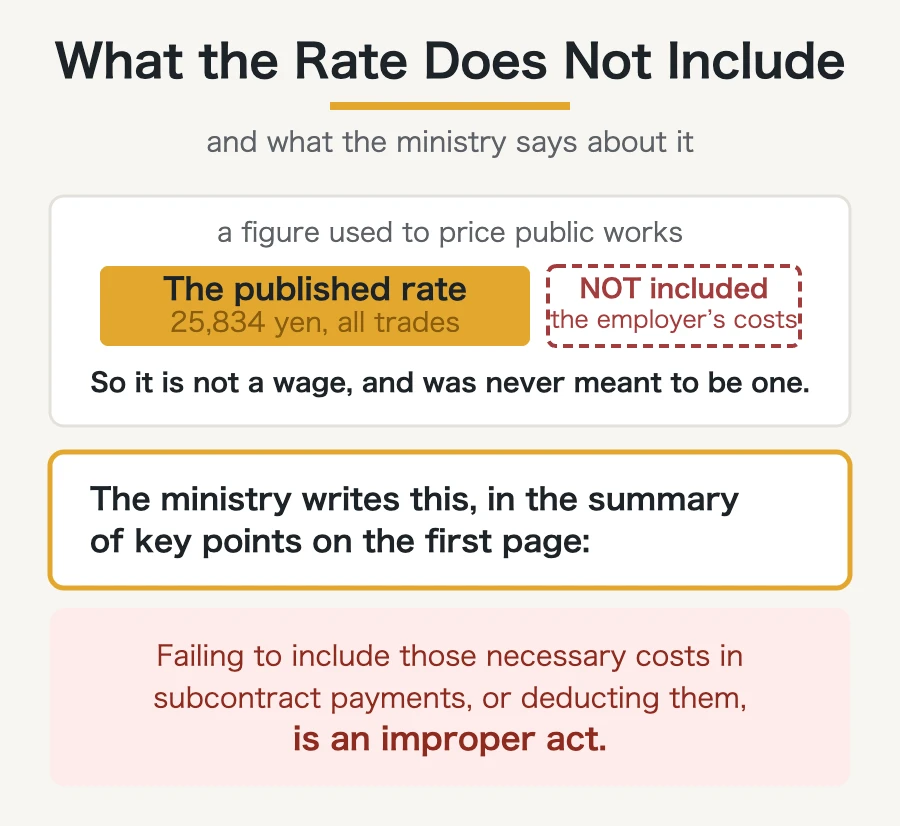
- That rate is not a wage. It excludes the costs the employer has to carry, and the ministry states that deducting them is an improper act.
- I have no reliable take-home figure for construction work here, and Chapter 5 explains why rather than guessing.
- Ask one question before you sign: is it nikkyu geppo, and what happens on a rained-off day?
Hi there, I’m Shirokuma!
If you’re thinking about construction work in Japan, there’s one question you want answered before any of the others, and most articles about working here skate past it. What does it pay?
This article is about construction wages in Japan, and Japan has an unusual answer to that question. Every March, the government publishes a daily rate for fifty-one construction trades, in each of the forty-seven prefectures. You can look up your own trade, in the prefecture you’d be working in, and read a number.
I’m going to show you those numbers.
But I need to tell you two things first, and I’d rather do it here than bury them.
That published number is not your wage. It isn’t a salary, it isn’t a promise, and the ministry that publishes it says so itself, in a sentence I’ll quote in full later because it’s the most important thing in this article.
And I am not going to give you an average take-home figure for construction work in Japan. I looked for one I’d be willing to stand behind and couldn’t get it from a source I trust. I’d rather tell you that than make something up.
In this article, you’ll learn:
- What each of the main trades is officially valued at, per day
- How that figure has moved over the last fourteen years, and what it was before
- What the published rate deliberately excludes
- How construction pay is actually structured here — daily, monthly, and what happens when it rains
- What to ask before you agree to anything
Japan Publishes a Price for Your Trade
The document is called the 公共工事設計労務単価 (kōkyō kōji sekkei rōmu tanka) — the design labour unit price for public works. It’s published by the Ministry of Land, Infrastructure, Transport and Tourism.
What it covers
It sets a daily rate for 51 trades, in each of the 47 prefectures. Not a national figure with regional guesswork attached — an actual number for, say, a steel fixer in one prefecture and a different number for the same trade in another.
When it changes
Every year, in March. The current edition was announced on February 17, 2026 and applies from March 2026.
The figures come from the public works labour cost survey carried out the previous fiscal year. So the rate isn’t set by negotiation or by decree — it’s a measurement of what was actually being paid, fed back into what the state will price work at next.
Why it exists at all
This is the part that explains everything else about it.
The rate exists so that public construction work can be priced. When a government body puts a project out to tender, somebody has to calculate what the labour in that project costs. The unit price is the number used for that calculation.
That purpose is worth holding onto, because it’s the reason the number behaves the way it does — and the reason it is not, and was never meant to be, a wage.
What Each Trade Is Worth
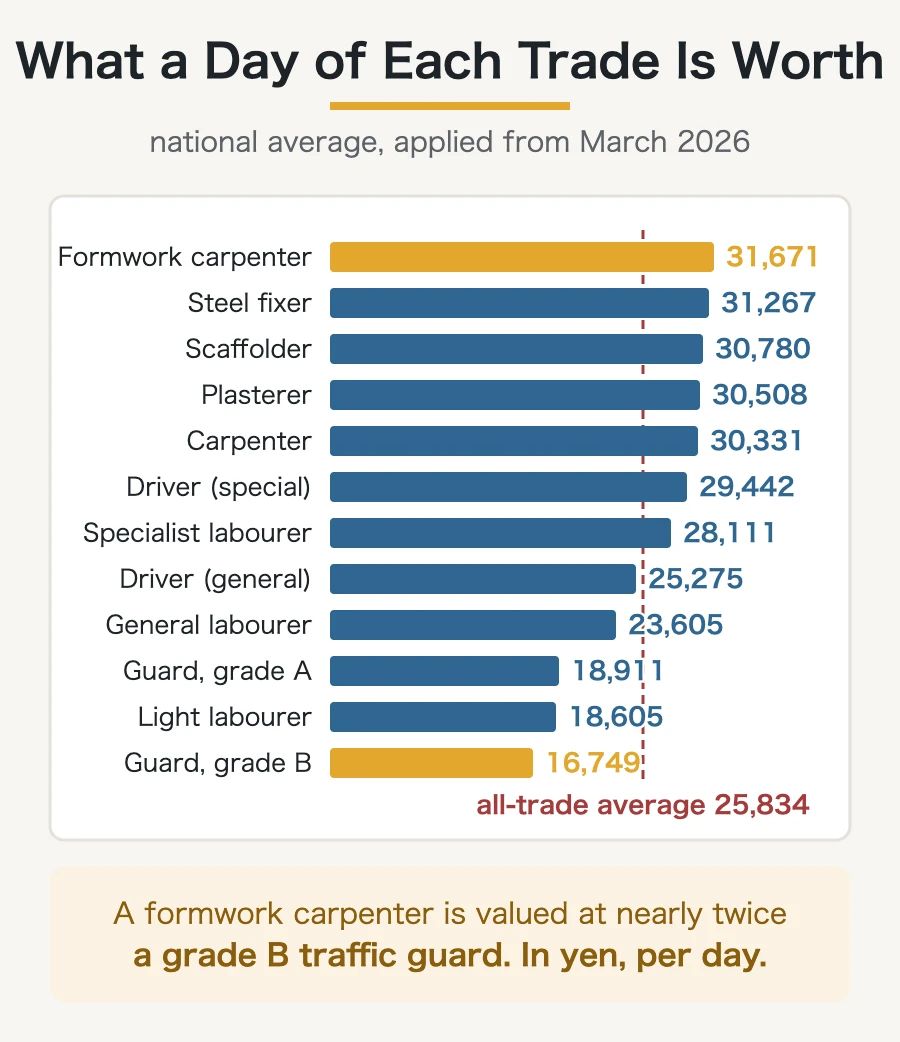
Here are the twelve main trades at the national average, under the rates applied from March 2026. The percentage is the change from the previous year.
| Trade | Per day | Change |
|---|---|---|
| Formwork carpenter (katawaku-kō) | ¥31,671 | +5.0% |
| Steel fixer (tekkin-kō) | ¥31,267 | +4.6% |
| Scaffolder / steel erector (tobi-kō) | ¥30,780 | +4.0% |
| Plasterer (sakan) | ¥30,508 | +4.1% |
| Carpenter (daiku) | ¥30,331 | +3.1% |
| Driver, special vehicles | ¥29,442 | +4.8% |
| Specialist labourer | ¥28,111 | +4.3% |
| Driver, general | ¥25,275 | +2.9% |
| General labourer | ¥23,605 | +3.0% |
| Traffic control guard, grade A | ¥18,911 | +5.8% |
| Light labourer | ¥18,605 | +2.9% |
| Traffic control guard, grade B | ¥16,749 | +6.7% |
The weighted average across all 51 trades is ¥25,834, which is the first time the figure has gone above ¥25,000. The twelve main trades above average ¥24,095.
What the spread tells you
Look at the top and the bottom. A formwork carpenter is valued at nearly twice a grade B traffic control guard — ¥31,671 against ¥16,749.
That gap is the clearest statement in the whole document about what Japanese construction considers skilled work. The trades that shape the structure sit at the top. They’re also, not coincidentally, the trades where it takes years to become useful.
A note on currency
I’m giving these in yen only, deliberately. Exchange rates move, and a conversion I write today is wrong by the time you read it. Convert at whatever today’s rate is — and remember you’d also be spending in yen, so the conversion matters less than it looks.
Fourteen Years of Going Up
A single year’s figure doesn’t tell you much. The series does.
The rate has risen every year since 2013
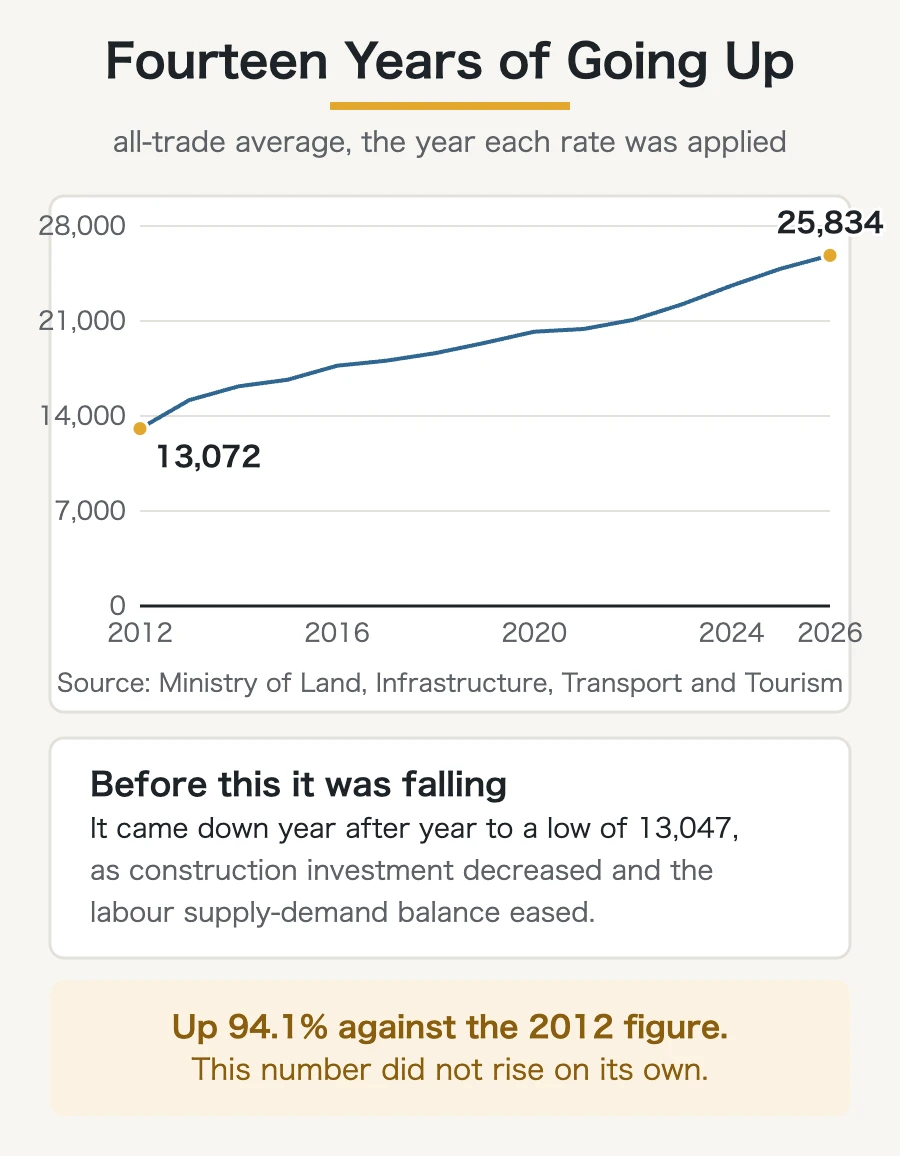
The March 2026 revision is the fourteenth consecutive annual increase, counting from the revision in fiscal 2013.
And the scale of it is larger than “fourteen increases” sounds. Against the fiscal 2012 figure, the all-trades rate is up 94.1 percent. The twelve main trades are up 93.4 percent.
It has roughly doubled.
What it was doing before that
Here’s the part that gives the increase its meaning.
Before 2013, the rate was falling — and it had been falling for years. From a high above ¥19,000 it came down, year after year, to a low of ¥13,047.
The ministry’s own chart annotates that decline plainly: it fell as construction investment decreased and the labour supply-demand balance eased. Less work, more people available for it, lower price.
So the shape of the whole series is a long fall, a bottom, and then fourteen years of climbing back and past where it started.
Two things changed in 2013
The fiscal 2013 revision wasn’t just another annual adjustment. The ministry notes two things about it: the calculation method changed substantially, and the amount corresponding to required statutory welfare costs was reflected in the figure.
That matters for reading the graph honestly. Part of the jump at the bottom of the curve is the rate starting to include something it hadn’t included before — not purely the market moving.
The useful way to read this chapter: this number did not rise on its own. It fell for a decade when there was less work than there were people. It has risen for fourteen years under a deliberate policy of raising it. Either way, it moved because of decisions — which is worth knowing if you’re deciding whether this industry is somewhere to build a career.
The Sentence the Ministry Had to Write
Now the most important part of the document, and it isn’t a number.
On the first page of the announcement, in the summary of key points, the ministry writes this:
The design labour unit price for public works does not include the personnel costs that the employer is required to bear. Accordingly, failing to include those necessary costs in subcontract payments, or deducting them from subcontract payments, is an improper act.
Read it twice. There are two separate statements in there and both matter.
One: the rate is not a wage
The published figure excludes the costs the employer has to carry — the employer’s share of social insurance and the rest of what it costs to employ somebody rather than simply to have them show up.
So the daily rate is not what lands in a worker’s hand, and it was never supposed to be. It’s a component used to price work, not a wage being announced.
Two: and don’t treat it as a ceiling
The second half of the sentence is doing something different. It’s telling the people who read this document what they must not do with it: do not leave those costs out of what you pay down the chain, and do not deduct them. That, the ministry says, is improper.
What I’m not going to do here
I’m not going to speculate about why a ministry needed to write that sentence, or about how often the thing it warns against happens.
What I’ll say is only this, because it’s visible on the page: the warning is there, it’s in the summary of key points rather than buried in an appendix, and somebody decided it needed to be said.
Sources: Ministry of Land, Infrastructure, Transport and Tourism, on the design labour unit price for public works applied from March 2026, announced February 17, 2026, and the accompanying announcement document. The quotation above is my translation of the third key point on its first page.
Construction Wages in Japan: Why I Can’t Give You an Average
You’ve now seen what the state says a day of your trade is worth. The obvious next question is what actually arrives in your bank account, and here I have to disappoint you deliberately rather than accidentally.
I don’t have a figure for construction take-home pay in Japan that I’d be willing to put in front of you. Let me explain exactly why, because the reasons are useful in themselves.
The national wage survey doesn’t break construction out — not in the part I can read
Japan runs a national survey of wage structure, and its preliminary results for 2025 were published in January 2026. The headline is that pay for regular workers reached ¥340,600 per month, up 3.1 percent and the highest on record.
That figure is for all industries, not construction. The preliminary release tabulates by education, length of service and age — not by industry in a form I could read off it.
And that number means something narrower than it looks
Here’s the part that matters more.
The survey’s own note defines the figure precisely: it is the average of scheduled pay for the month of June 2025. Scheduled pay. Not overtime, and not bonuses.
Now think about construction. Overtime has been the defining feature of this industry’s working hours for decades — it’s the whole reason the 2024 cap was such a big change. Applying an all-industry, overtime-excluding figure to construction work would be wrong in a direction I can’t size for you.
So I’m not going to do it.
Even a correct average would mislead you
Suppose I had the exact construction figure. It still wouldn’t answer your question.
Go back to the table in Chapter 2. The official daily rates run from ¥16,749 to ¥31,671 depending on trade. On top of that spread sits a prefecture, an experience level, a company, and the structure of how you’re paid — which is the next chapter.
An average across all of that tells you about the industry. It doesn’t tell you about you.
What there is instead
One thing is firm, and it’s a rule rather than a statistic.
If you come through the specified skilled worker route, the requirement on the employer is pay equal to a Japanese worker with equivalent skills. Not a fair wage, not the legal minimum — equivalent. I’ve written about what that means and what else a company has to have in place before it can hire you, and I’d read that before signing anything.
How Construction Pay Is Actually Structured
This is the part nobody explains to people arriving from outside, and it’s where most of the surprises live.
Nikkyū geppō: paid by the day, settled by the month
The common arrangement for trades is 日給月給 (nikkyū geppō), which translates awkwardly because it’s two words stuck together: daily wage, monthly salary.
What it means in practice: you earn a daily rate for the days you work, and the total is paid to you together at the end of the month, on the company’s payday.
So it looks like a monthly salary when it arrives. It isn’t one. It’s the days you worked, added up.
Hold that distinction, because everything in the rest of this chapter follows from it.
Jōyō and uke: two ways work gets charged
You’ll hear two words for how a piece of work is arranged, and the difference affects how the day feels.
請け (uke) is work within the contract — the scope that was priced and agreed.
常用 (jōyō) is work outside it. When something comes up that wasn’t in the contracted scope, it gets charged on a day-rate basis instead.
| Japanese | Say | What it is |
|---|---|---|
| 請け | uke | Work inside the contract — the scope that was priced and agreed |
| 常用 | jōyō | Work outside it, charged on a day-rate basis instead |
Here’s the thing about jōyō that’s worth knowing: it can be haggled down. Because it’s charged by the day rather than by the job, there’s room for argument about how many days it should have taken. Which means that when work is running on a jōyō basis, finishing it quickly is in everybody’s interest — the crew’s as much as the contractor’s.
And then it rains
Now the consequence of nikkyū geppō that catches people out.
If the work is paid by the day, and rain stops the day, what happens?
Three things, in my experience, and which one you get depends on your company and the situation.
Some companies pay a guarantee. There are employers who will cover a rained-off day rather than leave it at zero. Not all of them.
Usually, you get sent somewhere else. The normal response isn’t to go home — it’s to find a site that can work in the rain and send the crew there as support. Interior work, something under cover, somewhere the weather doesn’t reach.
And sometimes there’s nowhere to send you. If a site can’t be found, that’s when the day is genuinely lost.
If you take one practical thing from this article, take this question: **”Is it nikkyū geppō, and what happens on a rained-off day?”** Ask it before you agree to anything. The answer varies by company, it is not something you can look up, and it is the difference between a predictable month and an unpredictable one — in a country with a rainy season.
Source: Ministry of Health, Labour and Welfare, preliminary results of the 2025 Basic Survey on Wage Structure, published January 16, 2026. The survey’s own note defines the figure used here as the average of scheduled pay for June 2025.
What Moves Your Number
Two things sit on top of the daily rate, and they pull in opposite directions.
Allowances: there is no standard
You’ll hear about allowances. Overtime, weekend work, hazardous work, sites that are a long way from home — these come up constantly in conversations about pay.
I can’t give you a table of them, and I want to be clear about why: allowances are set by each company. There isn’t an industry standard, there isn’t a published schedule, and two employers doing identical work can handle them completely differently.
That makes them something to ask about, not something to look up. And it makes them a reasonable test of an employer: a company that can answer precisely what allowances exist and under what conditions is telling you something about how it runs.
Gross is rising. Take-home is not keeping up.
Here’s the part I’d want to be told, if I were arriving.
Pay in Japan has been going up. You’ve seen it twice already in this article — the official daily rate has risen fourteen years running, and the national wage figure is at a record.
But the amount deducted before the money reaches you has been going up as well.
My own observation, from watching pay slips over years rather than from a statistic: the face amount increases, and what actually lands doesn’t increase with it. I can’t put a figure on that gap and I’m not going to pretend to. It’s what I see.
So if you read “wages in Japan are rising” and picture your bank balance rising at the same rate — adjust that picture.
Three years
Which leads to the practical conclusion I’d give someone planning to come.
If you want to get past that — to reach the point where the increases are actually showing up in what you take home — my honest estimate is that you need to stay around three years.
That’s a judgement, not a rule, and nobody will show you a document that says it. But it’s the number I’d give a person asking me whether this is worth doing, and it has a consequence worth thinking about before you start: the first year or two are not where the money is. They’re where the skill is. The money comes after, and only if you’re still there.
The Supervisor Is Paid Differently
One structural difference is worth knowing, especially if you’re deciding which part of this industry to aim at.
Days off
The trades are on nikkyū geppō — paid for the days they work.
Site supervisors are not. A supervisor is on a monthly salary, and a day off doesn’t reduce it. Rain, a public holiday, a day the site is closed — the salary is the same.
| The trades | A site supervisor | |
|---|---|---|
| How pay is set | Nikkyū geppō — by the days worked | A monthly salary |
| A day off | Reduces the month’s pay | Does not reduce it |
| A rained-off day | A real question, answered by the company | Paid the same |
That is a genuinely different relationship with the calendar. For a trade, a lost day is lost money. For a supervisor, it isn’t.
I’d add one honest qualification before anyone concludes the supervisor’s deal is simply better. The security sits on one side of the ledger; the hours sit on the other, and I’ve written elsewhere about what this industry’s hours used to be and what the 2024 overtime cap changed. Read that before you decide which one you want.
What to ask before you agree to anything
Here’s the whole article turned into questions. Ask these, in this order, and write the answers down.
- **Is this nikkyū geppō, or a monthly salary?** You now know the difference and why it matters.
- What happens on a rained-off day? Is there a guarantee, do you get sent to another site, or is it unpaid?
- Which allowances exist, and what are the conditions for each? There’s no standard, so a vague answer is itself an answer.
- **What is the daily rate, and how does it sit against the published rate for this trade in this prefecture?** Not a demand — a comparison you’re entitled to understand.
- If you’re coming through the specified skilled worker route, ask how the employer demonstrates pay equal to a Japanese worker with equivalent skills. It’s a requirement, so there should be an answer ready.
And one thing to do before the conversation
Look your trade up.
The rates are published per trade and per prefecture, every March, by the ministry. Find the number for the work you’d be doing, in the place you’d be doing it, and go into the conversation knowing it.
You will almost certainly be the only person in the room who did — and whatever the answer turns out to be, you’ll be having a different conversation than you would have had otherwise.
Frequently Asked Questions
How much does a construction worker earn in Japan?
I can tell you what the state says a day of each trade is worth — the table in Chapter 2, running from ¥16,749 for a grade B traffic control guard to ¥31,671 for a formwork carpenter, with an all-trades weighted average of ¥25,834.
I can’t give you an average take-home figure, and Chapter 5 explains exactly why rather than asking you to take it on trust.
Is the published rate what I get paid?
No. The ministry states that the rate does not include the personnel costs the employer is required to bear, and that failing to include those costs in subcontract payments, or deducting them, is an improper act. It’s a figure used to price public works, not a wage being announced.
Where can I look up my own trade and prefecture?
The rates are published by the Ministry of Land, Infrastructure, Transport and Tourism each year and applied from March. The 2026 announcement is linked at the end of Chapter 4, and it covers 51 trades across all 47 prefectures.
Are foreign workers paid the same as Japanese workers?
There’s a legal requirement, and it’s worth knowing precisely. On the specified skilled worker route, the employer must pay an amount equal to a Japanese worker with equivalent skills. Not a fair wage, not the minimum — equivalent. How to check that a company is set up to meet its obligations is covered in my article on getting into construction work in Japan.
Do I get paid if it rains?
It depends on the company, and you should ask before you agree to anything. In my experience there are three outcomes: some employers pay a guarantee, most will send the crew to a site that can work under cover, and occasionally there’s nowhere to send you and the day is lost.
Why has the rate doubled?
Fourteen consecutive annual increases since the fiscal 2013 revision, from a low point of ¥13,047. Two honest caveats: the rate had been falling before that as construction investment declined, so part of the rise is recovery rather than gain; and the 2013 revision itself changed the calculation method and began including statutory welfare costs, so part of the step up is a change in what the number counts.
Summary: Look Up the Number, Then Ask the Questions
Three things to take away.
Japan publishes a price for your trade. Fifty-one trades, forty-seven prefectures, revised every March, free to read. Formwork carpenter ¥31,671 a day, general labourer ¥23,605, grade B traffic guard ¥16,749, all-trades average ¥25,834. Very few countries hand you that.
It is not your wage, and the ministry says so. It excludes the costs the employer has to carry, and the announcement states plainly that leaving those costs out of subcontract payments, or deducting them, is improper. Read the number as information, not as a promise.
And how you’re paid matters as much as how much. Nikkyū geppō means you’re paid for days worked, which makes a rained-off day a real question. Allowances vary by company with no standard to check against. And gross pay rising doesn’t mean take-home pay rising at the same rate.
What I left out
- An average take-home figure for Japanese construction work. I couldn’t source one I’d stand behind, and Chapter 5 sets out why the figure people usually quote doesn’t fit this industry.
- Any conversion into your currency. Rates move; mine would be stale.
- Any theory about why the ministry needed to write its warning. The warning is on the page. The reason isn’t, so I haven’t invented one.
Where to read next
The route in, and what a company must have in place before it can hire you: Construction Work in Japan: How to Actually Get In — the two tests, the categories, and how to check an employer before you sign.
What the trades at the top of that table actually do: Shokunin: Who’s Who on a Japanese Construction Site — the trades, the ranks, and how skill gets recognised here.
Why a day is the unit that matters so much: Construction Schedules in Japan: Who Actually Sets Them — who decides how long a job gets, and who carries it when it runs long.
Thanks for reading. If you’re working here and your pay is structured differently from what I’ve described, tell me — I’d rather this article got more accurate.
— Shirokuma