Japanese Construction Terms: The Words You’ll Hear on Site
The short version
- The goal here is not fluency. It is access — if you cannot follow what someone tells you while the work is in front of you, you miss the training, not just the words.
- Twenty-one tables of the words you will actually hear, from materials and tools to what gets shouted across a slab.
- Six phrases matter more than any vocabulary table. They are in chapter 7.
- There is a printable pocket card at the end, sized to carry.
- You can spend five years here and come away with five years of experience, or one year repeated five times. The difference is whether you could ask.
Hi there, I’m Shirokuma!
In my last article I said something I want to make good on.
I wrote that the craftspeople you’ll work beside don’t speak English and won’t try, and that if you arrive without the words for the things in front of you, the normal way of learning on a site — asking — is closed to you. You can be a skilled worker and still be stuck.
That’s a fair warning and a useless one on its own. So this article is the other half.
It’s the Japanese construction terms you’ll actually hear on site — the words themselves, and what to do when you meet one that isn’t in any of them.
Here’s what I actually did when I had people on my sites who didn’t share a language with me. I used a translation app for direct instructions — not elegant, but “move this here, we’re pouring at two” survives a phone. And for everything else I drew. On the drawing, on a scrap of paper, on the back of a work request sheet. A sketch of a detail means the same thing in every language.
Those two things got us through the day. What got people past the day was knowing the words.
In this article, you’ll learn:
- How language actually works on a Japanese site — which is not how it works in a classroom
- The words you’ll hear on your first morning, the names of materials and tools, and the ones that aren’t in any dictionary
- What to say when you don’t understand, which matters more than anything else here
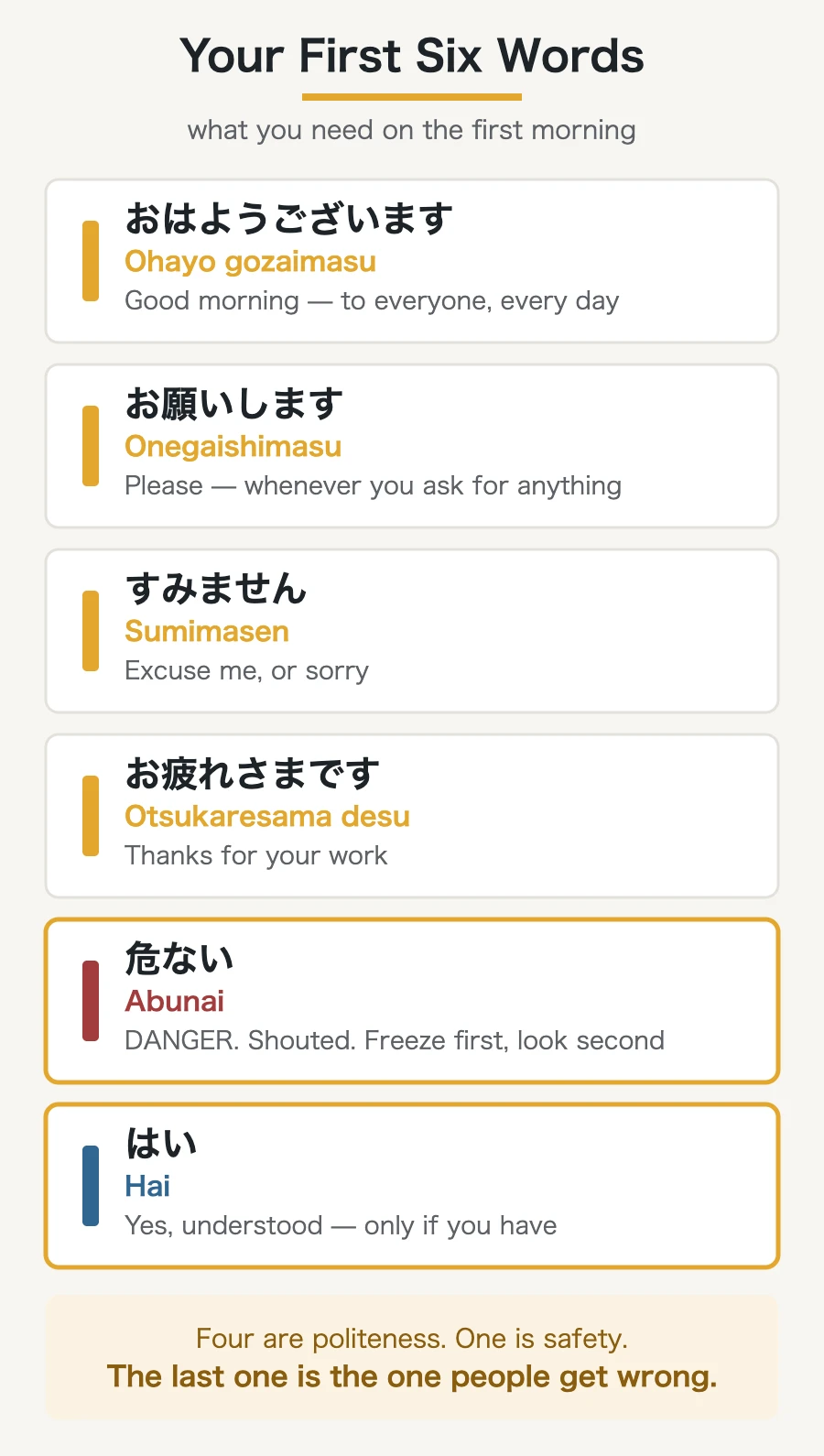
If you read nothing else, read these six. They are what you need on your first morning, before any of the vocabulary below.
- おはようございます — Ohayō gozaimasu — Good morning. To everyone, every morning, whether or not they answer at first.
- お疲れ様です — Otsukaresama desu — Thanks for your work. Passing someone, leaving, ending anything.
- ありがとうございます — Arigatō gozaimasu — Thank you. Say it for the small things too, not only the favors.
- すみません — Sumimasen — Excuse me, or sorry. To interrupt, or to pass behind someone.
- 危ない — Abunai — Danger. Stop. It’s shouted, not spoken. If you hear it, freeze first and look second — and you are allowed to shout it yourself, at anyone, on your first day.
- ヨシ! — Yoshi! — “Checked, and good.” Called out while pointing at the thing you’ve just checked. Join in — chapter 2 explains why.
Four of those are courtesy and two are safety. Nobody will mind if your grammar is wrong. People will notice whether you say these.
One honest note before we start. Everything below is what I heard and used on the sites I worked on. Japan is not uniform — trades, regions and companies say things differently, and an older carpenter in one prefecture will use a word a young scaffolder in another has never heard. Treat this as a starting vocabulary, not a standard.
How Language Actually Works on a Site
You won’t have conversations
This is the thing that surprises people who studied Japanese properly.
On site, almost nothing is said in full sentences. Work talk is short because it’s happening next to noise, at distance, through a mask, with gloves on, while someone is holding something heavy. Grammar is the first thing to go.
What’s left is usually a noun, a place, and a time.
Tekkin, koko, gogo. Rebar, here, this afternoon.
That’s not broken Japanese. That is the language of the site, and Japanese workers speak to each other the same way. Nobody will think less of you for it.
Which means nouns come first
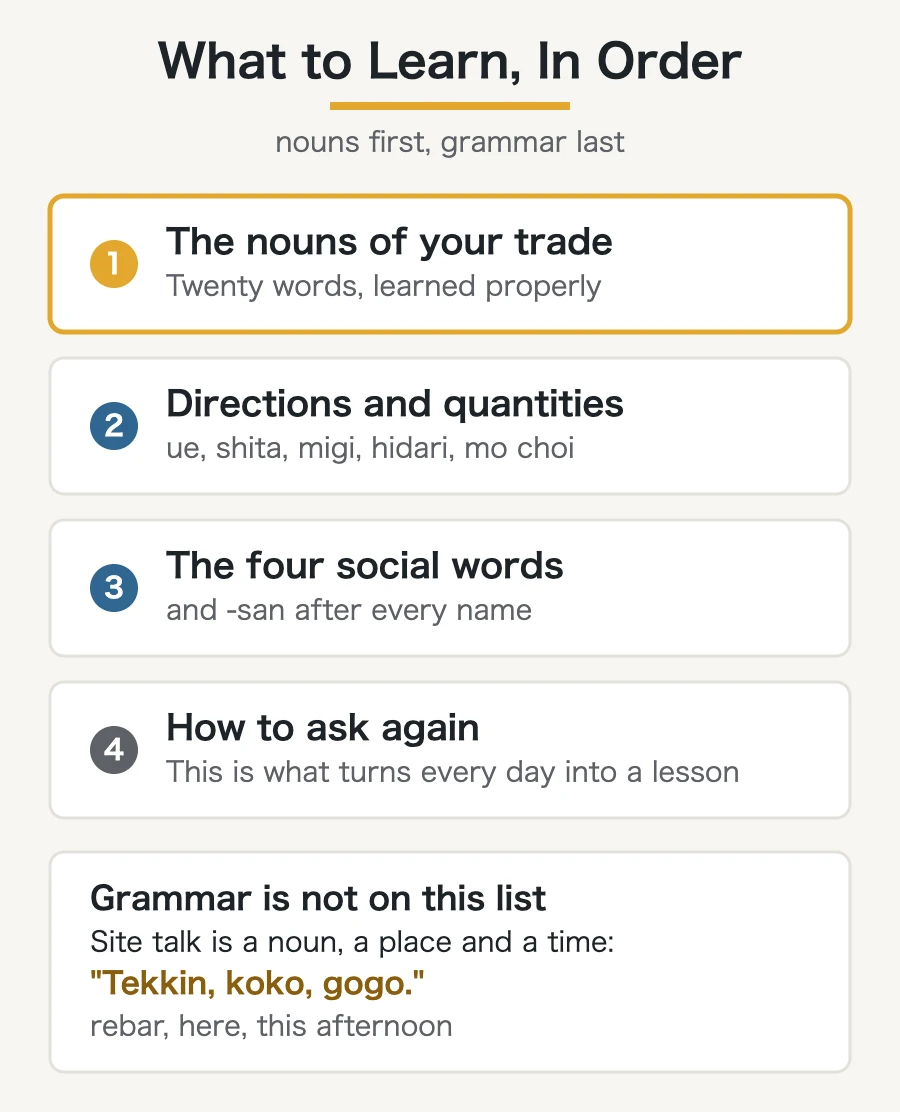
If you only have a few weeks before you arrive, don’t spend them on verb conjugation. Spend them on the names of the things in your own trade.
Here’s why, in order of how much it changes your day:
- Nouns let you understand an instruction. Without them you can’t act.
- Directions and quantities let you carry it out. Ue, shita, mou sukoshi.
- Four social words make you a person people want to work with (below).
- One question — how to ask again — turns every day into a lesson.
Sentences come after all of that, if they come at all. I’ve worked with people who never built a proper sentence in Japanese and were completely trusted, because they always understood what was being asked and always said so when they didn’t.
The four words that do the social work
Japanese has a reputation for elaborate politeness, and that reputation is earned — in offices. On a site, four expressions carry almost all of it.
| Japanese | Say | Means |
|---|---|---|
| おはようございます | Ohayō gozaimasu | Good morning — to everyone, every morning, whether or not they answer |
| お疲れ様です | Otsukaresama desu | Thanks for your work — passing someone, leaving, ending anything |
| ありがとうございます | Arigatō gozaimasu | Thank you — for small things as well as favors |
| すみません | Sumimasen | Excuse me, or sorry — to interrupt, or to pass behind someone |
One more you’ll hear constantly: onegaishimasu (お願いします), which sits somewhere between “please” and “I’m counting on you.” It goes with almost any request, and it’s worth adding as soon as the four above are automatic.
You do not need keigo — the formal register people study for job interviews. Nobody on a scaffold is using it. These four, said clearly and often, do more for you than three months of grammar.
Add -san to names and job titles and you’re finished with politeness. The foreman is shokuchō-san. The person whose name you’ve forgotten is -san attached to whatever you do remember.
Loud is not angry
Worth saying plainly, because it’s a common misreading.
People on site speak loudly, repeat themselves, and cut you off mid-sentence. That’s the environment, not the mood. A foreman shouting a one-word correction across a slab is doing his job at the speed the job needs. If someone is actually angry with you, you’ll know, and it will be quieter than you expect.
And when words run out, draw
I’ll come back to this at the end, but it belongs here too.
Construction is one of the few trades where the professional vocabulary is genuinely visual. A sketch of how two things meet is understood identically by a Japanese carpenter, a Filipino steel fixer and a Vietnamese pipe fitter. When a sentence fails, a line on paper usually doesn’t.
Learn to draw what you mean. It’s faster to acquire than fluency, and it works on your first morning.
The Words You’ll Hear on Day One
Before you set foot on site
Your first Japanese word on a Japanese project is probably a long one.
新規入場者教育 (shinki nyūjōsha kyōiku) is the new entrant induction — the session every worker sits through before their first day on that particular site. Not your first day in Japan: your first day on that site. You’ll do it again at the next one.
It covers the site rules, the hazards, where you may and may not go, and who is responsible for what. Ask in advance what language it will be in. On my sites we had ours rewritten into English, Vietnamese and Tagalog, because that was who was coming through the gate — but nobody is required to do that, so it’s worth asking before you accept a job.
The morning
| Japanese | Say | Means |
|---|---|---|
| 朝礼 | chōrei | The morning meeting. Everyone on site, same place, same time, every day |
| ラジオ体操 | rajio taisō | The radio exercises many sites do straight after chōrei |
| KY・危険予知 | kē-wai / kiken yochi | Hazard prediction — the short talk about what could go wrong today |
| 安全第一 | anzen daiichi | “Safety first.” You’ll see it on the gate and hear it in the meeting |
| ヨシ! | yoshi! | “Checked — good.” Said out loud while pointing at the thing you checked |
That last one deserves a note, because it looks strange the first time.
Pointing at something and calling out yoshi! is called 指差呼称 (shisa koshō). It feels theatrical until you understand what it’s for: saying a check out loud makes you actually do it instead of assuming you did. Everyone does it. Join in — refusing to looks like refusing the safety culture itself.
For what the whole morning looks like, I’ve written it out hour by hour in A Day on a Japanese Construction Site.
The clock
| Japanese | Say | Means |
|---|---|---|
| 一服 | ippuku | The break. Usually around 10:00 and 15:00, and it isn’t optional |
| 昼礼 | chūrei | The foremen’s midday meeting, where tomorrow gets arranged |
| 片付け | katazuke | Clearing up. Counted as part of the work, not something after it |
Ippuku originally meant “one smoke,” and you’ll still hear it used whether or not anyone is smoking. If someone says ippuku shiyō — let’s take a break — that’s an invitation, and taking it is usually a better idea than proving how hard you work.
The signs
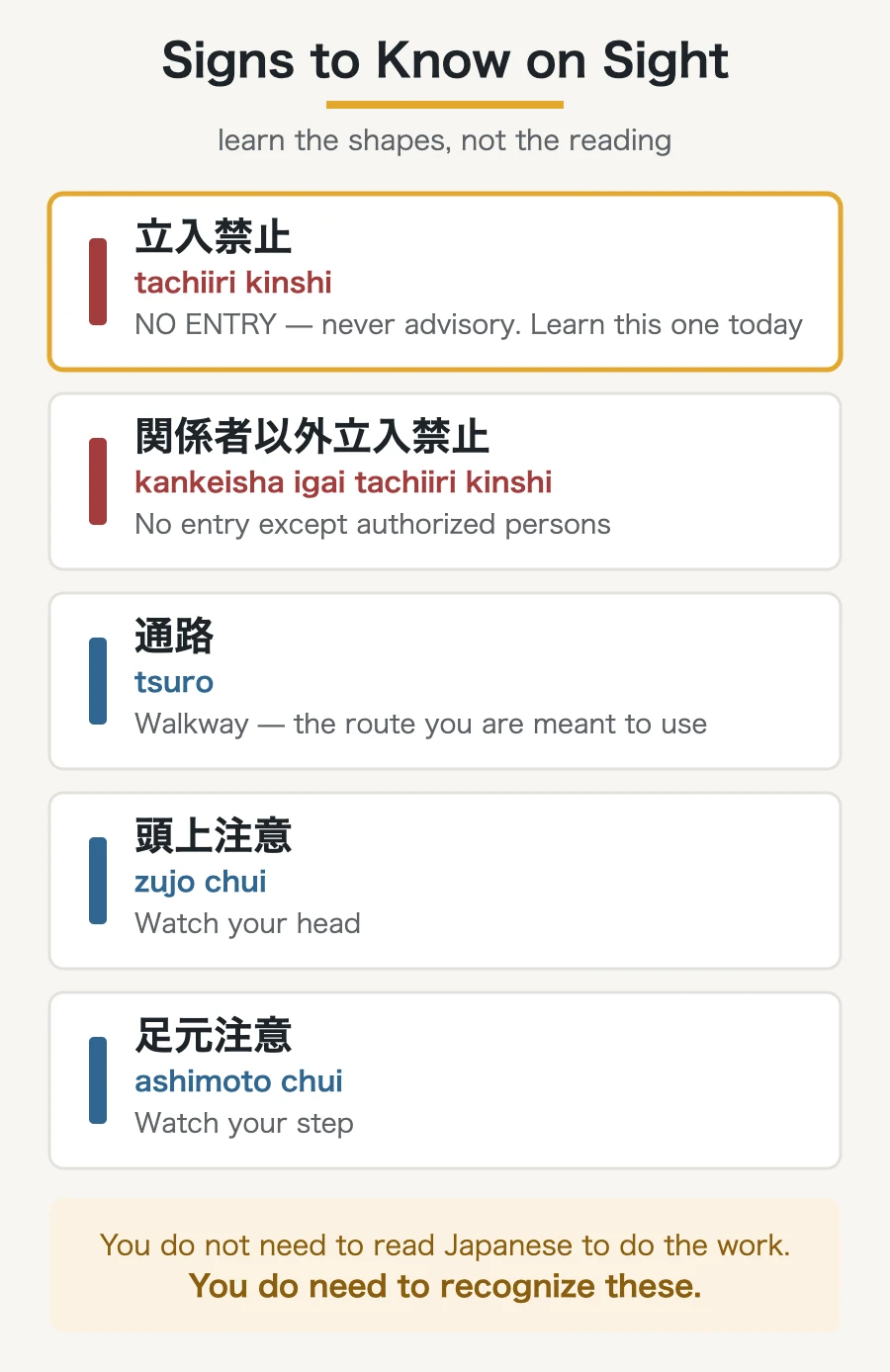
You’ll read these long before you can read anything else, so learn the shapes.
| Japanese | Say | Means |
|---|---|---|
| 立入禁止 | tachiiri kinshi | No entry |
| 関係者以外立入禁止 | kankeisha igai tachiiri kinshi | No entry except authorized persons |
| 通路 | tsūro | Walkway — the route you’re supposed to use |
| 頭上注意 | zujō chūi | Watch your head |
| 足元注意 | ashimoto chūi | Watch your step |
立入禁止 is the one to memorize today. A barrier in Japan is not advisory. If it’s up, someone put it there for a reason, and walking past it is the fastest way to lose the trust you’re trying to build. The reasoning behind rules like this is in Construction Safety in Japan.
The single most useful word
If you learn one word from this entire article, learn this one:
危ない (abunai) — dangerous, watch out, stop.
It’s shouted, not spoken. If you hear it, freeze first and look second. And if you see something about to go wrong, you are allowed to shout it yourself, at anyone, regardless of how new you are or how junior. Nobody will hold that against you. On a Japanese site, the person who calls a hazard is doing exactly what they’re supposed to do.
The people
You’ll hear job titles far more often than names in the first weeks.
Shokuchō is the foreman who leads a crew and answers for its safety. Oyakata runs the company. Motouke is the main contractor, shitauke the subcontractor. All of them take -san.
I’ve written about who’s who, and how the ranks fit together, in Shokunin: Who’s Who on a Japanese Construction Site.
The Names of Things: Japanese Construction Terms by Trade
Learn your own trade first, everything else later
This is the longest section, and I don’t want you to try to memorize it.
Find the table for the work you actually do and learn that one properly. Twenty nouns you’ll hear forty times a day will do more for you than two hundred you’ll hear once. The rest is here so that when a word floats past you from another trade, you can place it.
Concrete and formwork
| Japanese | Say | Means |
|---|---|---|
| 生コン | namakon | Ready-mixed concrete, as delivered by truck |
| 打設 | dasetsu | The pour itself. “Dasetsu wa ashita” — the pour is tomorrow |
| 型枠 | katawaku | Formwork — the mould the concrete is poured into |
| 支保工 | shihokō | The shoring holding that formwork up |
| バラす | barasu | To strike the formwork, to take it apart (see chapter 6) |
| 天端 | tenba | The top surface, and the level it’s supposed to finish at |
| スラブ | surabu | Slab |
Rebar
| Japanese | Say | Means |
|---|---|---|
| 鉄筋 | tekkin | Reinforcing bar. A steel fixer is a tekkin-kō |
| 主筋 | shukin | Main bars — the ones carrying the load |
| 帯筋・あばら筋 | obikin / abarakin | Ties and stirrups, the bars wrapping the main steel |
| かぶり | kaburi | Concrete cover — the distance from bar to surface |
| 結束線 | kessokusen | Tie wire |
| ハッカー | hakkā | The hooked tool used to twist that wire |
| 継手 | tsugite | A splice where two bars lap |
かぶり is worth learning even if you’re not a steel fixer. It’s checked, it’s photographed, and it’s the thing an inspector will point at.
Steel frame
| Japanese | Say | Means |
|---|---|---|
| 鉄骨 | tekkotsu | Structural steel |
| 建方 | tatekata | Erecting the frame |
| 高力ボルト | kōryoku boruto | High-strength bolt |
| 溶接 | yōsetsu | Welding |
| デッキプレート | dekki purēto | Metal deck laid over the beams |
| 柱・梁 | hashira / hari | Column / beam |
Interior finishing
| Japanese | Say | Means |
|---|---|---|
| 内装 | naisō | Interior finishing work as a whole |
| 下地 | shitaji | The backing or substrate — what the finish goes onto |
| 軽鉄 | keitetsu | Light gauge steel framing for ceilings and partitions (also “LGS”) |
| ボード | bōdo | Plasterboard |
| 間仕切り | majikiri | Partition |
| 建具 | tategu | Doors, windows and fittings |
| 巾木 | habaki | Skirting board |
Services — pipes, ducts and wiring
| Japanese | Say | Means |
|---|---|---|
| 設備 | setsubi | Mechanical and plumbing work, and the people who do it |
| 電気 | denki | Electrical work |
| 配管 | haikan | Pipework |
| 配線 | haisen | Wiring |
| ダクト | dakuto | Duct |
| スリーブ | surību | A sleeve cast into concrete for a pipe to pass through |
| インサート | insāto | An insert cast into the slab to hang things from |
| 天井内 | tenjōnai | The ceiling void — crowded, and shared by several trades |
Two words you’ll hear from everyone
Two nouns cross every trade, and both confuse newcomers for the same reason: they don’t map onto one English word.
墨出し (sumidashi) is setting out — snapping the lines on the floor and walls that everything else gets positioned from. Sumi is the ink itself. If someone says sumi ga nai — there’s no line — work stops until there is one, because guessing is not an option. The tool is a sumitsubo, and I wrote about it in the tool belt article.
養生 (yōjō) means two things that feel unrelated until you’ve been on site a while:
- Curing concrete — keeping it wet and protected while it gains strength
- Protecting finished work — the sheets, boards and tape over a floor, a lift car or a doorway so the next trade doesn’t damage it
Both are the same idea in Japanese: looking after something so it turns out right. Once you see that, the word stops being confusing. And the amount of yōjō on a Japanese site genuinely surprises people arriving from elsewhere — protecting other people’s finished work is treated as part of your job, not a favor.
The Words for Tools
Why this list matters more than it looks
Tool words come up constantly, and almost always as a request. Someone needs something, their hands are full, and they say one noun at you.
Get these and you become useful on day one, which is a much faster route to being taught things than being careful and quiet.
Measuring and marking
| Japanese | Say | Means |
|---|---|---|
| スケール | sukēru | The steel tape measure. This is what people actually say |
| 差し金 | sashigane | The L-shaped carpenter’s square |
| 墨つぼ | sumitsubo | The ink line used for setting out |
| 水平器 | suiheiki | Spirit level (you’ll also just hear reberu) |
| レーザー | rēzā | Laser level |
A note on the tape measure. In a catalogue or on the box it’s a konbekkusu — from “convex,” describing the curved steel blade. On the sites I worked on nobody said that. They said sukēru, and if you ask for a konbekkusu you may get a puzzled look before the right tool.
That gap is worth knowing about in general. The word printed on a product and the word shouted across a slab are often not the same, and it’s the second one you need.
Power tools
| Japanese | Say | Means |
|---|---|---|
| インパクト | inpakuto | Impact driver. The most-requested tool on any site |
| 電ドリ | dendori | Drill |
| サンダー | sandā | Angle grinder |
| 丸ノコ | marunoko | Circular saw |
| 発電機 | hatsudenki | Generator |
| ドラム | doramu | The extension cable reel |
Hand tools
| Japanese | Say | Means |
|---|---|---|
| 玄能・金槌 | gennō / kanazuchi | Hammer |
| バール | bāru | Pry bar |
| ラチェット | rachetto | Ratchet spanner — standard kit for scaffolders |
| シノ | shino | The tapered spike on a ratchet, for lining up holes |
| 番線 | bansen | Soft steel wire used for tying things temporarily |
| 脚立 | kyatatsu | Stepladder |
| 養生テープ | yōjō tēpu | The protective tape that removes cleanly |
Scaffolding
| Japanese | Say | Means |
|---|---|---|
| 足場 | ashiba | Scaffold |
| 単管 | tankan | Scaffold tube |
| クランプ | kuranpu | The coupler joining tubes |
| 手すり | tesuri | Handrail |
| 親綱 | oyatsuna | The lifeline you clip onto |
Safety gear — get these exactly right
| Japanese | Say | Means |
|---|---|---|
| ヘルメット | herumetto | Hard hat |
| ハーネス | hānesu | Full-body harness |
| ランヤード | ranyādo | The lanyard connecting harness to anchor |
| 安全靴 | anzengutsu | Safety boots |
| 地下足袋 | jikatabi | The split-toe footwear you’ll see on scaffolders |
| 手袋 | tebukuro | Gloves |
There’s a reason I’ve separated these out. A misunderstanding about a tool costs you a walk across the site. A misunderstanding about a harness costs more than that. If someone says something about your hānesu and you don’t follow it, stop and ask. Nobody has ever been annoyed at me for checking that twice.
What all of this looks like worn on a belt, and why people carry so little, is in The Japanese Tool Belt.
One rule about tools that isn’t a word
Don’t pick up someone else’s tools.
Not because anyone will shout at you — most likely nobody will say anything at all, which is worse. Tools here are personal. People buy their own, maintain them, and know exactly where each one sits on the belt. Borrowing without asking reads as a statement about how you regard the person.
Karite mo ii desu ka? — may I borrow this? — is a short sentence, and it’s one of the few full sentences in this article I’d genuinely recommend memorizing.
Directions and Signals
The words that move things
Once you can name a thing, the next job is moving it. This is a small vocabulary and you’ll use it more than any other.
| Japanese | Say | Means |
|---|---|---|
| 上・下 | ue / shita | Up / down |
| 右・左 | migi / hidari | Right / left |
| 前・後ろ | mae / ushiro | Forward / back |
| もうちょい | mō choi | A bit more — the site version of mō sukoshi |
| ゆっくり | yukkuri | Slowly |
| オーライ | ōrai | From “all right” — keep coming, you’re clear |
| ストップ・止めて | sutoppu / tomete | Stop |
| 待って | matte | Wait |
| ダメ | dame | No, don’t, not like that |
Ōrai catches people out because it sounds like agreement. It isn’t. It’s an instruction to keep going — used when reversing a truck or bringing a load down — and it stops the moment someone says sutoppu.
Say what you’re about to do
Here’s a habit that takes a week to build and marks you out immediately.
On a Japanese site, people announce their movements out loud. Not to be polite — so that nobody is surprised by a person appearing where they weren’t a second ago.
| Japanese | Say | Means |
|---|---|---|
| 入ります | hairimasu | I’m coming in |
| 通ります | tōrimasu | I’m coming through / passing behind you |
| 下ろします | oroshimasu | I’m lowering this |
| 上げます | agemasu | I’m lifting this |
| 開けます | akemasu | I’m opening this |
These are full sentences, which I said you wouldn’t need. They’re the exception, and they’re worth it, because each one prevents a specific accident.
Lifting signals are somebody’s job
When something is being lifted by crane, one person is designated to give the signals. It isn’t a role that whoever is nearest picks up.
So the rule for you is simple: if you are not that person, do not signal. Even if you can see the load better than they can, even if you’re sure. Two people signalling a crane is how a load goes somewhere nobody intended.
What you can always do is shout abunai. Stopping the job is never the wrong call.
The habit that matters most in this whole article
I’ve put this here rather than in the FAQ because it’s the thing I’d most want you to take away.
**Do not say hai when you haven’t understood.**
Hai means yes, and on site it functions as “understood, I’ll do it.” It’s easy to say when you’re new, tired, being spoken to quickly, and would rather not make someone repeat themselves. Everyone does it at least once.
The problem is that the person walks away believing something has been arranged that hasn’t. In an office that produces a bad afternoon. On a site it can produce a crew standing at the wrong place with a crane booked, or worse.
Nobody minds being asked again. Everybody minds finding out at 15:00 that something was never understood at 09:00. The next chapter is the small set of phrases that let you avoid it.
The Words That Aren’t in the Dictionary
Your app will fail you, and it’s worth knowing why
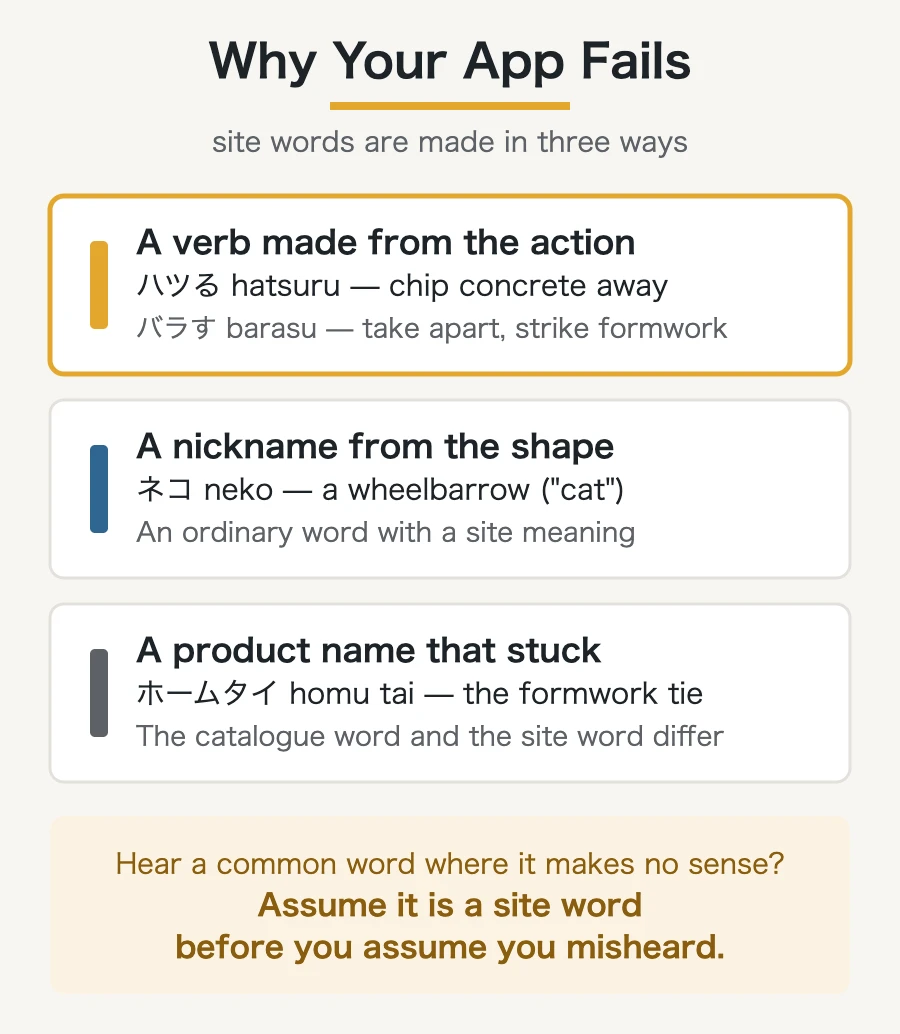
Some site words won’t be in your translation app, or will come back as something absurd. That isn’t the app being bad. It’s that these words were made on sites, by the people doing the work, and they were made in three predictable ways.
Once you can see the three patterns, an unfamiliar word stops being frightening. Here are five real ones.
Verbs invented from the action
| Japanese | Say | Means |
|---|---|---|
| ハツる | hatsuru | To chip hardened concrete away |
| バラす | barasu | To take apart — strike formwork, dismantle scaffold |
Japanese makes verbs out of almost anything by adding -ru, and sites do it more than anywhere else. Hatsuru is the sound and the act of chipping concrete off. Barasu is undoing something that was built to be undone.
Note that barasu is neutral. Nobody is destroying anything — formwork exists to be removed, and taking it down is a normal, skilled, scheduled job.
Nicknames from the shape
| Japanese | Say | Means |
|---|---|---|
| ネコ | neko | A wheelbarrow |
Neko means cat. The full name is nekoguruma — cat cart — and there are various stories about why. Nobody on site will tell you any of them. They will say “neko,” and point.
This is the pattern that catches people hardest, because the word is a completely ordinary Japanese word with a completely different meaning. If you hear a common word in a context where it makes no sense, assume it’s one of these before you assume you misheard.
Product names that became the word
| Japanese | Say | Means |
|---|---|---|
| ホームタイ | hōmu tai | The tie holding formwork at the right spacing |
Hōmu tai started as a product name. It’s now simply what the thing is called, by everyone, regardless of who made it.
You met this pattern already with the tape measure in chapter 4 — the catalogue says konbekkusu, the site says sukēru. It’s the same phenomenon from the other direction, and it’s why a vocabulary list built from product catalogues will quietly let you down.
And one word that’s just a noun made from a verb
| Japanese | Say | Means |
|---|---|---|
| フカシ | fukashi | Extra thickness added to a surface so it finishes where it should |
Fukasu means to build something out — to pack it thicker. Fukashi is the result. You’ll hear it when a wall has to come forward to cover a pipe, or to line up with something next to it.
It’s a good word to know even if you never say it, because if someone tells you there’s 30 mm of fukashi and you don’t know the word, you’ll set out from the wrong face.
Five words are not enough, and that’s the point
I’ve deliberately kept this short.
There are hundreds of these, they vary by trade and by region, and an article listing all of them would be an article nobody finishes. You’ll pick up the ones your own crew uses within a month, in the only way anyone ever does — hearing them, not reading them.
What you need isn’t the full list. It’s a reliable way to ask about the one word in front of you right now, which is the next chapter.
What to Say When You Don’t Understand
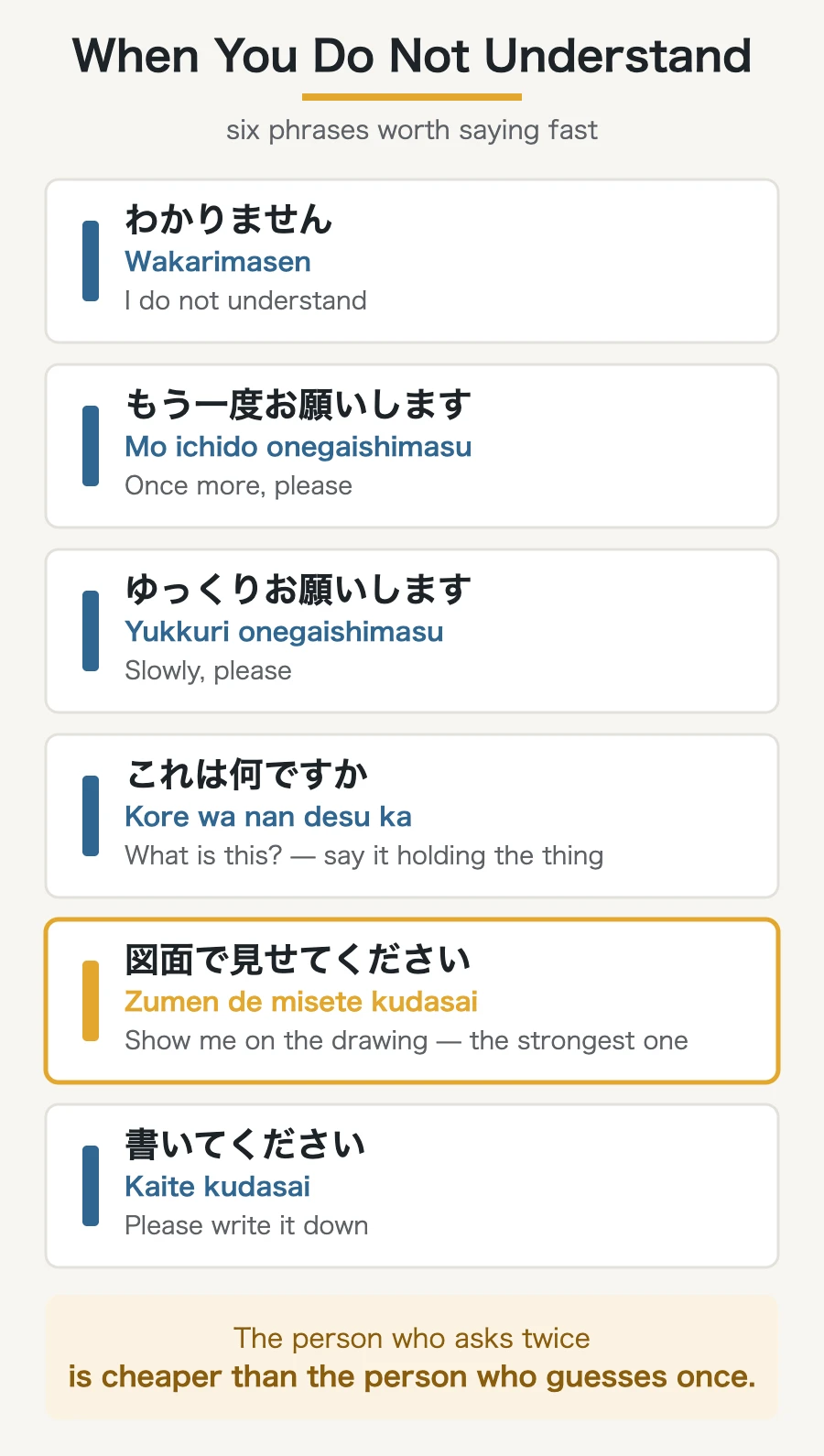
Six phrases, and then you can stop studying
Everything up to here has been vocabulary. This chapter is the part that keeps working after the vocabulary runs out, which it will, every day, for a long time.
| Japanese | Say | Means |
|---|---|---|
| わかりません | wakarimasen | I don’t understand |
| もう一度お願いします | mō ichido onegaishimasu | Once more, please |
| ゆっくりお願いします | yukkuri onegaishimasu | Slowly, please |
| これは何ですか | kore wa nan desu ka | What is this? |
| 図面で見せてください | zumen de misete kudasai | Please show me on the drawing |
| 書いてください | kaite kudasai | Please write it down |
Six phrases. If you learn nothing else in full-sentence form, learn these, and learn them well enough to say them fast — because the moment you need them is the moment you’re flustered.
The strongest one is about the drawing
Zumen de misete kudasai is the phrase I’d put above the rest, and not because of the Japanese.
It does something clever: it converts a language problem into a drawing problem. You may be new to Japanese, but you are not new to construction. On a drawing you are competent. You can point, measure, count, and disagree.
It also asks very little of the other person. You’re not asking them to teach you a language. You’re asking them to use the thing already rolled up under their arm — which takes ten seconds and is how they’d explain it to a Japanese apprentice anyway.
Point, and use “this”
Kore (this), sore (that), are (that over there). Combined with a finger, these three words carry an enormous amount of the day.
Kore, nan desu ka? — what’s this? — asked while holding the thing, is a complete and perfectly normal question. Nobody expects more.
And when you learn the answer, repeat it back once, out loud. It fixes the word, and it shows the person that their ten seconds worked.
Ask at the break, not during the lift
Timing matters as much as wording.
Do not stop a crew mid-lift to ask what something is called. Ask at ippuku, when people are sitting down with a drink and nobody is holding anything heavy.
This is how I learned most of what I know, incidentally. When I was young I’d just ask the craftspeople directly — “what kind of work is this?” — and they’d tell me, at length, because during a break there’s time and because people generally like explaining work they’re good at.
Same question during a concrete pour gets you a look, and rightly so.
Write it down the same day
Carry something to write on. A phone works; a small notebook in your belt works better, because it doesn’t need clean hands or a signal.
When you learn a word, write it as you heard it — katakana, romaji, whatever you can manage — and then draw the thing next to it. The drawing is the definition. You will not remember fukashi from a translation, but you will remember it from your own bad sketch of a wall packed out over a pipe.
Look at the page again that evening. Ten minutes on the day you heard a word is worth an hour a week later.
One last thing about asking
There’s a feeling, when you’re new and foreign and slow, that asking again is an imposition — that you’ve already used up your allowance of other people’s patience.
I want to be direct about this, because it costs people years.
The person who asks twice is cheaper than the person who guesses once. Everyone on that site knows it. A supervisor would far rather answer the same question three times in a morning than find out at 15:00 that a crew has been working from an assumption. When you ask, you are not taking something from the job. You are doing the job.
Questions People Actually Ask
Do I need to learn keigo?
No. Not for site work.
Keigo — the formal register — is for offices, clients and job interviews. On site, ohayō gozaimasu, onegaishimasu, sumimasen, otsukaresama desu, and -san after names cover almost everything. Spending study time on honorifics instead of the names of your materials is a bad trade.
Is JLPT N4 enough?
It’s enough to get the visa. It is not enough to work.
N4 is the level the Specified Skilled Worker route asks for, and I wrote about that requirement in Construction Work in Japan. The official description of N4 is “the ability to understand basic Japanese” — everyday topics, in basic vocabulary and kanji, spoken slowly (JLPT, checked September 29, 2026). But that is general Japanese — it will not contain kaburi, sumidashi, or fukashi, and those are the words your day is made of.
Think of N4 as the door and this article as the first week behind it.
Can I use a translation app on site?
Yes, for instructions. Be careful with it for safety.
I used one constantly for things like “move this here, we’re pouring at two,” and it worked fine. What I wouldn’t do is rely on it for a harness instruction, a crane signal, or anything where a mistranslation has a physical consequence. For those, ask someone to show you.
And don’t use it while walking, and never at height. That’s not a language rule, it’s the same rule as a phone anywhere on a site.
Will anyone speak English to me?
Almost certainly not, and it isn’t rudeness.
A site runs in Japanese, at speed, between people who have worked together for years. Nobody is withholding English — most people genuinely don’t have it, and the ones who have a little are usually too busy to switch. Plan around that rather than hoping.
I can’t read kanji. How bad is that?
Survivable, but fix the safety signs first.
You don’t need to read Japanese to do the work. You do need to recognize a small number of shapes on sight — 立入禁止 (no entry) above all, plus 通路 (walkway), 頭上注意 (watch your head) and 足元注意 (watch your step). Photograph them, learn the shapes as pictures, and you’ve covered the part that can hurt you.
What about drawings — are those in Japanese too?
Partly, and it matters less than you’d think.
A drawing is mostly numbers, lines and symbols, and you already read those. The Japanese on it is largely repeated notes, and repeated notes are the easiest thing in any language to learn. This is exactly why zumen de misete kudasai works so well.
People speak differently on different sites. Which version do I learn?
The one your crew uses.
Regions, trades and companies differ, and an older carpenter in one prefecture will use words a young scaffolder elsewhere has never heard. Nothing in this article is a standard — it’s what I heard and used on my sites. Treat your own crew’s vocabulary as the correct one and copy it.
How should I spend the weeks before I arrive?
In this order:
- The nouns of your own trade — twenty words, learned properly
- Directions and quantities — ue, shita, migi, hidari, mō choi
- The six phrases from chapter 7
- The four social words and -san
Notice that grammar isn’t on the list. It’ll arrive on its own once you’re hearing the language eight hours a day, and it’s the part that’s genuinely easier to pick up in Japan than out of a textbook.
Print this and keep it with you
A one-page card with the six words, the signs you need to recognize on sight, and the phrases for when you don’t understand. Print it at 100%, cut along the frames, put the two sides back to back, and laminate it. It fits a chest pocket.
Summary: Words Are Access
What this actually comes down to
The goal here was never fluency. It was access.
Every skill you’ll gain on a Japanese site — the way things are detailed here, the sequence, the tolerances people expect, the thousand small decisions a good craftsperson makes without thinking — gets transmitted the same way it always has: someone tells you, or shows you, while the work is in front of you.
If you can’t follow that, you don’t just miss the words. You miss the training. You can spend five years on Japanese sites and come away with five years of experience, or with one year repeated five times, and the difference is almost entirely whether you could ask.
That’s why I’d put the six phrases in chapter 7 above every vocabulary table in this article. The tables give you today. The phrases give you every day after.
The short version
- Nouns first, grammar last. Site talk is a noun, a place and a time
- Learn your own trade’s twenty words properly, and let the rest arrive
- ***Abunai* stops everything**, and you’re allowed to shout it on day one
- **Never say hai when you haven’t understood** — it is the single most expensive habit here
- **”Zumen de misete kudasai“** turns a language problem into a drawing problem, where you already know what you’re doing
- Write the word down and draw the thing the day you hear it
And the part that isn’t vocabulary at all
I’ll finish where I started my own career.
When I began as a supervisor, the craftspeople on my site didn’t talk to me. Not rudely — they just had no reason to. What changed it wasn’t a qualification or a clever instruction. It was saying good morning. Every day, to everyone, whether or not they answered. After a few weeks people started answering. After a few months they started telling me things I needed to know.
I’m Japanese, and I speak the language. It still took months.
So if you arrive with twenty nouns, six phrases and a notebook, and it’s slow at first — that isn’t because you’re foreign. That’s just how a site works. The greeting costs nothing, works from your first morning, and is the one part of this you can do perfectly on day one.
Where to go next
- Construction Work in Japan: How to Actually Get In — the routes, the tests, and how to check an employer
- Shokunin: Who’s Who on a Japanese Construction Site — the trades and ranks behind the job titles in chapter 2
- A Day on a Japanese Construction Site — where chōrei, KY and ippuku actually sit in the day
- The Japanese Tool Belt — the tools from chapter 4, worn
One request
Everything here is what I heard and used on my own sites. Japan is not uniform, and I’d genuinely like to know what yours says differently — a word I’ve got slightly wrong, or one I’ve never heard.
If you’re working here, tell me. I’ll add it, and I’ll say where it came from.
The objects behind the words: Japanese Carpentry Tools: What Lasted, and What Left — the sumitsubo, the square, and why the saw pulls.
When the words are printed on a drawing instead: Japanese Construction Drawings: How to Read One — GL and FL, 910 and 455, and why knowing which sheet is current matters more than knowing the kanji.