Three Mistakes I Made on a Japanese Construction Site
The short version
- Three real failures: a full truck of concrete over-ordered, a rebar count wrong under a beam already poured, and plastering repairs that surfaced two trades too late.
- In none of them was the error the problem. It was the time between the mistake happening and somebody saying so.
- Report before you have the full story. “Something is wrong and I do not know how bad yet” is a complete report.
- Open with 報告があります (hokoku ga arimasu). It buys you the room to say the rest badly.
- The mistake is an event. The silence is a decision, and the decision is the part that costs.
Hi there, I’m Shirokuma!
I’ve written eleven articles about how a Japanese construction site works. The hours, the rules, the trades, the words. All of it accurate, and all of it slightly misleading, because a site described in working order sounds like a place where things go according to plan.
They don’t. This article is about mistakes on a Japanese construction site, and the ones I know best are my own — I’ve made them on every project I’ve run.
I’ve told one of them already — I dropped a tool into wet concrete early on, which is the opening of my article about the tool belt. This article is about the ones I haven’t told, and about something more useful than the stories themselves: what a Japanese site actually does with a mistake once it’s reported.
That last part is the reason I wanted to write this. In my experience the most dangerous thing a newcomer brings onto a site isn’t inexperience. It’s the belief that a mistake is the end of something, and the instinct that follows from it.
In this article, you’ll learn:
- Why hiding a mistake costs far more here than making one
- Three things I got wrong, and what each of them changed
- How a Japanese site processes a mistake — and the exact words to use when you have to report one
A note on what’s not here. I’ve left out company names, people’s names and project names, and I’ve kept the details to what’s needed to make the point. These were real jobs with real colleagues, and none of them deserve to be identifiable because I wanted to make an article more vivid.
The Instinct That Will Hurt You
The first feeling is always the same
You realize something is wrong. Maybe you set out a line from the wrong reference, maybe you told a crew the wrong time, maybe you signed off on something you hadn’t actually checked.
And before you’ve finished the thought, there’s a second thought sitting underneath it: nobody knows yet.
That’s not weakness and it’s not a character flaw. It’s what everybody feels, in every country, in every industry. What matters is what you do in the next ten minutes.
Why it’s worse on a construction site
An office mistake usually waits politely in a file until someone finds it. A site doesn’t work that way.
A site is a chain of dependencies. The steel fixers work to the lines the survey put down. The formwork goes around the steel. The concrete goes into the formwork, and after that the mistake is no longer a drawing problem — it’s a demolition problem. Meanwhile the next three trades have planned their week around a date that is about to move.
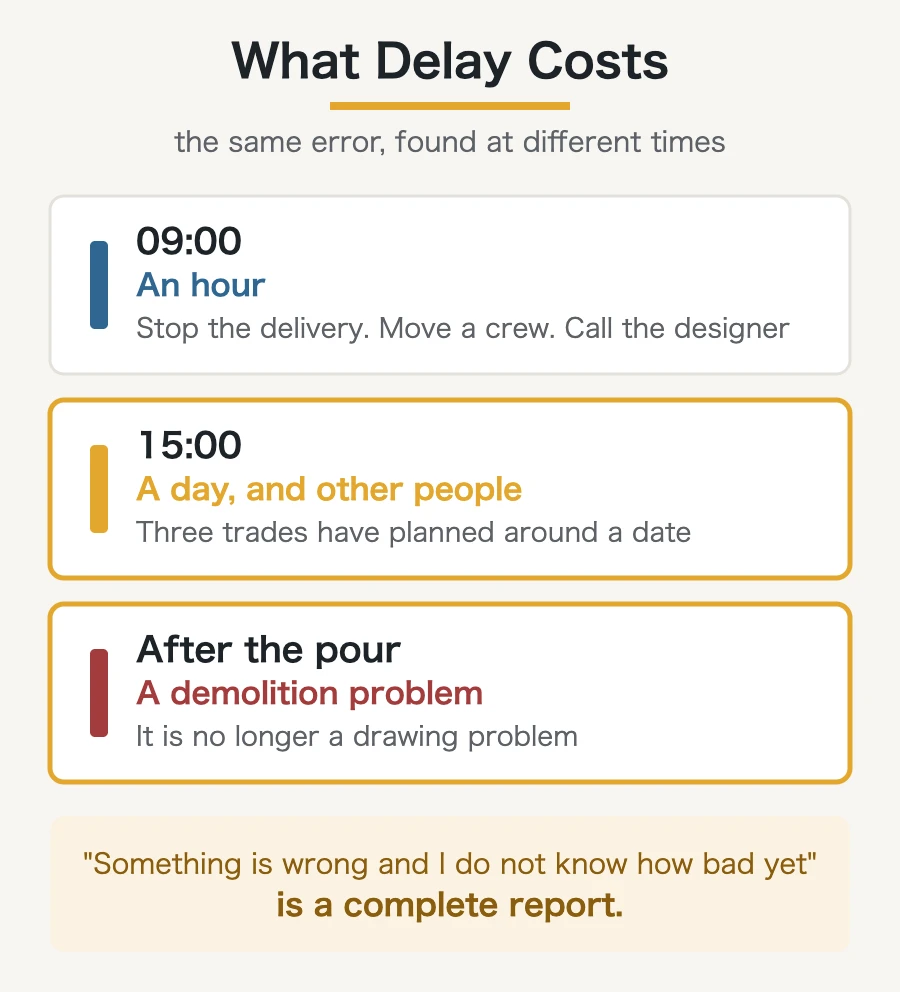
So the cost of a mistake on site isn’t fixed. It grows, quickly, and it grows into other people’s work. An error caught at 9:00 might cost an hour. The same error caught after the pour can cost a fortnight and involve twenty people who had nothing to do with it.
That’s the real argument against hiding it, and it has nothing to do with honesty being a virtue. It’s arithmetic.
What Japanese sites expect: hō-ren-sō
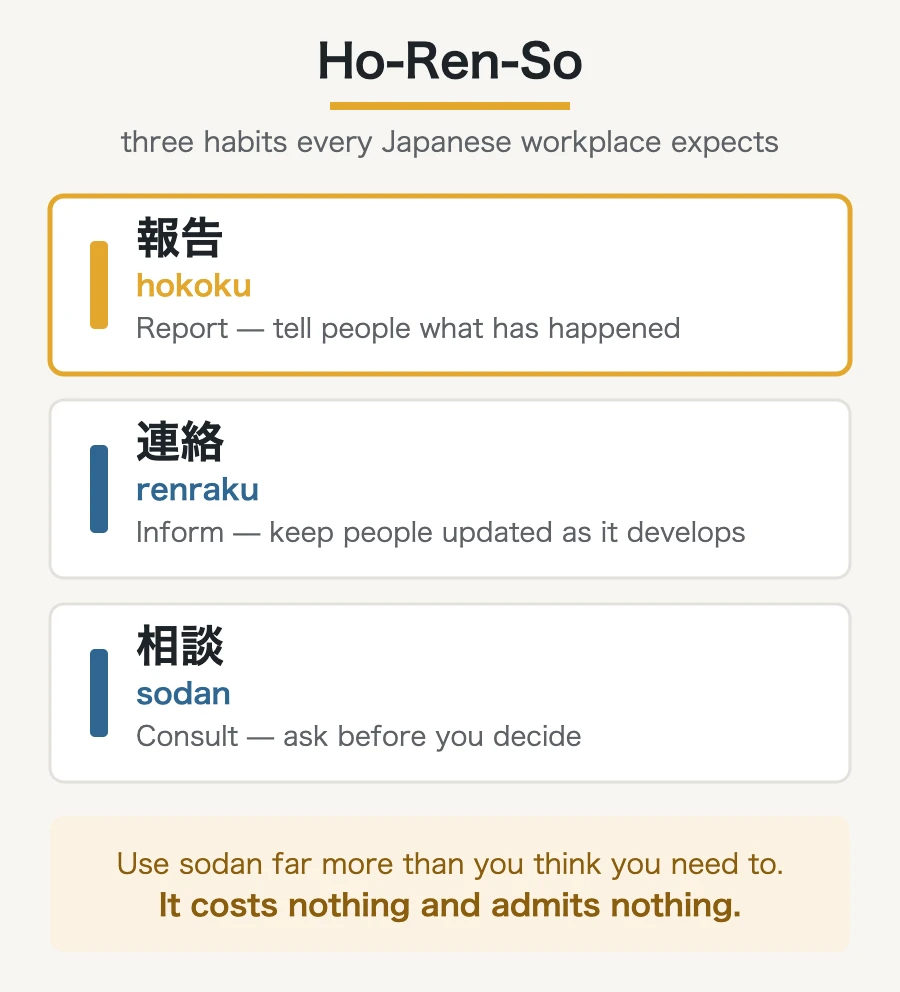
There’s a word you’ll hear in any Japanese workplace, including the site office: 報連相 (hō-ren-sō).
It’s three words stuck together:
| Japanese | Say | Means |
|---|---|---|
| 報告 | hōkoku | Report — tell people what has happened |
| 連絡 | renraku | Inform — keep people updated as it develops |
| 相談 | sōdan | Consult — ask before you decide something you’re unsure about |
It sounds like management-speak, and in an office it sometimes is. On a site it’s practical. Those three habits are what let a dozen companies work in the same space without constantly tripping over each other.
For you, the one that matters most is the first.
Report before you have the full story
Here’s the mistake people make about reporting: they wait until they can explain it properly.
They want to know how far the error spread, whose fault it was, and what it will cost — so they can walk in with a complete account instead of a confession. That feels responsible. It is the opposite of responsible, because the clock is running the whole time you’re assembling your explanation.
“Something’s wrong and I don’t know how bad yet” is a complete report.
As the person who used to receive these: I would far rather be told at 9:00 with half the facts than at 15:00 with all of them. At 9:00 I can stop a delivery, move a crew, and call the designer. At 15:00 I can only apologize to people.
In the last article I wrote that the person who asks twice is cheaper than the person who guesses once. This is the same rule one step further on. The person who reports early is cheaper than the person who reports completely.
What actually gets you in trouble
Not the mistake. I want to be plain about this because it’s the thing a newcomer most needs to hear.
In my experience, nobody’s reputation was ever destroyed by an error that got reported quickly and fixed. What damages people here is the delay — the hour or the day where someone knew and said nothing, and other people kept working on a wrong assumption.
That’s the thing a Japanese site genuinely does not forgive, and it’s worth understanding the difference before your first week rather than after it.
The Truck I Didn’t Need
Ordering concrete is a guess you have to get right
Before a pour, somebody works out how much concrete the job needs and orders it. You take the volume off the drawings, you add an allowance, and ready-mix trucks arrive through the morning on a timetable.
The awkward part is that the two ways of being wrong are not equal.
Order too little and the pour stops. Concrete that has started to set before the next load arrives leaves an unplanned joint in the middle of a structural member — a plane where one pour ended and another began. That is a quality problem, and depending on where it lands it can be a serious one.
Order too much and you have concrete nobody needs. It costs money, it has to go somewhere, and it is extremely visible.
So every supervisor builds in a margin, because the second mistake is the survivable one. The skill isn’t avoiding leftovers. It’s making the margin small.
When I was young, a little left over ruined my day
I’d like to say I was relaxed about this and learned the hard way. The opposite is true. In my early years, having even a small amount left over would put me in a cold sweat.
Which, looking back, was the correct instinct attached to the wrong fear. I was worried about being seen to have got it wrong, not about the material.
The worst one was a full truck
The most I ever had left over was a full ready-mix truck.
Nothing dramatic happens when this occurs. That’s the strange part. The pour finishes, people start packing up, and there is simply a truck still sitting there with a load in it and nowhere for it to go.
You can’t put it back. You can’t quietly deal with it later. It is a large vehicle in the middle of a site full of people who all understand exactly what it means. There is no version of this you get to keep to yourself.
The first thing I was asked
Not “how did this happen.” Not “whose figures were these.”
“First — what are you going to do about the money?”
And then I was told off, properly, and I apologized.
I’ve thought about that first question a lot since. At the time it felt like being asked the cruellest version of the obvious. Now I think it was the right question, because it was the only one with anybody else’s problem in it. The volume calculation was my business. The cost was going to land on someone.
Then I had to write it down
Here’s the part that actually changed something, and it wasn’t the telling-off.
I had to produce a plan — a written document setting out how I was going to check the quantity from then on. Not a promise to be more careful. A method: what I would check, when, and against what.
That distinction took me a while to appreciate. “Be more careful” is not a corrective action, because it relies on the same person in the same conditions making a better decision next time. A checking procedure doesn’t rely on me at all. It survives being tired, being busy, and being new.
That’s what the Japanese term saihatsu bōshi — preventing a repeat — actually means in practice, and I’ll come back to the full sequence in chapter 5.
What I’d take from it
Two things.
The margin is a skill, not a personality trait. I thought carefulness was something you either had or didn’t. It isn’t. It’s a method you write down and follow, and mine existed on paper from that week onward.
And the mistake you can’t hide is the easy kind. A truck sitting in the open removes the one decision that causes real damage — whether to say anything. I didn’t have to be brave. The next chapter is about the kind where you do.
The One Nobody Would Have Found That Day
What “dropping the beam” means
On a reinforced concrete job, the steel for a beam often isn’t tied in place inside the form. It’s assembled separately as a cage — bars laid out, stirrups wrapped, the whole thing tied together at a workable height — and then lowered into the beam formwork in one piece.
The Japanese for that last step is hari-otoshi: dropping the beam in.
It’s done this way for an obvious reason. Tying steel at waist height on an open deck is quick and accurate. Tying the same steel down inside a deep, narrow timber form, bent over, with your arms in the gap, is none of those things.
The moment after it goes in
A beam cage looks finished when it lands. That’s the thing.
It drops into place, the crane releases, and what you’re looking at is a neat grid of steel sitting exactly where the drawing says a beam goes. Nothing about it announces a problem.
I counted the bars afterwards anyway, because that’s what I’d been taught to do, and the count was wrong. There were not as many as there should have been.
Nobody was going to find it that day
The rebar inspection hadn’t happened yet.
That matters, and it took me a while to understand why. The inspection is a formal checkpoint before the pour, where the steel gets looked at against the drawings. It exists precisely to catch things like this.
But it hadn’t happened. So at that moment, the only person on that site who knew the beam was wrong was me — and I knew because I had done my own count, not because anybody had made me.
I genuinely do not know whether the inspection would have caught it. It might have. That uncertainty is exactly the problem, and it’s the reason I’m telling you this one.
The calculation you have about four seconds for
Here is what goes through your head, and I’d rather be honest about it than pretend it didn’t.
Nobody knows. There is a formal check coming that might find it, in which case it gets fixed anyway and I’m simply the person who didn’t spot it — which is a smaller kind of wrong than the person who spotted it and said nothing. And if the check doesn’t find it, concrete goes in on top, and then nobody will ever find it, because nobody can.
That last clause is the whole problem. A mistake that disappears permanently is the one with real pressure on it. The leftover concrete in the last chapter never put me under any pressure at all — I couldn’t have hidden a truck if I’d wanted to. This one I could have.
So I said it. Not out of courage, particularly. More that I’d already worked out that I’d have to look at that beam for the rest of the job.
Fixing it in the form
We didn’t lift the cage back out. The correction was done in place, down inside the formwork.
Which meant it was slow, cramped, awkward work — and it was not me doing it. It was the steel fixers, in a form they’d already finished with once, because of a count I’d got wrong.
That’s the part I’d pass on. When you picture the cost of your mistake, you probably picture your own embarrassment. The actual cost was several hours of someone else’s labour, done in a worse position than the first time, by people who were better at their trade than I was at mine.
What it taught me
Count before it goes in, not after. Obvious, and I only did it reliably after this.
Your own check comes before the official one. The inspection isn’t there to do your checking for you. It’s the last net, not the first — and a last net that keeps catching things is a sign the earlier ones aren’t there.
And the temptation scales with how well the mistake hides. You will be fine on the visible ones. Decide now, in advance, what you’ll do about an invisible one, because four seconds is not enough time to develop a position on it.
The One That Wasn’t Mine
Some of what you clean up, you didn’t spill
The first two were my own. This one wasn’t, and I’ve included it because it’s the kind that nobody warns you about.
There’s a blunt bit of site slang for it in Japanese — ketsu wo fuku. It isn’t polite language and I won’t translate it literally. It means being the person who sorts out what somebody else left behind.
What happened
It was plastering work. There were places that needed patching — repairs that had to be done at that stage, before anything went over them.
They weren’t done.
Nobody noticed in time, and the next trade came in and started work on top. By the time it surfaced, the job had changed shape completely. “Patch it” had become “undo what’s just been done, patch it, then do that work again” — with a second trade now involved in a problem they hadn’t created either.
This is the dependency chain, in its cheapest form
I wrote in chapter 1 that a site is a chain of dependencies, and that mistakes grow into other people’s work. This is the least dramatic possible illustration of it, which is why I like it as an example.
Nothing collapsed. Nobody was hurt. A small amount of patching didn’t happen, and because of the order things get done in, that small amount became several people’s afternoon.
The cost wasn’t in the error. It was in when it was found.
It was my senior’s package
And I think he knew.
I want to be careful here, because I never confirmed that and I’m not going to write it as though I did. I don’t know what he knew or when. What I know is that it was his to check, it didn’t get checked, and the thing that was waiting at the end of it was me.
I sorted it out.
Why I’d do the same again, and why that isn’t a moral
Let me not dress this up. It is unfair to be the person holding something you didn’t drop, and if you’ve done it, the unfairness is real and you don’t have to pretend otherwise.
But two things were also true.
The building doesn’t care whose package it was. Neither does the trade that’s now standing in front of unfinished work with their own schedule to keep. The question in the room is not who should have done it. It’s who is going to.
And it is seen, eventually. Not always said, and often not by the person you’d want to hear it from. But a site is a small place and people notice who closes things out.
I’d still rather be the person who sorted it than the person who was right about whose job it was.
What it actually taught me
Here’s the practical part, and it’s the most useful thing in this article for anyone who ends up supervising.
Mistakes don’t usually live inside someone’s work. They live in the gaps between two people’s work. The plasterer did their work. The next trade did theirs. What failed was the handover — the moment where one finishes and another starts, and somebody is supposed to look.
Japanese sites have a word for that junction between trades, toriai, and it’s where I’d now spend my attention if I had to choose. The middle of a trade’s work is usually fine. People are good at their own jobs. It’s the seam that nobody owns, and the seam is where things fall through.
So when you’re new and wondering where to look: not at the thing being built. At the places where one person’s responsibility ends and another’s begins.
What a Japanese Construction Site Does With a Mistake
The first question isn’t the one you expect
I described the textbook version of this sequence below. First, the version I actually got.
When I left that truck of concrete over, the first thing said to me was not “how did this happen” and not “whose figures were these.” It was “first — what are you going to do about the money?” Then I was told off. Then I apologized. Only after all of that did anyone talk about preventing it.
So let me be accurate about the order of events on a real site:
money → anger → apology → prevention
Not the clean diagram. But notice what the first question actually was. It wasn’t who. It was the consequence, and who it lands on — which is a more useful question than blame, even when it’s delivered at volume.
The textbook sequence below is what a site is trying to do. The shouting is the texture it arrives in.
The sequence
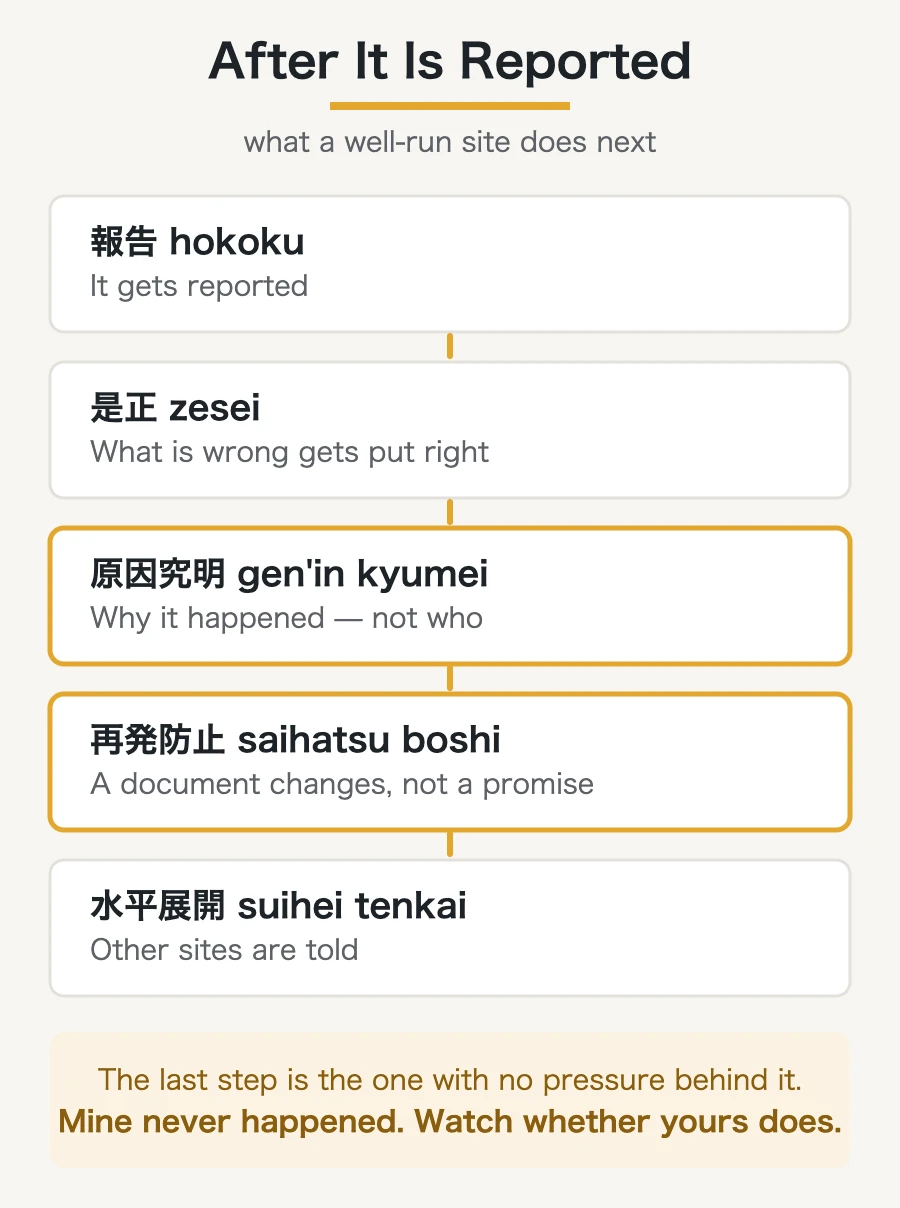
On the sites I worked on, a reported mistake went through roughly this sequence. The words are worth knowing, because you’ll hear them.
| Japanese | Say | Means |
|---|---|---|
| 報告 | hōkoku | It gets reported — ideally within minutes |
| 是正 | zesei | It gets corrected. What’s wrong gets put right |
| 原因究明 | gen’in kyūmei | Why it happened. Not who, but how it got this far |
| 再発防止 | saihatsu bōshi | Preventing a repeat — usually a change to a document |
| 水平展開 | suihei tenkai | Telling other sites, so they don’t repeat it |
The fourth step is more concrete than it sounds. “Prevent a repeat” usually means something physical changes: a line added to the work procedure, an extra check on a sheet, a different sequence, a sign where there wasn’t one.
If you’ve read my article on safety rules, you’ve already seen the serious version of this sequence — what happens after an accident. This is the same machinery running on an ordinary weekday, for things that hurt nobody.
The step that surprises people: suihei tenkai
Suihei tenkai means “horizontal deployment,” which is a very Japanese way of saying: your mistake gets sent to other sites.
Not with your name on it. But the thing you got wrong becomes a bulletin, a toolbox-talk item, a line in someone else’s checklist on a project you’ll never visit. When it works, the mistake bought something — it cost a day and it prevented four.
And here’s where I have to be honest
That’s the step that didn’t happen to me.
The plan I wrote after the concrete was mine. It changed how I checked quantities for the rest of my career, and as far as I know it never went anywhere else. Nobody asked for it. No other site got a copy. The knowledge stopped at the edge of my own desk.
I don’t think that was malice. It’s just that the last step is the one with no immediate pressure behind it — the problem is already fixed, everyone is busy, and sending a memo to other projects helps people you’ll never meet.
Which makes it a useful thing to watch for. Does what goes wrong here travel, or does it stop with the person who got it wrong? A company where corrections stay personal is a company that will keep rediscovering the same holes, and you will be one of the people who finds them.
Reporting the ones that didn’t happen
There’s a practice here worth knowing about even though it isn’t about mistakes exactly: ヒヤリハット (hiyari-hatto).
The name is two sounds — the gasp when something nearly happens, and the jolt right after. It means a near miss: the thing that almost went wrong and didn’t. No damage, no injury, nothing to fix. Sites collect them anyway.
Think about what that requires. A system that asks people to report events with no consequences only works if reporting is completely safe. The moment reporting a near miss can be used against you, nobody reports one again, and the site loses its early warnings.
That isn’t only my opinion. Japan’s Ministry of Health, Labour and Welfare, on its workplace safety site, describes a near miss as something that could have led to a serious accident but fortunately didn’t — and says plainly that for a reporting system to last, there has to be an agreement that managers will not blame the worker, with no punitive action, and an environment where people feel safe reporting. (Ministry of Health, Labour and Welfare, checked October 3, 2026)
Read that again as a design principle rather than a kindness. The blame has to be removed for the information to arrive. A site that punishes reports goes blind, and the ministry that writes the safety rules says so in writing.
The honest limit
I don’t want to leave you with a picture of a system that always works.
It depends heavily on the people. I’ve worked with supervisors who went straight to “right, what do we do now,” and I’ve worked with ones who needed to be angry first and useful second. The process I’ve described is what a well-run site does. It isn’t a guarantee.
So here’s how I’d use that, practically. Watch what happens the first time someone on your site reports a mistake — not yours, anyone’s. The response tells you more about that company than anything they said when they hired you. If the first move is blame, you’ve learned something important, and you should factor it into how long you plan to stay.
How to Report It, in Japanese
Why this chapter exists
Everything in chapter 1 assumes you can actually walk up to someone and say it.
If your Japanese is still at the level I described in the article on site vocabulary — nouns, directions, and a handful of phrases — then “report it immediately” isn’t advice yet. It’s a problem. So here are the actual words.
Open with four syllables
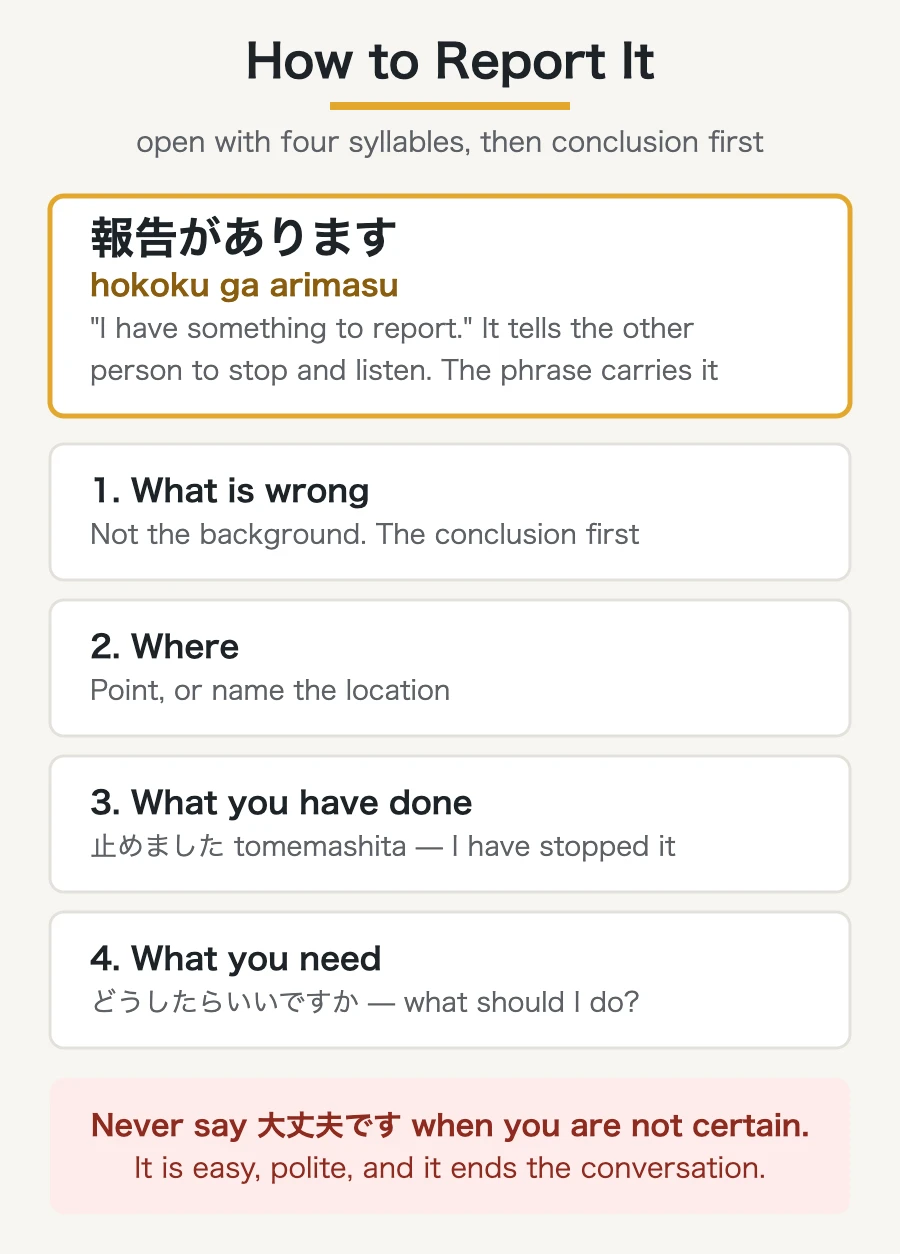
Start with this, and the rest becomes easier:
| Japanese | Say | Means |
|---|---|---|
| 報告があります | hōkoku ga arimasu | I have something to report |
It sounds formal written down. On site it’s completely normal, and it does something useful: it tells the other person to stop what they’re doing and listen properly. You don’t have to perform urgency. The phrase carries it.
Then say the conclusion first
Japanese working communication has a strong convention — ketsuron kara, the conclusion first — and it matters most in exactly this situation.
Do not build up to it. Do not start with the background, the reasons, or how it happened. Lead with the thing that is wrong, because the person listening needs to know in the first three seconds whether to pick up a radio.
Four parts, in this order:
- What’s wrong — ○○ ga chigaimasu. (The ○○ is wrong.)
- Where — point, or name the location
- What you’ve already done — tomemashita. (I’ve stopped it.)
- What you need — dō shitara ii desu ka? (What should I do?)
The words themselves
| Japanese | Say | Means |
|---|---|---|
| 間違えました | machigaemashita | I got it wrong |
| ミスしました | misu shimashita | I made a mistake |
| 止めました | tomemashita | I’ve stopped the work |
| まだ範囲が分かりません | mada han’i ga wakarimasen | I don’t know the extent yet |
| 見てください | mite kudasai | Please come and look |
| どうしたらいいですか | dō shitara ii desu ka | What should I do? |
| やり直します | yarinaoshimasu | I’ll redo it |
| ご迷惑をおかけしました | go-meiwaku wo okake shimashita | I’m sorry for the trouble I’ve caused |
That last one is for afterwards, once it’s resolved — not for the moment of reporting. In the moment, facts are more use than apology.
Apologize once, then give information
I want to be careful here, because Japan has a reputation for apology and the reputation is partly earned.
But a report is not the place for a long one. Sumimasen once, then the facts. A detailed apology at the moment of reporting delays the information the other person actually needs, and — this is the part that took me years to understand — it quietly makes the conversation about your feelings instead of the problem.
The apology that counts here isn’t the words. It’s that you came and said it early, and that you have already stopped the work.
If your Japanese runs out halfway
It will. Three things that work:
Bring them to it. Mite kudasai — please come and look — solves more than any vocabulary. A mistake you can point at doesn’t need to be described.
Draw it. The same habit from the vocabulary article. A sketch of what should have been there and what is there instead is understood instantly.
Use the translation app — but after you’ve opened your mouth, not before. Say hōkoku ga arimasu, get the person’s attention, then take the extra thirty seconds to type. Don’t spend those thirty seconds standing alone deciding how to phrase it.
Two things not to say
「大丈夫です」when it isn’t. Daijōbu desu — “it’s fine” — is the single most dangerous phrase available to you, because it’s easy, it’s polite, and it ends the conversation. If someone asks whether something is okay and you aren’t certain, don’t use it.
「はい」to a fix you didn’t follow. Same rule as the last article. When someone tells you how to correct the problem, that instruction is now the thing that matters most on site, and it is the worst possible moment to nod along. Ask again. Ask three times.
Print this and keep it with you
The reporting phrases above, plus the six words and the signs you need to recognize, on a one-page card. Print it at 100%, cut along the frames, put the two sides back to back, and laminate it. The phrase you want in a hurry is 報告があります.
Questions People Actually Ask
Will I be fired for making a mistake?
In my experience, no — not for one that got reported and fixed.
I’ve never seen someone lose a job over an error they brought forward quickly. I have seen people lose trust, permanently, over an hour of silence. Those are two different situations and they’re treated differently.
I can’t promise you anything about a specific company, and I wouldn’t trust anyone who did. What I can tell you is which of the two things the industry actually reacts to.
Who do I tell first?
Your own supervisor — the person directly above you — unless someone is in danger.
That exception matters. If there’s an immediate hazard, you shout abunai at whoever is closest, regardless of rank or company. Safety doesn’t wait for a chain of command.
For everything else, go to your own shokuchō or supervisor first. Going over their head looks like you’ve decided they can’t handle it, and on a site where you need that person every day, that’s an expensive way to be right.
What if it’s not my mistake?
Report it exactly the same way, and keep the report about the problem.
The temptation is to lead with “this wasn’t me.” Resist it — not because you should be a martyr, but because it changes what the conversation is about. Say what’s wrong, where, and what you’ve done. Whose package it was will come out on its own, and it’ll land better if you weren’t the one who raised it.
What if I’m not sure it’s even a mistake?
Then you’ve got the easiest version of this, and there’s a word for it.
Sōdan — the third part of hō-ren-sō from chapter 1 — means consulting someone before you decide. “I’m not sure about this, can you look?” costs nothing, carries no admission, and is how most problems get caught while they’re still small. Use it far more than you think you need to.
Can I report in English?
Only if the person you’re reporting to speaks it, which usually means no.
Use the phrases in chapter 6, and lean on mite kudasai — come and look. A problem you can point at doesn’t need much language. Open your mouth first, then reach for a translation app.
How bad does it have to be before I say something?
Lower than you think.
New people set the threshold far too high, because they’re measuring “is this worth bothering someone about.” That’s the wrong measure. The right one is: if this turns out to be real, how much worse does it get in the next two hours?
If the answer is “quite a lot,” it’s already worth saying.
Does a mistake follow me to the next company?
The industry is smaller than it looks, so assume people talk.
But what travels isn’t usually the error. It’s how you were when it happened — whether you said something straight away, whether you stayed to sort it out, whether you were the person pointing at somebody else. That’s the part worth managing, and it’s entirely within your control.
What if my supervisor is the problem?
Then you’ve learned something about where you are, and you’re allowed to act on it.
I’ve written elsewhere about changing employers under the Specified Skilled Worker route — it’s possible within the same work category, and it requires an application rather than a handshake. It isn’t instant and it isn’t free.
But it exists, and knowing that it exists changes how a bad week feels. I’ll come back to this in the last chapter, because it’s what I’d most want to tell my younger self.
Summary: What I’d Tell Myself
The three have one thing in common
Look at what actually did the damage in each of them.
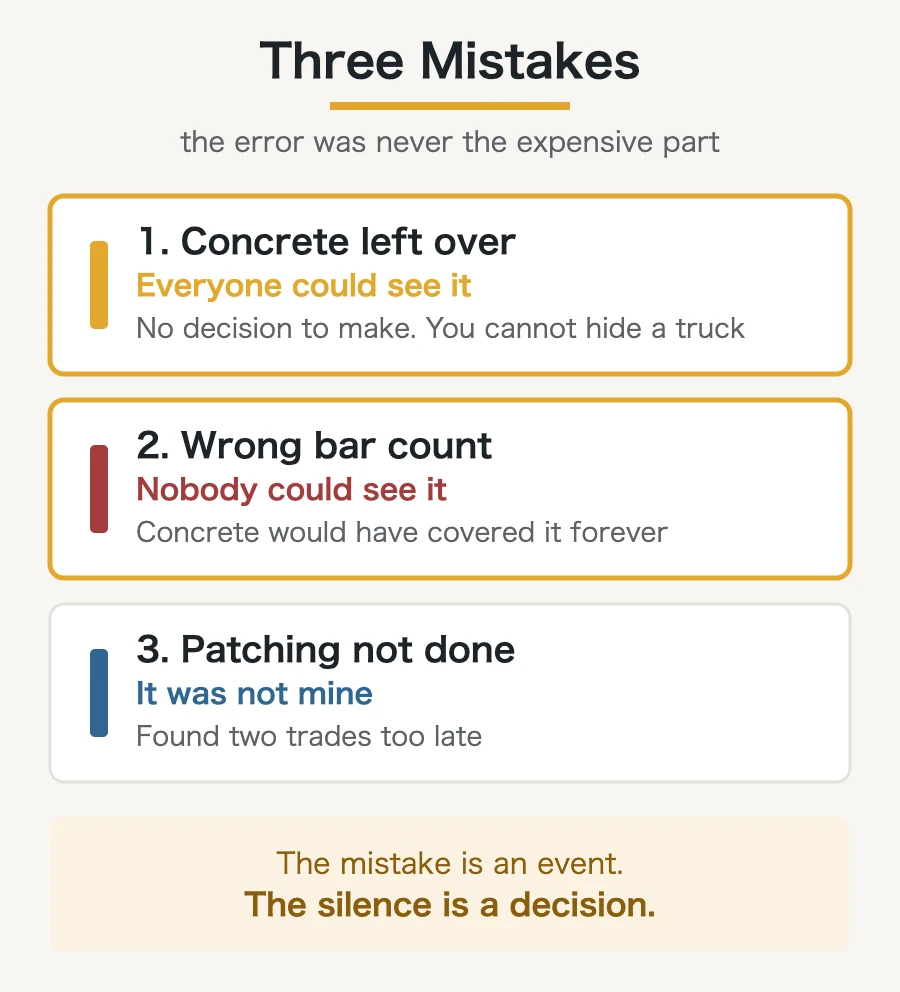
The leftover concrete cost money, and I couldn’t have hidden it if I’d tried. The beam I could have hidden, and the cost of that one would have been permanent. The plastering wasn’t mine at all, and what made it expensive was that it surfaced two trades too late.
In none of the three was the error itself the problem. It was always the time between the mistake happening and somebody saying so — or, in the third case, the seam where nobody was looking at all.
That’s the whole article, really. The mistake is an event. The silence is a decision, and the decision is the part that costs.
The short version
- Report before you have the full story. “Something’s wrong and I don’t know how bad yet” is a complete report
- Open with 報告があります (hōkoku ga arimasu), then the conclusion first
- Never say 大丈夫です when you aren’t certain
- Your own check comes before the official one. The inspection is the last net, not the first
- “Be more careful” is not a corrective action. A written method is
- Watch the seams between trades — that’s where things fall through, not in the middle of anyone’s work
- And watch what happens the first time somebody on your site reports a mistake. It tells you what kind of company you’ve joined
The part I’d actually say
If I could get a message back to the young supervisor standing on a deck in a cold sweat because there was a truck of concrete left over, it wouldn’t be any of the above.
It would be this:
Don’t take it so heavily. If it gets too hard, you can change jobs.
That’s not resignation and it isn’t advice to quit. It’s the thing I needed to know and didn’t, and I think it matters more for you than it did for me.
Here’s why. Everything in chapter 1 — report immediately, don’t hide it, say the thing nobody else knows — assumes you can afford to be honest. And if you believe you are trapped, that calculation changes. If a mistake feels like it could end everything, hiding it starts to look rational. I’ve watched that happen to people, and it never began with dishonesty. It began with fear.
So knowing there’s a door is not a plan to walk through it. It’s what makes the rest of this affordable. You report the beam because you can survive the conversation, and you can survive the conversation partly because this job is not the only job.
For anyone here on a Specified Skilled Worker status, that door is a real one with rules attached, and I’ve written them out in Construction Work in Japan. Know where it is. Then go back to work and probably never use it.
Where to go next
- Construction Safety in Japan — the serious version of the sequence in chapter 5, and where the rules came from
- Japanese Construction Terms — the vocabulary behind the reporting phrases in chapter 6
- Construction Work in Japan — the routes in, and what the law says about changing employers
- The Japanese Tool Belt — including the mistake I didn’t retell here
One last thing
I’ve been deliberately unflattering about myself in this article, and I want to be clear that this isn’t modesty.
Everyone I respect in this industry has a list like this one. The difference between the people who got good at the work and the people who didn’t wasn’t the number of mistakes. It was how fast they said them out loud.
You’ll have your own three. Say them early.
The job where being late is measured in minutes: Concrete Pour in Japan: The Clock Starts at the Plant — transport is capped at 1.5 hours, and once the concrete passes its release time, nothing you do brings it back.